





 Friday, 23-10-26








The rapid evolution of Southeast Asia's digital economy has placed telecommunications infrastructure at the forefront of national and regional development. Indonesia, as the largest economy in the region, is experiencing unprecedented growth in digital commerce, cloud computing, and automated enterprise services. To keep pace with this surging demand, state-owned telecommunications giant PT Telkom Indonesia has announced a major strategic commitment. The firm plans to allocate between 18 and 20 percent of its annual revenue toward expanding and upgrading its technical capabilities. For corporate decision-makers, tech investors, and telecommunications analysts, understanding the broader implications of Telkom digital infrastructure investment is critical for tech leaders seeking to navigate Asia-Pacific digital transformation.
This substantial capital deployment is designed to bridge the gap between potential digital market value and real-world network availability. With Indonesia's digital economy projected to reach 360 billion United States dollars by 2030, the necessity for robust network architecture has never been higher. Without targeted funding for fiber networks, cellular towers, and next-generation data centers, the nation's economic projections would remain theoretical. By committing a significant percentage of its top-line revenue, Telkom Indonesia is laying the foundation required to sustain heavy data traffic, support high-density connectivity, and cement the country's position as a central digital hub in Southeast Asia.
Capital Allocation and Reinvestment Strategies
A financial commitment of 18 to 20 percent of top-line revenue represents one of the most aggressive capital expenditure budgets in the regional telecommunications sector. Based on Telkom Indonesia's consolidated revenue of 146.7 trillion Indonesian rupiah recorded in 2025, this capital allocation translates to roughly 29 to 30 trillion rupiah in annual capital expenditure. Rather than dispersing funds broadly without strategic alignment, the leadership team has prioritized direct revenue-generating assets that support core business operations.
Allocating up to one-fifth of annual revenue toward Telkom digital infrastructure investment serves as the backbone for four key operational pillars: mobile network infrastructure through Telkomsel, domestic and international fiber optic networks through Telin, physical passive infrastructure via tower deployment, and edge-to-hyperscale data centers. Each pillar plays an interconnected role in maintaining network resilience. Telkomsel continues to expand its cellular coverage, upgrading LTE stations and expanding 5G coverage across urban centers and industrial zones. Simultaneously, physical tower assets provide the spatial density required to prevent signal attenuation in rapidly expanding metropolitan areas.
BATIC 2026 and Expanding Global Subsea Connectivity
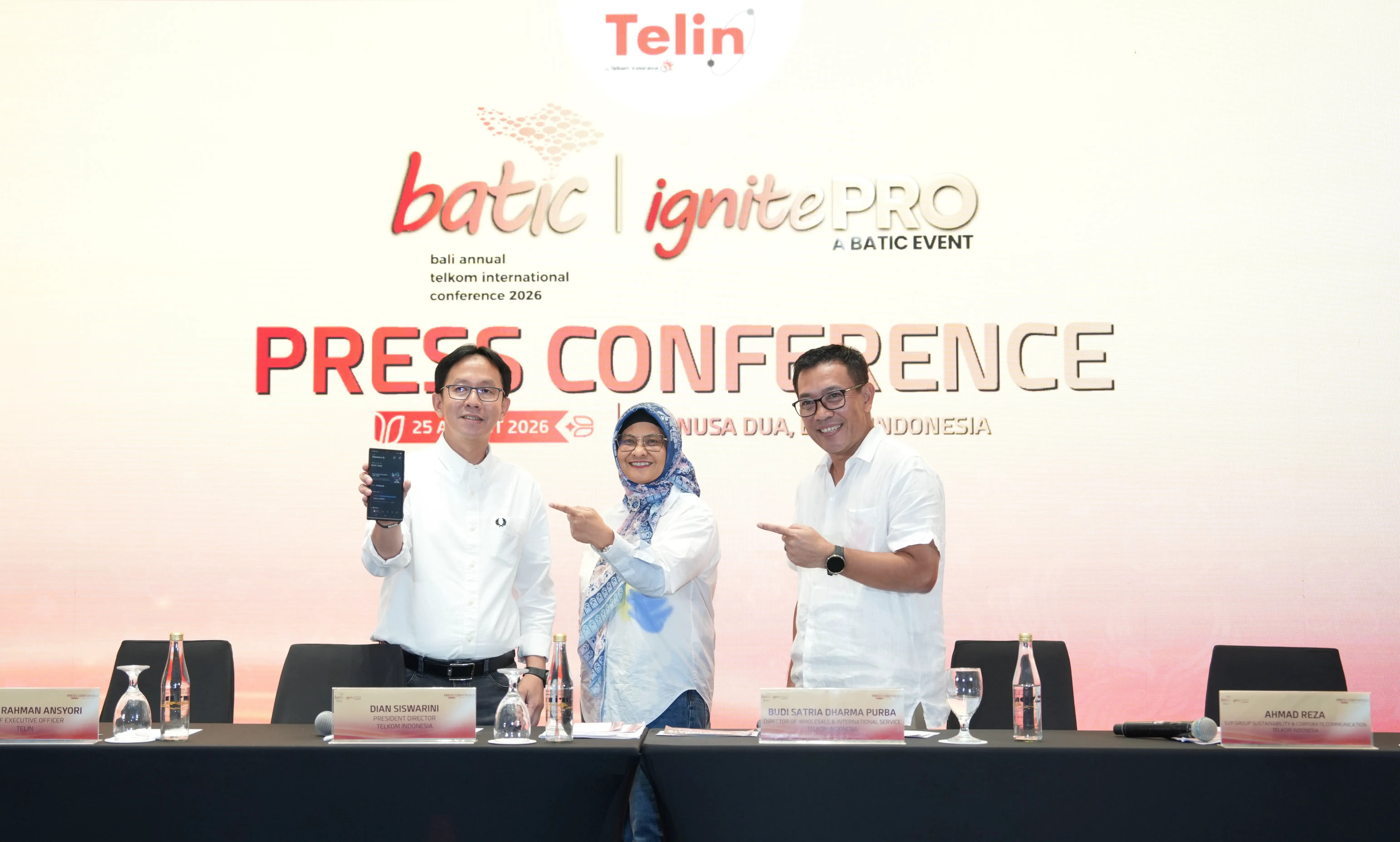
The strategic imperatives driving these capital decisions were highlighted during the 11th Bali Annual Telkom International Conference, held in Nusa Dua, Bali. Bringing together more than 2,700 global delegates and over 760 telecommunications companies from 67 countries, the conference served as an international platform for cross-border collaboration. At the conference, executive leadership stressed that domestic network density must be paired with high-capacity international connectivity.
Expanding global connectivity through Telkom digital infrastructure investment requires extensive international cooperation, particularly in building and maintaining submarine fiber optic cables. Telkom's wholesale and international arm, Telin, recently completed a landmark subsea cable system connecting Singapore to the United States via Indonesian waters. Although the complex project required five years of engineering and regulatory planning to complete, market demand was so extreme that available bandwidth capacity neared saturation within less than twelve months of operation. This rapid bandwidth consumption illustrates the exponential rise in international data traffic, driven by content streaming, cross-border digital trade, and cloud computing adoption across the Asia-Pacific region.
The Impact of Artificial Intelligence on Bandwidth Requirements
One of the primary catalysts for network expansion is the global explosion of artificial intelligence applications. Industry measurements indicate that the integration of artificial intelligence models into enterprise workflows increases bandwidth consumption by up to ten times compared to traditional cloud workloads. From generative AI tools to autonomous enterprise management systems, data transmission speeds and latency margins are pushed to their absolute limits.
As artificial intelligence models scale, the focus of Telkom digital infrastructure investment shifts toward high-capacity data centers and resilient backhaul networks capable of processing high-throughput computations. To address these emerging technological challenges, recent industry gatherings have introduced specialized executive forums such as ignitePRO, which focus on autonomous enterprise management and AI-driven networking architecture. Modern data centers must not only offer high power density and advanced cooling solutions, but they must also sit directly on high-speed fiber optic intersections to allow real-time data ingestion and model inference without regional latency bottlenecks.
Unlocking Indonesia's Digital Economy Potential by 2030
The long-term vision behind these capital investments extends far beyond immediate revenue growth for the carrier. It directly correlates with Indonesia's national economic trajectories. Studies estimating the country's digital economy value at 360 billion dollars by 2030 rely on accessible, affordable, and high-speed internet access across all major island groups. Capitalizing on the projected 360 billion dollar digital market makes continuous Telkom digital infrastructure investment essential for connecting underserved communities and empowering regional small and medium enterprises.
Digital transformation in an archipelagic state presents unique logistical and structural hurdles. Connecting thousands of islands requires a combination of high-density subsea cable loops, satellite ground stations, and terrestrial fiber trunk lines. By building a unified digital ecosystem, Telkom enables small business owners in remote provinces to access digital payment processing, cloud inventory platforms, and global e-commerce portals. Furthermore, local technology startups benefit from reduced latency and improved cloud hosting choices, allowing them to scale innovative software solutions without relying exclusively on overseas server infrastructure.
Navigating Archipelagic Infrastructure Challenges and Market Dynamics
Building and maintaining physical telecommunications assets across an archipelago of over 17,000 islands requires nuanced operational strategies and substantial ongoing capital management. Submarine cable routes must be planned around complex marine geography, seismic activity zones, and heavy maritime traffic lanes. Physical maintenance of underwater fiber lines demands specialized cable-laying vessels and continuous sea-bed monitoring to prevent accidental anchor strikes or physical ruptures.
On land, civil works for terrestrial fiber optics and tower installation require complex land-acquisition processes and regulatory alignment across hundreds of regional municipal governments. To maximize capital efficiency, telecommunication operators increasingly rely on asset co-location and infrastructure sharing agreements. By leasing tower capacity through dedicated tower subsidiaries and establishing open-access subsea landings, companies can minimize duplicate expenditures while accelerating network expansion into remote geographical zones.
Sustainability and Future Trends in Telecommunications
As digital infrastructure footprint expands, energy consumption naturally increases. Future growth strategies must balance high computational power with environmental sustainability commitments. Hyperscale data centers require innovative energy management protocols, including liquid cooling technology, solar panel integration, and power usage effectiveness optimization. International partners and enterprise clients increasingly demand carbon-neutral data processing facilities as part of their global corporate responsibility metrics.
Looking forward, the integration of low Earth orbit satellite networks, private 5G enterprise setups, and edge computing nodes will define the next decade of telecommunications architecture. By combining terrestrial fiber networks with satellite backhaul and high-density computing hubs, telecommunications leaders can ensure consistent service uptime even during natural disasters or major network disruptions.
Conclusion
The aggressive commitment to reinvest nearly one-fifth of corporate revenues into network assets underscores a visionary approach to regional connectivity. By aligning capital deployment with long-term technological trends such as artificial intelligence and subsea cable interconnectivity, Telkom Indonesia is proactively shaping the digital ecosystem of Southeast Asia. As business operations, governance, and consumer activities become increasingly digital, the long-term impact of Telkom digital infrastructure investment will redefine how Southeast Asia connects with the rest of the world, transforming regional economic potential into sustained prosperity.
Read More