





 Wednesday, 21-10-26








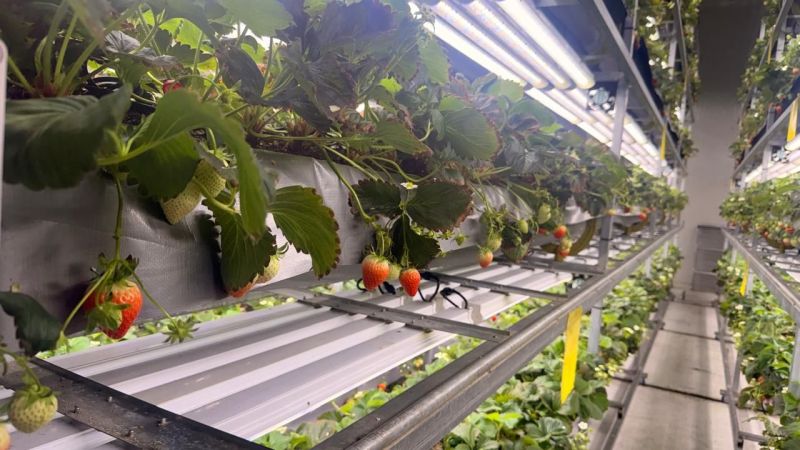
A Korean smart farm exporter has turned a pilot project into a full-scale commercial win in the United Arab Emirates, signaling how quickly controlled-environment agriculture is moving from experiment to export category. Agro Solution Korea signed a smart farm export contract worth $2.6 million with UAE buyer Alfafa after completing a one-year proof-of-concept project supported by KOTRA’s Dubai Trade Center. The original pilot was valued at $800,000 and focused on proving that strawberry cultivation technology could work in desert conditions while maintaining productivity and quality.
The sequence matters. This was not a simple equipment sale. It was a staged market-entry process that began with local demand discovery, moved into demonstration, and ended with a commercial contract. That matters because buyers in complex markets usually want evidence before they commit, especially when the operating environment is harsh and the food supply chain is under pressure.
Why The UAE Is Turning To Smart Farms
The UAE’s interest in smart farm systems is closely tied to food security. The country’s National Food Security Strategy 2051 is designed to make the UAE a global leader in innovation-driven food security, while official and institutional sources note that the country still relies heavily on imports for most of its food needs. The Ministry of Climate Change and Environment has been cited as saying roughly 90 percent of food comes from abroad, and that dependence is especially sensitive in an arid climate with limited agricultural land and water.
That dependency becomes more visible during periods of geopolitical stress. The Asiae report linked the deal to concerns about supply chain stability in Gulf countries after disruption risks around the Strait of Hormuz and broader Middle East conflict. In that environment, smart farm investments become more than a technology story. They become a resilience story.
What Makes Korean Smart Farm Technology Attractive
Korean smart farm exports stand out because they package more than hardware. According to the report, the export model can include design, construction, and operation systems, which gives buyers a more complete solution rather than a patchwork of separate components. In the UAE project, the demonstration phase showed that strawberry cultivation equipment and cultivation methods adapted to a desert climate could work together in a practical setting.
That integrated model is important for overseas buyers. In markets where climate, water availability, and logistics all create operational risk, the ability to deliver a full smart farm system reduces uncertainty. It also gives exporters a stronger value proposition, because the product is no longer only a greenhouse or a set of sensors. It becomes an operating framework for stable, localized food production. That is exactly why the sector is gaining traction across the Gulf and beyond.
The Market Opportunity Extends Beyond One Deal
The UAE contract sits inside a much larger growth story. Asiae reported that the global smart agriculture market is projected to grow at an average annual rate of 15 percent and reach $8.37 billion by 2033. Independent market research points in the same direction, with Grand View Research estimating that the broader smart agriculture market was worth $25.36 billion in 2024 and could reach $83.72 billion by 2033, reflecting a 14.6 percent CAGR.
That market expansion is being driven by the same forces visible in the UAE case: pressure on food systems, the need for more efficient production, and rising interest in controlled-environment agriculture. Smart farm adoption is no longer limited to a narrow group of early adopters. It is becoming part of the wider industrial answer to climate volatility, supply chain fragility, and land scarcity.
KOTRA’s Export Pipeline Is Doing The Heavy Lifting
One reason the UAE deal is worth watching is the way it was built. KOTRA and Korea’s Ministry of Agriculture, Food and Rural Affairs have been running the Agri-Industry Export Promotion Program since 2020. The program supports companies through buyer matching, local demand identification, overseas proof-of-concept projects, commercialization, and follow-up negotiation. That structure helps de-risk entry into unfamiliar markets.
The results in the first half of this year were not trivial. The article says KOTRA and the ministry supported three initiatives, including exhibitions and roadshows in Azerbaijan, Eastern Europe, and Laos. Those efforts produced 15 memorandums of understanding worth $4.01 million and three export contracts worth $2.87 million. Additional roadshows are planned for Australia, China, Southeast Asia, including Indonesia and Vietnam, and Argentina. That suggests a coordinated push, not a one-off success.
Why This Matters For Food Security Strategy
The deeper significance of the deal is that it shows how smart farm technology can be positioned as infrastructure for food resilience. In a market like the UAE, where imports remain central to food availability, local production systems that can function in desert conditions have obvious strategic value. The government’s food-security agenda is built around improving resilience, encouraging innovation, and reducing vulnerability to external shocks. Smart farms fit neatly into that policy direction.
There is also a regional ripple effect. The Asiae report said interest in K-smart farms is being confirmed not only in the Middle East but also in ASEAN, Australia, and CIS markets. That matters because these are regions where climate stress, agricultural productivity gaps, or import dependence create a similar demand profile. In other words, the UAE is not just a destination market. It is a reference market.
What Comes Next For Smart Farm Exporters
The next phase will likely depend on execution. The article notes that KOTRA is expanding overseas consortium programs and continuing to organize roadshows, local demonstration projects, buyer identification, and partnership matching. Myeonghee Kim of KOTRA’s Industrial Innovation and Growth Division said the agency will continue to provide end-to-end support, from demand discovery to commercialization. That kind of scaffolding matters because smart farm deals often require patience, adaptation, and repeated proof.
For Korean exporters, the lesson is clear. Success in smart farm markets will come from solving the buyer’s real problem, not simply selling advanced equipment. In the UAE, that problem is food security under extreme climate conditions. A smart farm becomes compelling when it can prove productivity, quality, and operational reliability in exactly the place where those things are hardest to achieve.
This UAE deal is more than a headline about a new export contract. It shows how smart farm technology is moving into the core of food-security planning, especially in markets where imports are vulnerable and climate conditions are unforgiving. The combination of pilot testing, government-backed export support, and proven desert adaptation created a commercial outcome that could be repeated in other markets facing similar pressures. If the current trend continues, smart farm exports may become one of Korea’s most persuasive agri-tech stories abroad.
Read More