





 Saturday, 10-10-26








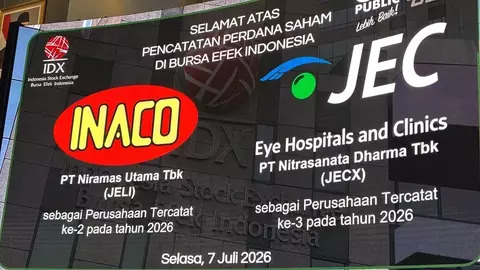
The latest Indonesia Stock Exchange IPO story is not about one company, but two. On July 7, 2026, PT Niramas Utama Tbk, known by its ticker JELI, and PT Nitrasanata Dharma Tbk, ticker JECX, officially began trading on the Indonesia Stock Exchange. Both names arrived in a market that has been watching for fresher listing activity, and both shares immediately drew strong early demand, with reports noting they hit the upper auto rejection limit on debut.
Two New Listings Signal Renewed Appetite
JELI and JECX came from different corners of the market, but together they offered a useful snapshot of what Indonesian investors are currently willing to support. JELI sits in the consumer non cyclicals segment, while JECX belongs to healthcare. On the official e-IPO platform, both were listed on July 7, 2026, with JELI priced at Rp900 per share and JECX priced at Rp1,250 per share. The platform also shows that JELI offered 2,660,000 lots, while JECX offered 4,879,835 lots.
The day matters because Indonesia’s capital market has been trying to rebuild confidence and widen participation. Reuters reported in June that the Financial Services Authority expects as many as 75% of listed firms to meet the new 15% free float requirement within the first year, as regulators continue rolling out capital market reforms after MSCI raised concerns about transparency and potential market downgrade risks. In that context, each new listing is more than a routine corporate event. It is also a test of liquidity, appetite, and trust.
JELI’s Growth Story Is Built Around Inaco
JELI, or PT Niramas Utama Tbk, is better known to consumers through its Inaco brand. According to the company’s IPO materials, the consumer food producer aimed to raise as much as Rp392 billion. The prospectus and related reporting show a clear capital allocation plan. About 51.04% of proceeds are earmarked for a capital injection into subsidiary Niramas Pandaan Sejahtera to expand production capacity for gummy candy and jelly products. Another 18.36% is set aside for capital expenditure, including machinery and warehouse capacity improvements, while 10.63% would be used to repay part of short term working capital loans to Bank Mandiri. The remaining 19.97% would support working capital.
That use of proceeds tells a familiar but important IPO story. JELI is not coming to the market simply to raise money and wait. It is trying to turn public capital into operating scale. For investors, that kind of clarity can be attractive, especially in a consumer non cyclicals business where factory efficiency, distribution strength, and product expansion matter more than hype. JELI’s debut therefore fits neatly into the broader Indonesia Stock Exchange IPO narrative, where the market rewards companies that can explain where the cash is going and why it should create value.
JECX Taps Healthcare Demand Through Jakarta Eye Center
JECX, the ticker for PT Nitrasanata Dharma Tbk, offers a different type of growth thesis. The company operates Jakarta Eye Center, one of the better known eye care brands in the country. Jakarta Globe reported that JECX planned to raise as much as Rp683.1 billion through its listing on the IDX, issuing about 487.98 million new shares, which equals 15% of its enlarged issued and paid up capital. During book building, the indicative price range was Rp1,200 to Rp1,400 per share, and the final listing price on e-IPO was set at Rp1,250.
Its use of proceeds is also tightly described. Jakarta Globe reported that Rp185 billion would be injected into subsidiaries to support expansion and working capital needs. That included Rp50 billion for Nitra Sanata Bali to fund lease payments, salaries, and operating expenses, plus support for business units such as Orbita and JEC Candi Sejahtera, which would also use funds to repay loans to BCA. The remainder is intended for general corporate purposes through 2027. In other words, JECX is using the IPO as a working platform for service expansion, not just as a one time balance sheet event.
Why This IPO Wave Matters For Indonesia
The Indonesia Stock Exchange IPO market has been under more scrutiny than usual. Reuters noted in June that MSCI deferred a possible downgrade of Indonesia’s equity market to frontier status until November, which gave policymakers more time to prove that reforms are working. Those reforms include a higher free float requirement, more disclosure, tighter minimum capital rules, and a push toward demutualisation of the exchange itself. Regulators and market watchers are hoping these changes will improve governance, trading quality, and foreign investor confidence.
That background matters because public listings do not happen in a vacuum. If investors believe the market is more transparent and more liquid, IPO demand usually becomes healthier and pricing becomes more sustainable. If they worry about thin liquidity or weak governance, new listings may still attract short term enthusiasm, but long term interest can fade quickly. Indonesia is trying to stay on the right side of that equation, and the arrival of JELI and JECX suggests that the pipeline is still alive.
What Investors Are Really Looking At
The strong first day reaction to both shares shows that retail appetite remains active. IDNFinancials reported that both JELI and JECX hit the upper auto rejection limit on their first trading day, a sign that demand exceeded available supply in early trading. That does not automatically mean the stocks will keep rising, but it does show that investors were willing to chase the debut. In today’s Indonesia Stock Exchange IPO environment, that kind of first day momentum often becomes the headline, even though the real test comes later, when earnings, execution, and disclosure need to justify the listing price.
For investors, the important questions are straightforward. Can JELI turn more factory capacity into stronger sales and margins? Can JECX convert its healthcare brand into wider reach and more efficient operations? Can both companies manage debt, working capital, and expansion without stretching the balance sheet? These are the kinds of questions that matter once the excitement of an IPO fades. A strong debut is useful, but a strong operating record is what turns a fresh ticker into a durable public company.
Outlook For The Indonesia Stock Exchange IPO Market
The bigger lesson from this Indonesia Stock Exchange IPO round is that the market is still capable of absorbing new stories when the business case is clear. Consumer food and healthcare are both defensive sectors in different ways, and both can appeal to investors who want exposure to domestic demand rather than more volatile cyclical themes. That mix can help sustain the pipeline, especially if more companies present simple, credible plans for growth and use of funds.
There is also a broader policy story unfolding behind the scenes. Reuters reported that Indonesia’s reform package could eventually push billions of dollars of extra shares into the market as companies comply with the higher free float rule. That may sound disruptive, but it could also deepen trading, improve price discovery, and make future listings easier to absorb. For now, JELI and JECX are useful reminders that even in a cautious market, the Indonesia Stock Exchange IPO pipeline can still produce successful debuts when timing, sector, and valuation line up.
Conclusion
JELI and JECX may not be the biggest listings in Indonesia’s recent history, but their debuts matter because they arrived at the right moment. They reflect a market that is still hungry for new issuers, a regulator trying to improve market quality, and companies that are using the public market for real expansion rather than branding alone. For anyone tracking the Indonesia Stock Exchange IPO trend, these two names are worth watching beyond their opening day pop.
Read More