





 Tuesday, 29-09-26








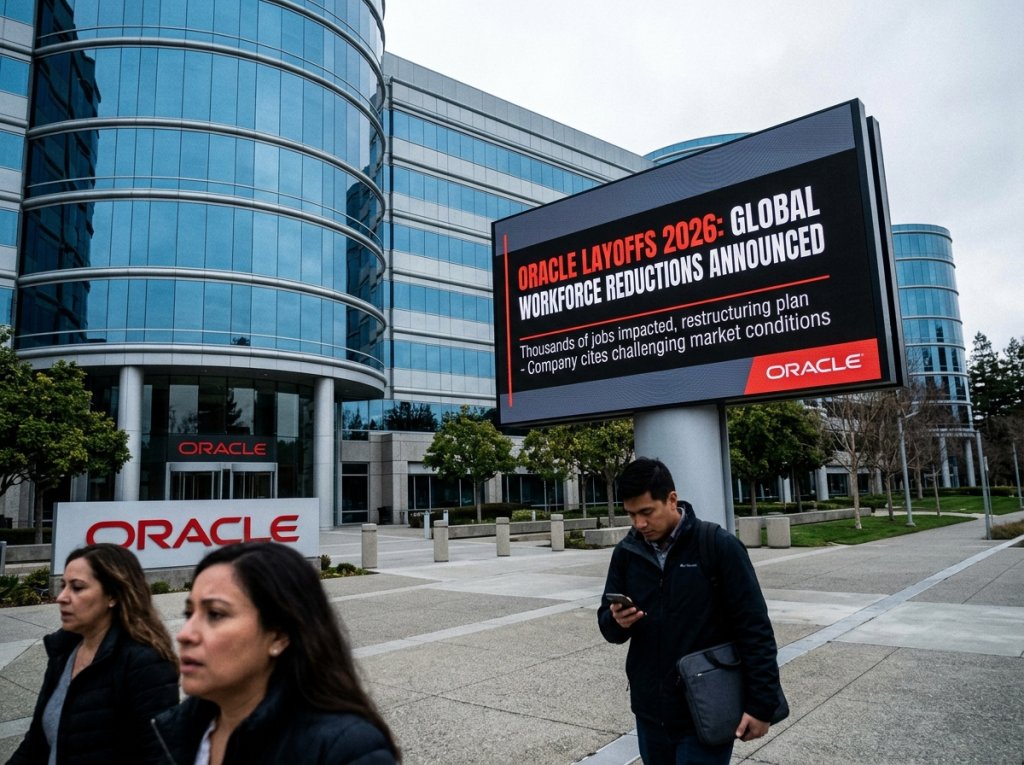
Oracle layoffs are no longer just a staffing story. They have become a signal of how aggressively major technology companies are redirecting money, talent, and infrastructure toward artificial intelligence. Current reporting says Oracle reduced its workforce by about 21,000 employees over the past year, bringing headcount down to roughly 141,000 as of May 31, 2026. The company’s annual reporting also showed $1.8 billion in restructuring costs for fiscal 2026, while capital expenditures jumped to $55.663 billion, a level that points to an enormous buildout of cloud and AI infrastructure.
That makes Oracle layoffs a useful lens for understanding a wider industry shift. The company is still posting growth, with its fiscal 2026 revenue rising 17 percent year over year to $67.4 billion, but the cost of staying competitive in AI is clearly rising just as fast. Oracle’s own results show cloud revenue reaching $33.989 billion in fiscal 2026, which helps explain why management is prioritizing capital intensity and operational efficiency at the same time.
Why Oracle Layoffs Happened
The simplest explanation is that Oracle is rebalancing its cost structure to support a much more expensive future. The company has been increasing spending on data centers, cloud capacity, and AI infrastructure, and that requires capital. Oracle’s fiscal 2026 results show capital expenditures of $55.663 billion, which is far above the prior year and indicates a very large infrastructure expansion program. In that context, Oracle layoffs can be read as part of a broader effort to preserve flexibility while financing the next phase of growth.
This is not unusual in the current tech cycle. Many large technology companies are trimming headcount while increasing AI-related spending, because the return on labor is being compared with the return on compute, data centers, and automation. Reporting on Oracle says the company linked part of the job reduction to artificial intelligence and cloud infrastructure, and also noted that AI adoption may continue to contribute to future job cuts. That makes Oracle layoffs part of a larger management thesis, not just a short-term expense reduction.
Oracle’s own business mix supports that interpretation. Its cloud revenue has become a major growth engine, and the company has been emphasizing infrastructure, cloud applications, and AI-related positioning in its public materials. Oracle says it offers cloud infrastructure and integrated cloud applications, and its FY 2026 reporting shows cloud continuing to scale materially. In other words, the company is not shrinking away from technology investment. It is shifting resources toward the parts of the business it believes will matter most in the AI era.
How Big The Oracle Layoffs Really Are
The scale matters. Cutting roughly 21,000 workers in one year is not a minor restructuring. Reuters-syndicated coverage summarized by multiple outlets says Oracle’s workforce fell by about 13 percent, from 162,000 to 141,000, over fiscal 2026. It also notes that Oracle did not specify whether every reduction was a formal layoff or where the cuts occurred geographically. That ambiguity matters, but the headline number is still large enough to rank as one of the most consequential tech workforce reductions of the year.
Oracle layoffs also came with a sharp increase in restructuring costs. Reporting on the annual filing says those costs reached $1.8 billion in fiscal 2026, compared with $374 million the previous year. That jump is important because restructuring costs usually include severance and related termination expenses, which means the company was not simply freezing hiring. It was actively paying to reshape the organization.
There is also a forward-looking warning embedded in the reporting. Oracle’s annual report reportedly said that additional job cuts could occur as AI adoption continues to change the company’s operating model. That does not mean further reductions are guaranteed, but it does suggest management sees the current Oracle layoffs as part of an ongoing transition rather than a one-time event. For investors and employees, that is a more important signal than the single year’s headcount number.
AI Spending Is Changing The Corporate Playbook
The real story behind Oracle layoffs is the new trade-off between people and infrastructure. Building AI at scale requires immense spending on compute, storage, networking, and power. Oracle’s fiscal 2026 results show how expensive that has become, with capital expenditures climbing to $55.663 billion. The company’s own results also show that its cloud business is growing quickly, which suggests management is betting that future revenue will justify today’s spending.
This helps explain why Oracle layoffs are not being treated as an isolated labor event. They are part of a broader operating model in which technology companies try to reduce fixed personnel costs while building the infrastructure needed for AI products and services. Reuters-syndicated reporting says Oracle’s job reductions align with a wider pattern across big tech, where firms are trimming headcount while ramping up AI and infrastructure investment. That pattern is now visible across the industry, and Oracle is one of its clearest examples.
Oracle’s public positioning also makes sense in this light. The company presents itself as a cloud and AI infrastructure provider, and its results show that cloud is becoming central to the business. When a firm commits to this kind of capex intensity, every other expense line comes under pressure. Oracle layoffs are therefore not only about reducing payroll. They are about making room for a much heavier investment cycle, one that prioritizes servers, data centers, and AI capacity over internal labor growth.
That is a difficult shift for workers, but it is also a defining feature of the current AI economy. Companies increasingly see labor as one lever among many, not the only one. If automation, cloud scale, and AI infrastructure can generate more output per dollar, executives will keep moving budget in that direction. Oracle layoffs show how far that logic has advanced in a business that was once defined mainly by enterprise software and databases.
What Investors, Workers, And The Market Should Watch Next
For employees, Oracle layoffs raise obvious questions about morale, job security, and internal mobility. When a company reduces headcount while increasing AI investment, the workforce often interprets the message as a sign that future efficiency will matter more than historical loyalty. Oracle has not said the reductions were concentrated in one region or business line, but the size of the cuts alone suggests a broad organizational reset.
For investors, the key question is whether Oracle’s AI spending will create enough future growth to justify the near-term pain. Some market coverage says the stock has not recovered meaningfully even after the layoffs and restructuring announcement. That skepticism is understandable. Heavy capex can improve future positioning, but only if the company converts that spending into sustainable revenue and margin expansion. Oracle layoffs therefore sit at the center of a classic growth-versus-efficiency debate.
For the broader market, Oracle is one more reminder that AI is not free. The shift to artificial intelligence is creating winners in cloud infrastructure, data center hardware, and enterprise software, but it is also forcing companies to make hard decisions about labor allocation. Oracle layoffs do not mean the company is weakening. They mean management believes the next phase of competition will be capital intensive, AI centric, and structurally different from the last one.
Conclusion
Oracle layoffs are best understood as a strategic move inside a much larger AI transformation. The company is cutting thousands of jobs, absorbing higher restructuring costs, and simultaneously spending heavily on cloud and infrastructure capacity. That combination tells a clear story: Oracle is trying to buy future relevance in the AI market by reshaping its present cost base.
The lesson extends beyond Oracle. As AI competition intensifies, more companies will likely face the same calculation between payroll, infrastructure, and long-term growth. Oracle layoffs may be one company’s decision, but the logic behind them is becoming a template for the wider technology sector.
Read More