





 Friday, 23-10-26








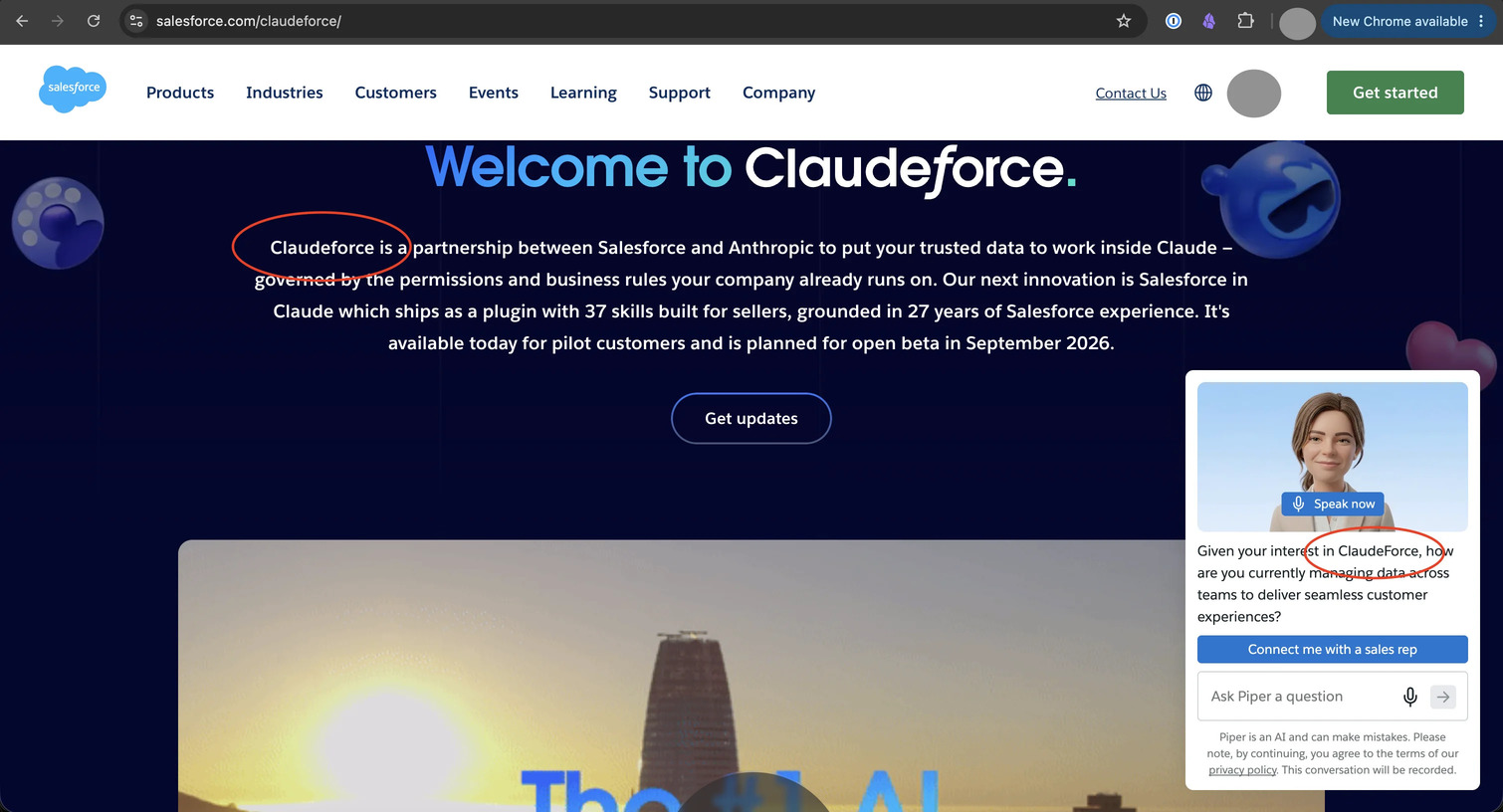
The enterprise software landscape is undergoing one of the most significant architectural transformations in decades. For nearly thirty years, customer relationship management systems required human professionals to navigate static, multi-tabbed user interfaces to input data, update deal stages, and retrieve operational insights. That paradigm is now shifting toward agentic intelligence. In a landmark collaboration known as Claudeforce, Salesforce and Anthropic have joined forces to fuse advanced artificial intelligence reasoning directly with enterprise systems of record. As part of this historic expansion, the companies introduced an initial suite of 37 pre-built capabilities through the Salesforce in Claude plugin. These new Salesforce AI sales features allow revenue teams to analyze pipeline health, prepare for high-stakes meetings, and execute governed CRM actions without ever leaving their conversational AI environment.
By bridging the gap between conversational reasoning and deterministic business software, this integration addresses a long-standing friction point in enterprise sales operations. Rather than forcing sales representatives to manually search across CRM records, email threads, and messaging channels, the integrated system allows professionals to issue natural language commands that trigger complex actions. The underlying platform reads real-time account context, evaluates pipeline risk, and performs record updates while preserving all existing business rules, security permissions, and corporate governance rails.
Redefining the User Experience in Enterprise Software
For decades, software application vendors focused on building complex graphical interfaces to accommodate expanding feature sets. While these platforms gathered massive amounts of valuable commercial data, they also created administrative burden for frontline workers. Sales representatives frequently report spending a disproportionate amount of their workweek on manual data entry, record maintenance, and cross-platform navigation rather than engaging directly with prospective clients.
The introduction of specialized Salesforce AI sales features inside the Claude interface marks a fundamental transition from static user interfaces to dynamic agentic interactions. Software is no longer merely a digital repository where humans manually record events after they happen. Instead, software is evolving into an active partner capable of interpreting intent, contextualizing historical data, and carrying out multi-step workflows. By placing enterprise data directly where revenue teams conduct daily planning and communications, the platform eliminates interface friction and restores precious hours to revenue generating activities.
Unpacking the 37 Pre-Built AI Sales Skills
At the core of the newly launched plugin is a packaged library of 37 domain-specific skills tailored for every stage of the commercial lifecycle. Unlike generic artificial intelligence assistants that rely solely on public web knowledge or basic text summaries, these advanced Salesforce AI sales features operate within live enterprise context. They draw data from customer records, opportunity histories, email logs, and internal messaging to deliver precise operational assistance.
Among these skills, meeting preparation functionality allows representatives to quickly generate deep brief summaries before client calls. The system synthesizes recent deal interactions, identifies key decision makers, outlines past objections, and highlights active product requirements. For sales leaders and pipeline managers, deal health review capabilities evaluate opportunity progression against historical win-loss patterns, flagging stalled accounts or missing stage validations. Additional skills cover account development, lead triage, quote generation support, and routine record hygiene. By packaging these capabilities into structured skills, the platform ensures that daily sales tasks are executed with consistent quality and minimal effort.
Robust Governance and the AIforce Framework
A primary concern for enterprise technology executives considering artificial intelligence adoption is data security and regulatory compliance. Large corporations cannot afford to grant autonomous agents unrestricted write access to underlying core records without strict oversight mechanisms. The integration addresses these concerns through AIforce, Salesforce's enterprise harness designed to connect business workflows and data layers to AI agents via standardized protocols, Application Programming Interfaces, and command-line interfaces.
Because every action initiated within the conversational plugin routes directly through existing system channels, configured validation rules, approval thresholds, and field-level permissions remain fully enforced. An administrator connects the service once at the organizational level, ensuring that individual sellers can only view data and execute actions for which they already hold explicit authorization. Furthermore, by making Claude available within the Salesforce Trust Boundary through Amazon Bedrock, highly regulated sectors such as healthcare, financial services, and public administration can deploy these Salesforce AI sales features while maintaining complete data privacy and sovereignty.
Expanding Claude Across Agentforce and the Slack Ecosystem
The partnership between Salesforce and Anthropic extends far beyond a single sales plugin, establishing a bi-directional technology exchange that spans the entire software ecosystem. Beyond bringing CRM capabilities into the conversational AI assistant, Claude serves as a primary reasoning engine across core Salesforce platforms. Specifically, Claude powers the Atlas Reasoning Engine within Agentforce, supporting advanced autonomous agents such as Agentforce Vibes and Agentforce Coworker to help organizations build custom digital assistants tailored to unique industry demands.
Simultaneously, the integration deeply impacts daily workplace collaboration by positioning Claude as the default intelligence model across the Slack platform. Powering Slackbot, automated summaries, and thread tags, the model enables team members to deliberate complex business decisions inside group channels and immediately trigger authorized actions in their CRM system without switching applications. This seamless flow between team dialogue, intelligent reasoning, and automated system updates illustrates how enterprise software is evolving toward a unified, agentic operational model.
Strategic Implications for Modern Revenue Organizations
The deployment of these innovative Salesforce AI sales features carries profound strategic implications for revenue operations, sales leadership, and enterprise IT management. For sales leaders, the ability to automate routine pipeline reviews and deal health assessments means more accurate revenue forecasting and faster deal velocity. Representatives receive real-time guidance on next best actions, ensuring that high-value opportunities receive timely attention.
For IT administrators and system architects, the launch highlights the paramount importance of data quality and governance hygiene. Because AI agents rely on underlying CRM records to generate insights and execute workflows, maintaining clean data structures, clear permission hierarchies, and well-defined business rules becomes even more essential. Organizations that have invested in structured data architecture will derive the greatest immediate value from agentic workflows. As competitive pressures demand greater operational efficiency, adopting integrated Salesforce AI sales features provides revenue teams with a decisive advantage in managing client relationships and driving sustainable corporate growth.
The Future of Enterprise Intelligence and Agentic Workflows
As enterprise organizations continue to evaluate digital transformation priorities, the fusion of advanced reasoning models with systems of record represents a permanent shift in how software creates value. The success of initial pilot implementations points toward a broader industry trend where conversational interfaces serve as the primary window into complex enterprise databases. Over time, pre-built skills will likely expand beyond revenue departments into customer service, marketing, supply chain management, and human resources.
Ultimately, the Claudeforce initiative proves that artificial intelligence delivers its greatest economic value when embedded directly into established business workflows. By combining Anthropic's state-of-the-art reasoning capabilities with Salesforce's decades of enterprise data, security infrastructure, and operational logic, modern enterprises are gaining access to an operational model that thinks, reasons, and executes at scale. Organizations that embrace these advanced capabilities will not only accelerate productivity across their commercial teams, but also redefine what it means to operate an agile, data-driven enterprise in the modern era.
Read More