


 Thursday, 22-10-26


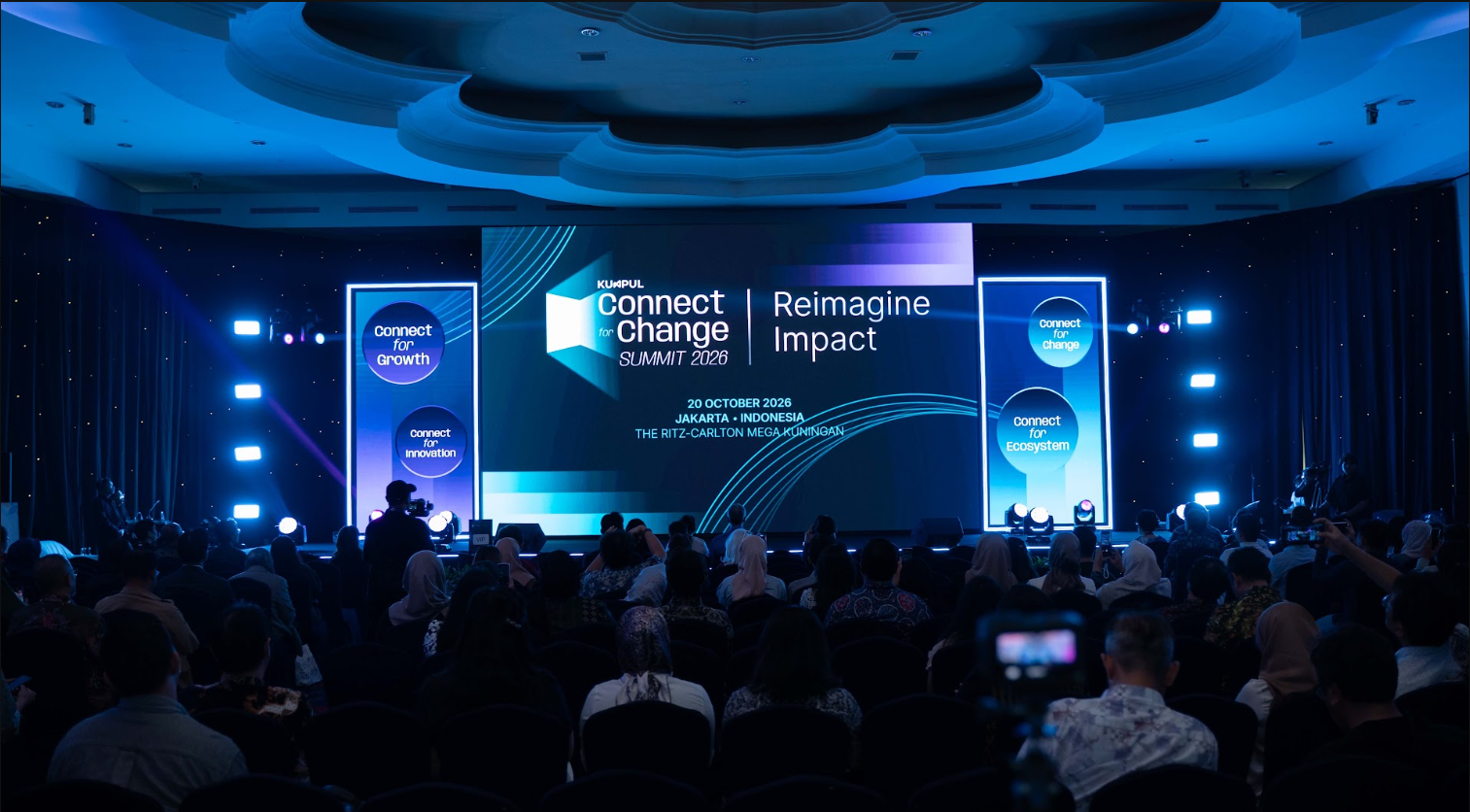
Jakarta, October 20, 2026 – For many growing businesses, having a product and access to a market is no longer enough. Their challenges are becoming increasingly complex and interconnected, ranging from access to financing, technology, and markets to networks and the support systems needed for MSMEs and startups to grow. This highlights that growth cannot be driven by a single approach.
Against this backdrop, KUMPUL once again hosted the KUMPUL Connect for Change Summit (KUMPUL C4C Summit) 2026 under the theme Reimagine Impact. Now in its second year, the summit brought together more than 1,000 participants from 16 countries to rethink how different ecosystem stakeholders can work together more effectively to create meaningful impact.
Reimagine Impact: Rethinking How to Support Growth
Reimagine Impact promotes the view that capacity building alone is insufficient when pursued in isolation. Growth also depends on how entrepreneurs, governments, corporations, investors and financial institutions, civil society organizations, ecosystem builders, and communities connect with one another. Impact, therefore, needs to be built through a more integrated approach rather than through standalone interventions.
One example of this systemic disconnect is the Missing Middle: businesses that are growing but remain underserved by the financing and growth support they need. Southeast Asia is home to approximately 71 million small and growing businesses (SGBs), accounting for 97% of all businesses in the region. Fewer than 30% of these businesses have access to formal financing, while the annual financing gap across ASEAN exceeds USD 300 billion, equivalent to approximately IDR 5,380 trillion.
Faye Wongso, Founder and Chairperson of KUMPUL and KUMPUL Impact, said that KUMPUL's 11 years of experience have shown that capacity building is insufficient when pursued separately from other forms of support.
“Business growth also requires access to supply chains, markets, financing, technology, and networks. Through the KUMPUL Connect for Change Summit 2026, we aim to create more opportunities for different stakeholders to connect and foster collaborations that are relevant to needs on the ground,” she said.
Connecting Perspectives, Innovation, and Collaboration Opportunities
The KUMPUL Connect for Change Summit 2026 translated the Reimagine Impact theme into four key areas of discussion: technology and innovation, social and environmental impact, communities as infrastructure, and global partnerships. Together, these areas examine growth not only from a business perspective but also through the lenses of human capacity, sustainability, technology, and cross-border connectivity.
During the session “Can the World Still Trust Us?”, Retno Marsudi, Indonesia's Minister of Foreign Affairs from 2014 to 2024, highlighted the importance of long-term investment in education and human capacity amid technological change and shifting global dynamics.
“Indonesia is part of the global system. Therefore, we must continue to strengthen our own capabilities, move faster, and ensure that the innovations being developed genuinely support Indonesia's progress,” Retno Marsudi said.
From a financing perspective, Miguel Soriano of the International Finance Corporation (IFC), part of the World Bank Group, highlighted the need for a system that is more adaptable to the way businesses grow.
“The issue is not simply that there is not enough money, but that the links in the financing chain are still missing. We need to rethink how financing is designed and make it better aligned with how these businesses actually grow,” Soriano said.
These cross-sector discussions were also translated into the Executive Lab Forum (ELF), which explored how AI adoption can evolve into solutions that create value and attract investment, with strategic partners BNI Ventures and AI Ignition supporting the initiative. Another forum focused on designing pathways for catalytic capital for small and growing businesses (SGBs) in Indonesia, supported by Tribhuwana Advisory.
Beyond the Executive Lab Forum, the KUMPUL Connect for Change Summit 2026 featured two business-matching sessions designed around entrepreneurs' needs.
BEKUP Business Matching connected creative economy startups with prospective partners to explore collaboration, business development, and investment opportunities. Meanwhile, SOLUSI Business Matching brought together social enterprises working in integrated terrestrial and marine landscape management in Indonesia with prospective partners, based on their business needs and collaboration interests. The initiative aimed to open up partnership opportunities across more inclusive value chains.
The KUMPUL C4C Summit 2026 continued with an Innovation Tour on October 21, 2026, in collaboration with the Ministry of Creative Economy/Creative Economy Agency of the Republic of Indonesia and Living Lab Ventures.
Delegations from Indonesia, the Philippines, Singapore, Japan, and the United States, representing diverse sectors including ecosystem builders, accelerators and industry platforms, social impact and development, digital technology, AI and cloud, climate and agritech, and consulting and advisory, participated in the World Conference on Creative Economy (WCCE) and visited the Biomedical Campus in BSD City. The tour provided participants with an opportunity to gain a closer look at Indonesia's innovation ecosystem and establish cross-border connections.
The KUMPUL Connect for Change Summit 2026 was supported by PETRONAS, BNI, UD Impact, Living Lab Ventures, BNI Ventures, and the German Federal Ministry for the Environment, Climate Action, Nature Conservation and Nuclear Safety (BMUKN) through the International Climate Initiative (IKI), implemented by a consortium involving Yayasan KEHATI.
The event series also involved the Ministry of Creative Economy/Creative Economy Agency, Tribhuwana Advisory, KUMPUL Leaders (KULI), and BritCham Indonesia as strategic partners.
Read More