





 Sunday, 06-09-26








Indonesia Chooses Access Over Alignment
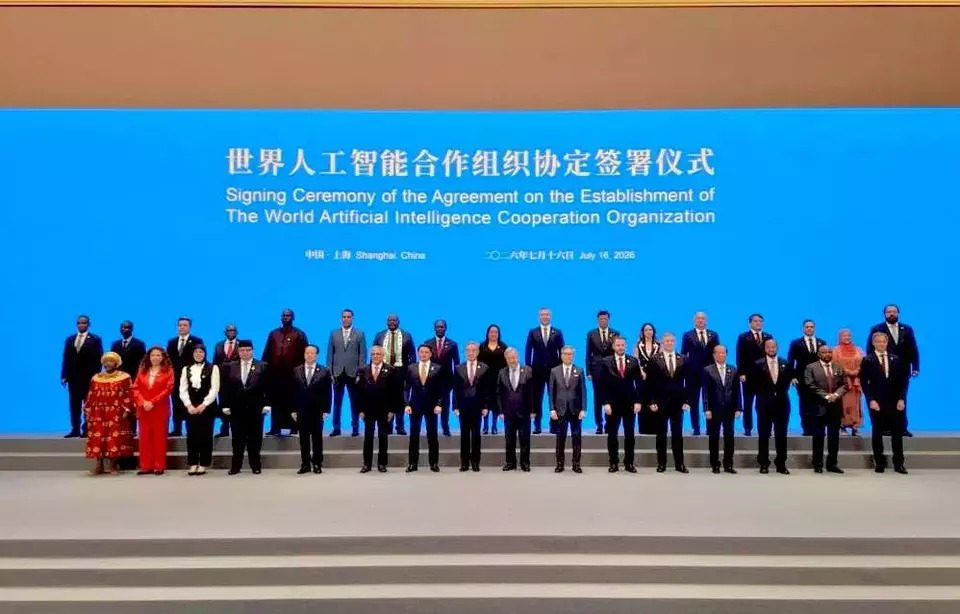
Indonesia is signaling that it does not want to be forced into a binary choice between China’s WAICO and the United States’ Pax Silica. Coordinating Minister for Economic Affairs Airlangga Hartarto said Indonesia is committed to advancing artificial intelligence while maintaining a balanced approach to cooperation with both countries, and he described AI as a “neutral and non-political tool.” He made the remarks in Shanghai after Indonesia signed the founding declaration of WAICO, even as discussions on Pax Silica continued.
That message matters because it puts Indonesia in a familiar diplomatic posture: cooperate widely, avoid unnecessary alignment, and keep the country’s economic options open. In the fast-moving AI race, that approach can be seen as pragmatic. Indonesia wants access to technology, capital, standards, and supply chains from both sides without being boxed into one camp. The country’s leaders are presenting that as a matter of national interest rather than geopolitical hedging.
What WAICO And Pax Silica Actually Are
WAICO, or the World Artificial Intelligence Cooperation Organization, is a China-initiated intergovernmental body meant to strengthen global AI governance and international cooperation. Indonesia became a founding member when Airlangga signed the establishment agreement in Shanghai on July 17, 2026. Antara reported that 29 countries signed the founding agreement, and the initiative was presented as a people-centered framework for safe, fair, and beneficial AI development.
Pax Silica is the U.S. Department of State’s flagship effort on AI and supply chain security. The State Department says the initiative is designed to build a new economic security consensus among allies and trusted partners around secure AI supply chains, semiconductors, critical minerals, energy inputs, advanced manufacturing, and technology infrastructure. The U.S. hosted a second Pax Silica summit in Washington in June 2026, underscoring that the initiative is already functioning as a serious diplomatic platform rather than a loose idea.
Airlangga’s point is that these two frameworks are not identical and do not necessarily conflict. Antara reported that he said WAICO focuses on positioning AI as a tool, while Pax Silica promotes broader digital development beyond AI itself. He also said Indonesia remains involved in Pax Silica, which suggests Jakarta wants room to participate in both tracks rather than choosing one and closing the door on the other.
Why Indonesia Is Avoiding A Hard Choice
Indonesia’s neutral stance is not just about diplomacy. It is also about strategy. The country is trying to deepen its role in the global digital economy while preserving flexibility in trade, technology, and industrial policy. Airlangga said Indonesia needs to be directly involved in international cooperation and global AI governance so that AI develops in a healthy, beneficial, safe, and equitable manner. He also framed Indonesia’s WAICO role as a way to help bridge the global AI divide.
That framing is important because the global AI race is no longer only about model performance or consumer applications. It is also about who controls the stack beneath AI: chips, data flows, cloud capacity, electricity, minerals, and manufacturing capacity. Pax Silica explicitly focuses on those supply chain foundations, while WAICO is centered on governance and broader international cooperation. Indonesia is effectively saying it needs access to both the governance conversation and the industrial supply chain conversation.
There is also a political economy reason for this posture. Indonesia wants to attract investment and technology transfer without becoming overdependent on any single power bloc. The country has a history of balancing major partners across trade, infrastructure, digital policy, and natural resources. In this case, neutrality is less about indecision and more about preserving leverage. That is an inference from the official statements and the structure of the two initiatives.
How The US And China Initiatives Differ
WAICO and Pax Silica are not mirror images. WAICO was introduced in Shanghai alongside the World Artificial Intelligence Conference 2026, and the organization’s founding agreement emphasizes a human-centric approach to AI development under the principles of the UN Charter. Antara reported that the body is meant to support global governance, consultation, and shared benefits. That makes WAICO a governance-oriented framework with a strong diplomatic flavor.
Pax Silica, by contrast, is built around economic security and resilient supply chains. The U.S. State Department says the initiative is about AI supply chain security, trusted partners, and the broader industrial base that supports AI adoption. It is not only about AI ethics or governance. It is also about the strategic materials and production systems that determine who can build and deploy AI at scale.
That difference is why Airlangga said the two schemes are not necessarily at odds. If WAICO is about the rules of AI, Pax Silica is about the physical and commercial infrastructure that makes AI possible. Indonesia can therefore argue that participating in one does not automatically exclude participation in the other. This is the core logic behind Jakarta’s neutral position on Pax Silica and WAICO.
What Indonesia Gains By Staying Open To Both
The first gain is access. By staying active in both circles, Indonesia keeps a seat at conversations that could shape future AI standards, supply networks, investment flows, and digital trade arrangements. Airlangga noted that cooperation in digital affairs is also part of the Agreement on Reciprocal Trade between Indonesia and the United States, which shows the AI discussion is connected to broader economic diplomacy.
The second gain is relevance. Indonesia has already been positioning itself as a more serious digital player. Antara reported that Airlangga said Indonesia’s participation in WAICO is strategically important for ensuring global AI governance remains people-centered and benefits developing countries. That is a strong statement of ambition. It suggests Indonesia does not want to be a passive user of imported technology. It wants to help shape the rules.
The third gain is bargaining power. If Indonesia is seen as open to both Chinese and U.S.-led frameworks, it can potentially widen its options for cooperation in chips, cloud infrastructure, AI talent, cybersecurity, and digital manufacturing. The country’s current stance gives policymakers flexibility to negotiate project by project instead of making a wholesale geopolitical commitment. That flexibility is one of the clearest advantages of the Pax Silica approach from Indonesia’s perspective. This is an inference based on the cited reporting.
The Risks Of Trying To Walk The Middle Line
Neutrality does not eliminate risk. If geopolitical tensions intensify, Indonesia may eventually be pressed to clarify where its deepest loyalties or dependencies lie. The more both sides invest in rival ecosystems, the harder it becomes to remain fully noncommittal. That is especially true in areas like semiconductors, data governance, and cybersecurity, where standards and partnerships tend to cluster around shared strategic interests.
There is also the execution challenge. Joining frameworks is easier than turning them into domestic capability. Indonesia still needs talent, infrastructure, and investment to capture value from either WAICO or Pax Silica. Without that, participation could become symbolic rather than transformative. Airlangga’s comments about equitable, safe, and people-centered AI point to that concern, because they suggest Indonesia wants tangible developmental outcomes, not only diplomatic visibility.
For businesses, this means policy watchers should pay close attention to whether Indonesia’s neutral stance leads to concrete outcomes such as AI training partnerships, semiconductor participation, cross-border data arrangements, or local digital infrastructure projects. The significance of Pax Silica for Indonesia will depend less on the headline and more on the implementation that follows. That is the real test of whether neutrality can be turned into advantage.
A Measured Bet On Strategic Flexibility
The clearest takeaway is that Indonesia is choosing flexibility over alignment. By joining WAICO while keeping a pathway open to Pax Silica, the government is telling both Washington and Beijing that it wants engagement, not exclusivity. That stance may frustrate those who prefer clearer blocs, but it fits Indonesia’s economic and diplomatic style.
In practical terms, the Pax Silica debate is less about ideology than about access to the future of AI infrastructure. Indonesia wants to remain inside the room where standards, supply chains, and digital rules are being written. It also wants to avoid being trapped in a zero-sum contest that could limit its options. That makes its neutral posture a calculated move, not a passive one.
If the strategy works, Indonesia could emerge as a useful bridge between competing technology ecosystems. If it fails, the country risks being seen as committed enough to be pressured, but not committed enough to shape outcomes. For now, though, Pax Silica represents something Indonesia is determined to protect: strategic room to maneuver.
Read More