





 Monday, 14-09-26








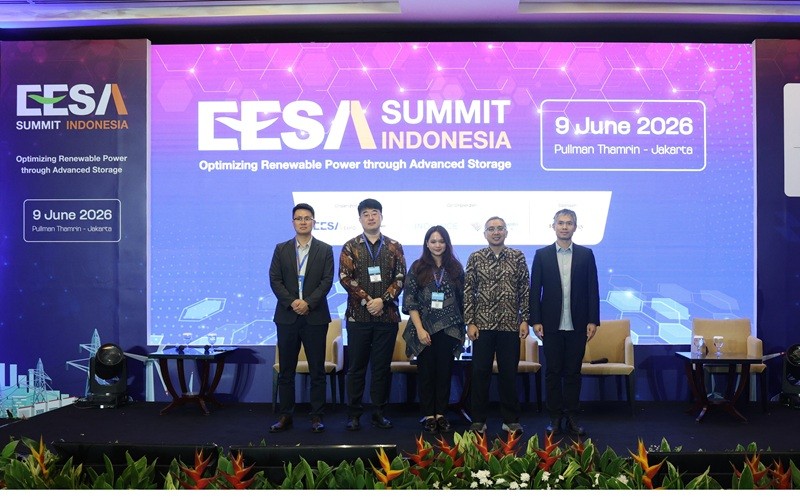
China’s push into Indonesia’s solar market is not just about panels. It is about the missing layer that can make a massive solar rollout actually work: an energy storage system. In the IDXChannel report published on June 10, 2026, several Chinese companies were said to be eyeing Indonesia’s solar power plant market, especially after President Prabowo’s target to build up to 100 gigawatts of solar capacity in the coming years. The report also stressed that the plan becomes much harder to execute without storage technology, because solar generation depends on weather conditions and therefore needs buffering to remain reliable.
That is why the discussion around solar in Indonesia is changing. The real question is no longer whether the country has enough sunshine. It does. The question is whether Indonesia can build an energy storage system large enough, affordable enough, and distributed enough to support a national rollout that spans islands, villages, cities, and industrial zones. The EESA Summit Indonesia 2026 was built around exactly that idea, framing energy storage as a bridge between China’s industrial strength and Indonesia’s fast-growing clean energy ambitions.
Why An Energy Storage System Is The Missing Piece
The logic behind the 100 GW solar ambition is straightforward. Solar power is abundant, but it is intermittent. Clouds, nightfall, and regional weather patterns all affect output. That means a large solar buildout without storage can create a system that looks impressive on paper but struggles in daily operation. The IDXChannel article makes this point directly, warning that the target faces serious challenges if it is not paired with an energy storage system.
That is also why the national target has increasingly been discussed together with batteries and transmission infrastructure. Reuters reported earlier in 2026 that Prabowo’s 100 GW solar target was being framed as a major national plan, while other coverage said it would require massive investment in photovoltaic farms, storage systems, and grid infrastructure. IESR has gone further, describing the solar program as a solar plus battery storage roadmap rather than a pure solar rollout. Its official materials say the plan includes 80 GW of village scale solar with battery storage across 80,000 villages and 20 GW of centralized solar.
That matters because Indonesia is not a single grid. It is an archipelago, and that makes power planning harder. A village microgrid in eastern Indonesia does not face the same operating conditions as an industrial cluster in Java, but both still need reliability. A well designed energy storage system can smooth solar output, reduce the need for diesel backup, and support electricity access in places where grid connections are weak or costly. That is why storage is not a nice add on. It is the central enabler.
Why Chinese Firms Are Moving Fast
The EESA Summit Indonesia 2026 gives a clear clue about why Chinese companies are paying attention. The summit’s official site says the event is meant to connect Indonesia’s market with Chinese advanced storage energy, and it specifically highlights large scale photovoltaic systems with storage and island or industrial microgrids as the two core market themes. The site also says China has strong advantages in energy storage because of its industrial base and market experience.
That combination is strategically attractive. Indonesia offers scale, sunlight, and a huge long term demand curve. China offers manufacturing depth, battery know how, and an ecosystem of suppliers that can move quickly when a market opens. For Chinese firms, Indonesia is not just another export destination. It is a potential platform for utility scale solar, battery energy storage systems, grid services, and island electrification projects. That is why the phrase energy storage system keeps appearing alongside investment interest. It is the component that makes the solar pitch commercially credible.
The EESA Summit also emphasizes cooperation between government, energy companies, investors, and technology providers. Its Indonesian event page says the summit is designed to strengthen collaboration and explore advancements in storage technology and energy transition. The structure of the event itself tells a story. This is not a casual trade conversation. It is a serious matchmaking platform for deal flow, policy alignment, and project development.
From Indonesia’s side, that can be useful if it is handled carefully. The country needs technology, financing, and execution capacity, but it also needs projects that are practical and bankable. A strong energy storage system can increase project value by improving dispatchability and making solar a more dependable asset for the grid. That is especially important where electricity demand is rising but backup power costs are still high.
What This Means For Indonesia's Grid And Investors
If the 100 GW target is implemented seriously, the winners will not be the companies that simply ship panels. The winners will be the companies that can deliver solar plus storage as an integrated package. IESR’s official study says the solar strategy is meant to strengthen energy resilience, energy self sufficiency, and reliable electricity access. It also says the program involves phased retirement of high cost and high emission diesel plants in line with PLN’s electricity plan. That suggests the market opportunity extends well beyond generation hardware.
For investors, the appeal is obvious. An energy storage system improves the economics of a solar plant by helping it deliver power when it is actually needed, not only when the sun is shining. It can reduce curtailment, support peak shaving, and make microgrids more resilient. In markets like Indonesia, where islands and remote communities often rely on diesel, the potential cost savings are especially important. IESR has argued that solar plus storage is increasingly competitive against diesel and even some fossil based alternatives.
There is also a wider industrial policy angle. Reuters reported in 2025 that an Indonesian Chinese battery joint venture could eventually produce batteries for solar energy storage as part of a broader domestic power battery ecosystem. That is relevant because solar expansion does not happen in a vacuum. It creates demand for batteries, cabling, inverters, control systems, software, and maintenance services. In that sense, the solar push can stimulate a larger clean energy supply chain if the policy framework rewards local value creation.
Still, the risks are real. A national target of this scale can easily become too dependent on imports, slow procurement, or weak grid readiness. The solution is not to reduce ambition. It is to sequence the rollout intelligently. That means prioritizing high impact locations, pairing solar with storage from the start, and designing projects around actual demand profiles rather than abstract capacity figures. Without that discipline, the 100 GW target could become a slogan rather than a functioning system. The energy storage system is what helps prevent that outcome.
There is another point that often gets overlooked. Storage is not only about reliability. It is about trust. Businesses invest when they believe power will be available consistently. Communities adopt new services when outages become less frequent. Governments build confidence when clean energy projects can prove they are not fragile. A solar program that arrives with a credible energy storage system sends a different message from one that arrives with panels alone. It says Indonesia is planning for long term operations, not just ribbon cutting.
The Bigger Picture For Indonesia-China Energy Cooperation
The China-Indonesia energy discussion now sits at a more mature stage. It is no longer just about capital flows or equipment sales. It is about how both sides can build a deployable model for solar, storage, and grid modernization. The EESA Summit Indonesia 2026 positions itself as a channel for that cooperation, and the IDXChannel report shows that Chinese firms are already looking seriously at the opportunity.
For Indonesia, that cooperation can support a transition from diesel heavy systems to cleaner and more flexible power structures. For China, it opens the door to export storage technology, engineering services, and integrated energy solutions. For both sides, the strongest projects will likely be the ones that treat the energy storage system as core infrastructure rather than a supplementary cost item.
The bottom line is simple. Indonesia’s 100 GW solar ambition can only become a real power system if the country builds the storage layer that solar needs. That is why Chinese companies are moving in, why policymakers are emphasizing reliability, and why storage has become the center of the conversation. The panels will attract attention. The energy storage system will determine whether the plan works.
Read More