





 Sunday, 25-10-26








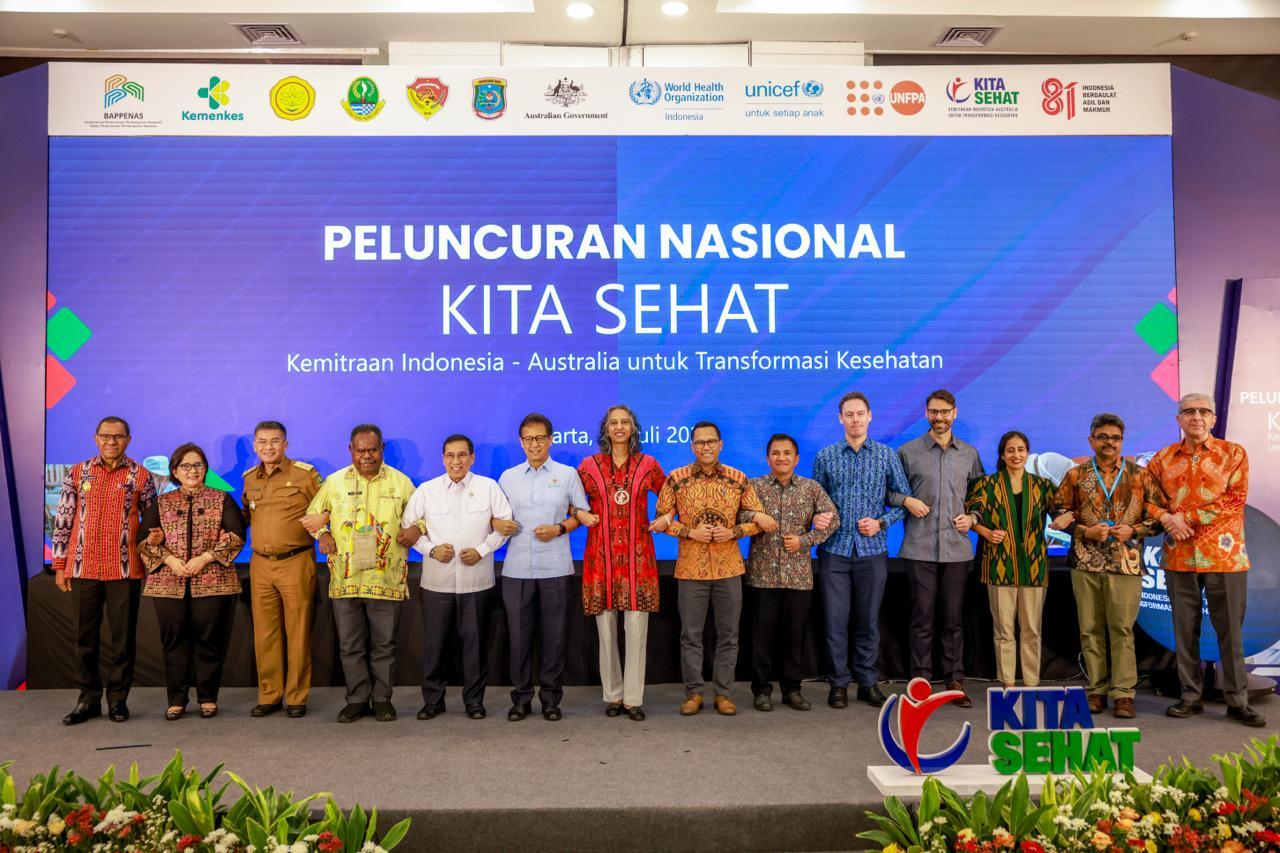
The Indonesian and Australian governments have officially launched the KITA SEHAT (Indonesia–Australia Health Transformation Partnership) program, a joint investment worth up to AUD100 million to strengthen Indonesia's healthcare system from the national level to remote regions (20/07).
The partnership will run from 2025 to 2033 and focuses on strengthening primary healthcare services, improving health security, and advancing the One Health approach across the country.
Indonesia and Australia Launch KITA SEHAT Health Partnership Worth Up to AUD100 Million
The program was launched at the Ministry of National Development Planning (Bappenas) office in Jakarta on Monday (20/7).
The long-term partnership will be implemented in two phases through the Ministry of National Development Planning/Bappenas, the Ministry of Health, and the Ministry of Agriculture. The program will be coordinated with Australia's Department of Foreign Affairs and Trade (DFAT) and supported by WHO, UNICEF, and UNFPA as development partners.
Ministry of Health Prioritizes Primary Healthcare and Measurable Outcomes
Minister of Health Budi Gunadi Sadikin emphasized that every international partnership should be designed strategically to deliver tangible benefits, especially at primary healthcare facilities.
"The government must keep people healthy. The main focus should be on primary healthcare services, followed by referral services. I thank the Australian Government for supporting Indonesia. However, I also need truly specific targets and a clear focus. We should not have many activities without visible results. I ask for support to ensure primary healthcare services function well, including increasing immunization coverage to above 90 percent, implementing the Free Health Check program, reducing stunting, and controlling disease risk factors," said Minister Budi.
KITA SEHAT Supports Indonesia's Long-Term Health System Transformation
Deputy Minister of National Development Planning and Deputy Head of Bappenas Febrian Alphyanto Ruddyard said the health sector is a key foundation of Indonesia's transformation under the 2025–2045 National Long-Term Development Plan (RPJPN).
He said the partnership should be measured by the capacity it builds for Indonesia rather than by ceremonial achievements.
"KITA SEHAT is more than a cooperation project. It is a joint investment to build a stronger, more resilient, and future-ready health system for Indonesia. We are not seeking dependency. Through this partnership involving the central government, regional governments, academics, professional organizations, businesses, and development partners, we aim to create opportunities to learn from one another, strengthen national capacity, and develop shared solutions," said Febrian.
Australian Deputy Ambassador to Indonesia Gita Kamath said Australia considers Indonesia its main strategic partner in strengthening health resilience across the Indo-Pacific region.
"KITA SEHAT reflects the strong and long-standing health partnership between Australia and Indonesia, as well as our shared commitment to achieving health for all. For more than three decades, Australia and Indonesia have worked together to strengthen primary healthcare services, support immunization and disease control, improve maternal and infant health, and build a more resilient health system," said Gita Kamath.
She added that Australia is committed to supporting the program through systemic interventions that benefit communities in the coming years.
"KITA SEHAT will strengthen institutions, improve the capacity of healthcare workers, enhance healthcare service systems, and strengthen cross-sector coordination in responding to future health threats. Australia is proud to stand alongside Indonesia in implementing this program, and we remain committed to its future success," she said.
Pilot Implementation Begins in Three Indonesian Provinces
As an initial step, KITA SEHAT will be implemented intensively at the national level and in three pilot provinces: West Java, East Nusa Tenggara, and Southwest Papua.
The launch was attended by Southwest Papua Governor Elisa Kambu, West Java Deputy Governor Erwan Setiawan, and East Nusa Tenggara Deputy Governor Johni Asadoma, demonstrating regional commitment to replicating innovation and best practices at the local level.
The program will integrate locally led approaches, gender equality, disability, and social inclusion (GEDSI), as well as climate resilience, to accelerate the achievement of the social justice goal of "Health for All" toward Golden Indonesia 2045.
PHOTO: MINISTRY OF HEALTH
This article was created with AI assistance.
We make every effort to ensure the accuracy of our content, some information may be incorrect or outdated. Please let us know of any corrections at [email protected].
Read More