





 Monday, 14-09-26








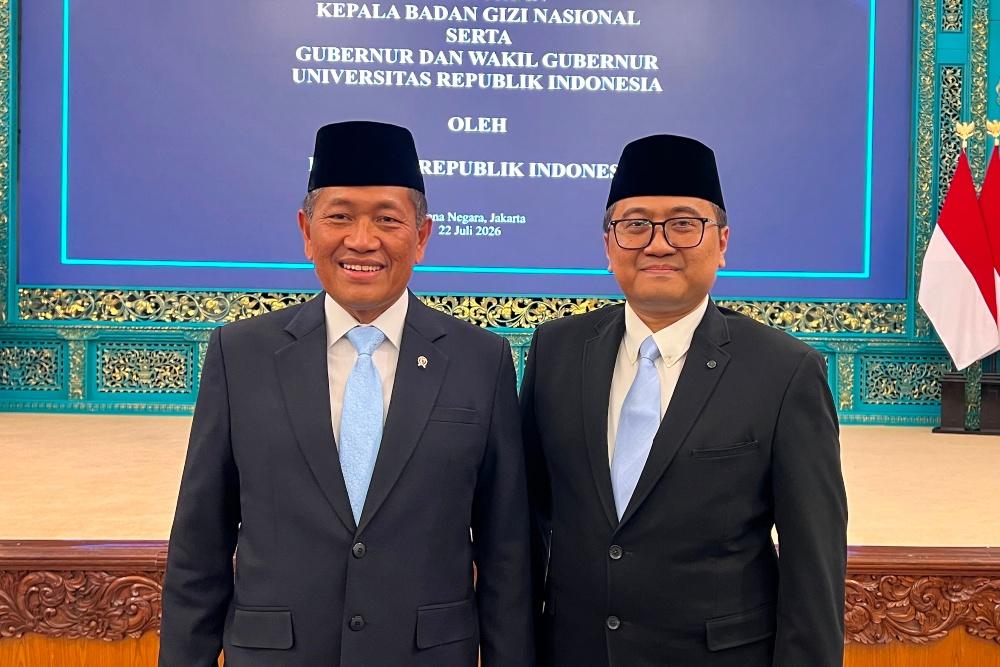
Indonesia's newest higher education institution, Universitas Republik Indonesia, now has a physical roadmap. A day after President Prabowo Subianto formally installed its top leadership at the State Palace, the university's governor confirmed where the main campus will eventually stand and how the institution plans to operate while that construction gets underway.
What Is Universitas Republik Indonesia?
Universitas Republik Indonesia, often shortened to URI, is a newly formed institution built to train future leaders for government agencies and state owned enterprises. It was introduced this week when President Prabowo swore in Marshal (Ret.) Donny Ermawan Taufanto as Governor of URI and Professor Yos Sunitiyoso, an academic from the Bandung Institute of Technology, as Vice Governor. The appointments were made official through Presidential Decree Number 80/P of 2026, signed at the State Palace in Jakarta on Wednesday, July 22, 2026.
Donny, who also serves as Deputy Minister of Defense, described the new university as part of a larger effort to consolidate several existing leadership and education programs under a single structure. He pointed to institutions abroad, such as France's Institut National du Service Public, formerly known as École Nationale d'Administration, which has long trained senior civil servants. The goal, as he explained it, is to build a similar pipeline of disciplined, values driven leaders for Indonesia's bureaucracy and its state companies.
New Campus Planned for North Bogor's Cikasungka Site
The most concrete update to come out of the swearing in ceremony concerns the location of the future URI headquarters. Donny told reporters that the main building will rise in Cikasungka, an area in North Bogor, West Java. He explained that the land currently belongs to PT Perkebunan Nusantara, a state owned palm oil company, and that it has not been productive for some time.
Because the plantation is no longer generating meaningful output, the government plans to repurpose it for educational use, with Universitas Republik Indonesia among the first beneficiaries. Donny was careful to note that the project has not broken ground yet. Land acquisition and legal designation are still being finalized, and no firm construction timeline has been announced. In other words, the institution currently exists with a governor, a mission, and a future address, but not yet a finished building.
Temporary Office in a BUMN Building in Central Jakarta
While the Bogor campus works its way through planning and land arrangements, URI will not sit idle in the meantime. Donny confirmed the university will borrow two floors of a state enterprise ministry building along Jalan Medan Merdeka Selatan in Central Jakarta. That space will function as a working office so the institution can begin operating, hiring staff, and setting up its programs before the permanent campus is ready.
Using an existing government building as a stopgap is a practical choice. It lets Universitas Republik Indonesia start functioning almost immediately rather than waiting years for construction to wrap up, and it keeps costs manageable during the institution's earliest and most uncertain phase. For an organization this new, having any working address at all is a meaningful head start.
From Unproductive Palm Oil Land to a Center of Learning
The choice of Cikasungka is notable for reasons beyond convenience. Converting retired plantation land into a university site reflects a pattern the government has leaned on before: taking underused state assets and giving them a second purpose. PTPN's holdings around North Bogor have reportedly declined in productivity over the years, and turning that acreage into an education and training hub gives the land new economic and social value instead of leaving it dormant.
For residents of the surrounding North Bogor area, the announcement means a sizable institutional campus could eventually become a neighbor, potentially bringing new jobs, infrastructure, and activity to a part of West Java that has traditionally leaned more agricultural than academic. It also signals that more state land conversions of this kind may follow as the broader URI network expands.
Leadership Behind the New Institution
Donny Ermawan Taufanto brings a military and defense background to his new post, having built his career through senior Air Force roles before taking on his current position as Deputy Defense Minister. Yos Sunitiyoso, by contrast, offers an academic perspective as a professor at one of Indonesia's most respected engineering schools. Together, the pairing is meant to combine discipline and strategic thinking with scholarly rigor, echoing how Donny has described the university's broader aim of blending managerial skill with national character building.
Under the governor's office, which is also referred to as the National Education Development Agency, three separate bodies will operate side by side: one overseeing the Garuda excellent schools program, one managing higher education, and one running the State Administration Institute, which trains civil servants. Bringing these three functions under a single structure is meant to reduce duplication and create a more consistent pipeline that runs from secondary school all the way through senior government training.
A Broader Vision: Ten Campuses Nationwide
North Bogor will not be the only home for Universitas Republik Indonesia. Government officials have indicated that the plan eventually calls for ten URI campuses spread across the country, each carrying the same mission of producing capable, principled leaders for public service and state enterprises. The Cikasungka site is expected to serve as the flagship location given its proximity to Jakarta, but the broader rollout suggests the government views this as a long term, nationwide investment rather than a single showcase project.
Funding for both the temporary office and the future campus will come from the state budget. Officials have said the exact cost is still being calculated, with detailed budget planning underway for the remainder of 2026 and into future fiscal years. Students admitted to Universitas Republik Indonesia are expected to receive full scholarships, though specifics on tuition coverage, housing, and admission requirements have not yet been made public.
What This Means for Indonesia's Future Leaders
For now, Universitas Republik Indonesia is still very much a work in progress. It has leadership, a legal foundation, a temporary home, and a planned site for its flagship campus, yet many operational details remain unresolved. Prospective students, current civil servants, and state enterprise employees who might one day pass through its programs will likely be watching closely as land acquisition in Cikasungka moves forward and as the government finalizes how admissions, curriculum, and campus life will actually work.
What is already clear is that the government sees this institution as more than a typical public university. It is being positioned as a strategic training ground, one intended to shape the next generation of officials who will run ministries, civil service agencies, and state owned enterprises. Whether Cikasungka becomes the campus its planners envision, and how quickly the ten satellite campuses take shape, will say a great deal about how seriously that ambition is carried out in practice.
Read More