





 Thursday, 10-09-26








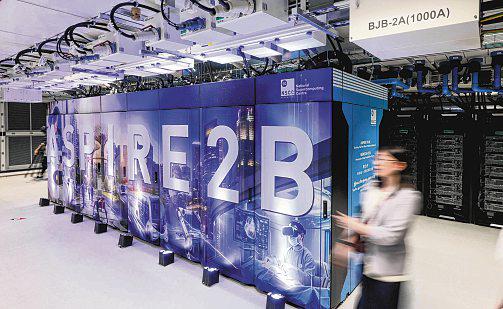
Singapore has launched a new national research supercomputer called Aspire 2B to enhance artificial intelligence capabilities across climate science, healthcare, and language processing (08/06).
The system will support around 9,000 public researchers from universities, research institutes, and government agencies.
It is designed to help users build more complex AI models and reduce the time required for experimentation.
Minister for Digital Development and Information Josephine Teo said AI will act as a multiplier for research work, allowing faster breakthroughs and improved workflows.
She also stated that workloads previously sent overseas can now be processed using Singapore’s national infrastructure.
Nvidia-Powered Aspire 2B Becomes Singapore’s Most Powerful Research Supercomputer
Aspire 2B is powered by more than 1,500 Nvidia H200 graphics processing units (GPUs), making it Singapore’s largest cluster of advanced AI chips.
The system delivers more computing power than 120,000 high-end artificial intelligence laptops combined. It is also capable of performing more than 100 quadrillion calculations per second, a task that would take the global population over 170 days to complete manually.
Aspire 2B offers four times the computing power of its predecessors, Aspire 2A and Aspire 2A+, which were launched in 2024 and have supported more than 1,500 projects.
AI Supercomputer to Support Climate Forecasting, Disease Prediction, and Language AI
The Aspire 2B supercomputer will be used for advanced climate modelling that combines artificial intelligence with physics-based simulations. It will also support higher-resolution weather forecasting models.
According to Minister Josephine Teo, this capability will help anticipate intense rainfall and rising sea levels earlier, supporting urban planning and coastal defence strategies.
In healthcare, the Singapore Medical Foundation AI Model will use Aspire 2B to train larger models using diverse health records, including text, images, and audio data.
These systems are expected to help hospitals identify patient health risks earlier and improve preventive care.
Singapore Expands National AI Infrastructure for Public Research Institutions
Aspire 2B is part of Singapore’s national AI infrastructure programme supported by a $270 million commitment announced in 2024 by the National Research Foundation.
The system is overseen by the National Supercomputing Centre, which was established in 2015 to support high-performance computing needs in Singapore.
The infrastructure will also support multilingual AI development. One example is A*STAR’s Meralion model, which can understand languages such as Hokkien, Mandarin, Tamil, and Malay, including regional accents and colloquial expressions.
Meralion is currently used by social service agency Lion Befrienders to automate routine check-in calls for seniors.
Researchers will further develop AI models that support more languages, multimodal inputs, and more advanced capabilities.
Aspire 2B to Integrate with Quantum Computing and Develop Future AI Talent
Aspire 2B will be linked to the Helios quantum computer, which will be developed in Singapore later in 2026 through a partnership between US-based Quantinuum and Singapore’s National Quantum Office. This integration is intended to help solve complex problems that cannot be handled efficiently by either system alone.
The National Supercomputing Centre has also trained about 1,000 specialists to operate supercomputers as part of the national programme.
Training initiatives include workshops, user consultations, and hands-on support for researchers and students.
Minister Josephine Teo said that future AI systems such as AI agents and physical AI will require significantly higher computational capacity.
She also emphasized that success depends not only on hardware scale but on how efficiently the infrastructure is used and supported by skilled people.
PHOTO: MAGZTER
This article was created with AI assistance.
We make every effort to ensure the accuracy of our content, some information may be incorrect or outdated. Please let us know of any corrections at [email protected].
Read More