





 Monday, 21-09-26








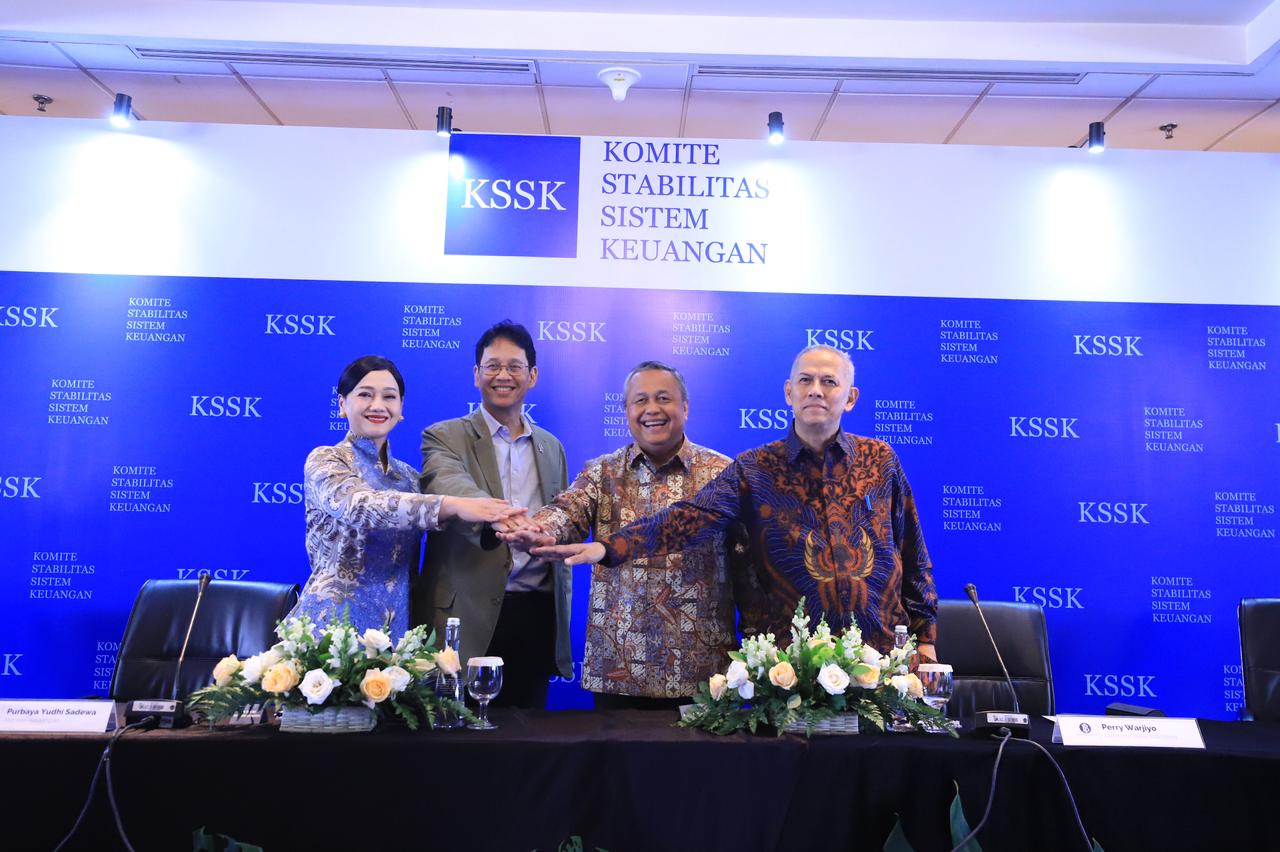
The Financial System Stability Committee (KSSK) stated that Indonesia's fiscal, monetary, and financial sector conditions remained well maintained in the first quarter of 2026 despite increased volatility in global financial markets caused by the conflict in the Middle East. Indonesia's economy grew 5.61% year-on-year during the period, supported by domestic demand and government spending (07/05).
The assessment was presented following KSSK's Second Regular Meeting of 2026, held on 27 April 2026.
KSSK consists of the Minister of Finance, the Governor of Bank Indonesia (BI), the Chairperson of the Financial Services Authority (OJK), and the Chairperson of the Indonesia Deposit Insurance Corporation (LPS).
According to KSSK, the conflict in the Middle East has weakened the global economic outlook by disrupting supply chains and increasing global oil and commodity prices.
The committee noted that rising inflation and heightened financial market volatility have also strengthened the U.S. dollar and limited capital flows to emerging markets.
Indonesia's Economic Growth Supported by Consumption and Investment
Indonesia's economic growth accelerated from 5.39% year-on-year in the previous quarter to 5.61% in the first quarter of 2026.
Household consumption remained strong, supported by consumer confidence, increased economic activity during the National Religious Holidays period, and government stimulus measures and social assistance programs.
Government spending also increased significantly through national priority programs, including the Free Nutritious Meals Program, Fishermen's Villages, and People's Schools.
Investment growth remained strong, supported by the start of downstreaming projects under Danantara and infrastructure development linked to government priority programs.
Manufacturing activity remained in expansion territory, with the Purchasing Managers' Index reaching 50.1 in March 2026.
Retail sales grew 2.4% year-on-year, while Indonesia recorded a trade surplus of USD3.3 billion in March.
KSSK projects Indonesia's economic growth in 2026 to reach 5.4% or higher through policy coordination among government institutions and efforts to strengthen investment and job creation.
Rupiah Stability and External Resilience Remain a Focus
Indonesia recorded a trade surplus of USD5.5 billion during January-March 2026, supported by a surplus in non-oil-and-gas trade.
However, foreign portfolio investment recorded net outflows of USD1.7 billion during the first quarter due to increased uncertainty in global financial markets.
The Rupiah exchange rate stood at IDR16,995 per U.S. dollar at the end of March 2026, depreciating 1.88% compared with the end of 2025.
Bank Indonesia strengthened exchange-rate stabilization policies by intervening in offshore Non-Deliverable Forward, spot, and Domestic Non-Deliverable Forward transactions.
As of 5 May 2026, the Rupiah remained relatively stable at IDR17,415 per U.S. dollar. During the early part of the second quarter, foreign capital inflows reached USD3.3 billion, particularly into Bank Indonesia Rupiah Securities and Government Securities.
Indonesia's foreign exchange reserves reached USD148.2 billion at the end of March 2026, equivalent to six months of imports.
Inflation Remains Within Target While State Budget Supports Growth
Consumer Price Index inflation remained within the target range of 2.5±1% in April 2026.
Inflation stood at 2.42% year-on-year in April, lower than 3.48% recorded in March. Core inflation declined to 2.44%, while volatile food inflation eased to 3.37%.
Administered price inflation also declined to 1.53%, supported by government measures to maintain fuel and electricity subsidies.
KSSK projects inflation to remain within the target range during 2026 and 2027 through consistent monetary policy and government price-control measures.
The State Budget continued to serve as a shock absorber amid global pressures and commodity price volatility.
State revenue reached IDR574.9 trillion in the first quarter of 2026, growing 10.5% year-on-year. Tax revenue increased by 20.7% to IDR394.8 trillion.
State expenditure reached IDR815.0 trillion, up 31.4% year-on-year, supported by spending on social assistance, infrastructure, and national priority programs.
The Government reiterated its commitment to maintaining subsidized fuel prices and keeping the fiscal deficit below 3% of GDP.
Bank Indonesia Strengthens Policy Coordination and Monetary Measures
Bank Indonesia maintained the BI-Rate at 4.75% throughout February, March, and April 2026.
The central bank continued implementing policies to stabilize the Rupiah, control inflation, maintain liquidity, and support economic growth.
Up to 4 May 2026, Bank Indonesia had purchased IDR123.1 trillion in Government Securities as part of monetary and fiscal policy coordination.
The central bank also strengthened foreign exchange transaction policies and continued efforts to deepen money and foreign exchange markets.
As of the first week of April 2026, incentives under the Macroprudential Liquidity Incentive Policy reached IDR427.9 trillion.
Bank Indonesia also launched cross-border QRIS connectivity with South Korea on 1 April 2026 and with China on 30 April 2026 to expand digital payment connectivity.
Banking and Financial Sector Performance Remains Strong
Bank lending grew 9.49% year-on-year in March 2026 to IDR8,659 trillion, driven mainly by investment loans, which expanded 20.85%.
Banking sector asset quality remained well maintained, with the gross Non-Performing Loan ratio at 2.1% and the net Non-Performing Loan ratio at 0.8%.
Third-party funds increased by 13.55% year-on-year to IDR10,230 trillion.
Banking resilience remained strong, with the Capital Adequacy Ratio reaching 25.09% and the Loan-to-Deposit Ratio recorded at 84.64%.
The Indonesia Composite Index closed at 7,048.22 at the end of March 2026 before rising to 7,057.11 as of 5 May 2026.
Capital market fundraising reached IDR59.35 trillion year-to-date as of 5 May 2026, while the number of investors increased to 24.74 million accounts.
In the insurance sector, total assets reached IDR1,195.75 trillion in March 2026. Pension fund assets grew 10.49% year-on-year to IDR1,684.89 trillion.
Outstanding peer-to-peer lending financing increased 26.25% year-on-year to IDR101.03 trillion.
The number of crypto asset consumers reached 21.37 million as of March 2026, with transaction values totaling IDR22.24 trillion. A total of 1,464 crypto assets had been approved for trading.
KSSK stated it will continue strengthening policy coordination, monitoring global developments, and implementing mitigation measures to maintain economic and financial system stability while supporting the Government's priority programs.
PHOTO: OJK
This article was created with AI assistance.
We make every effort to ensure the accuracy of our content, some information may be incorrect or outdated. Please let us know of any corrections at [email protected].
Read More