





 Sunday, 25-10-26








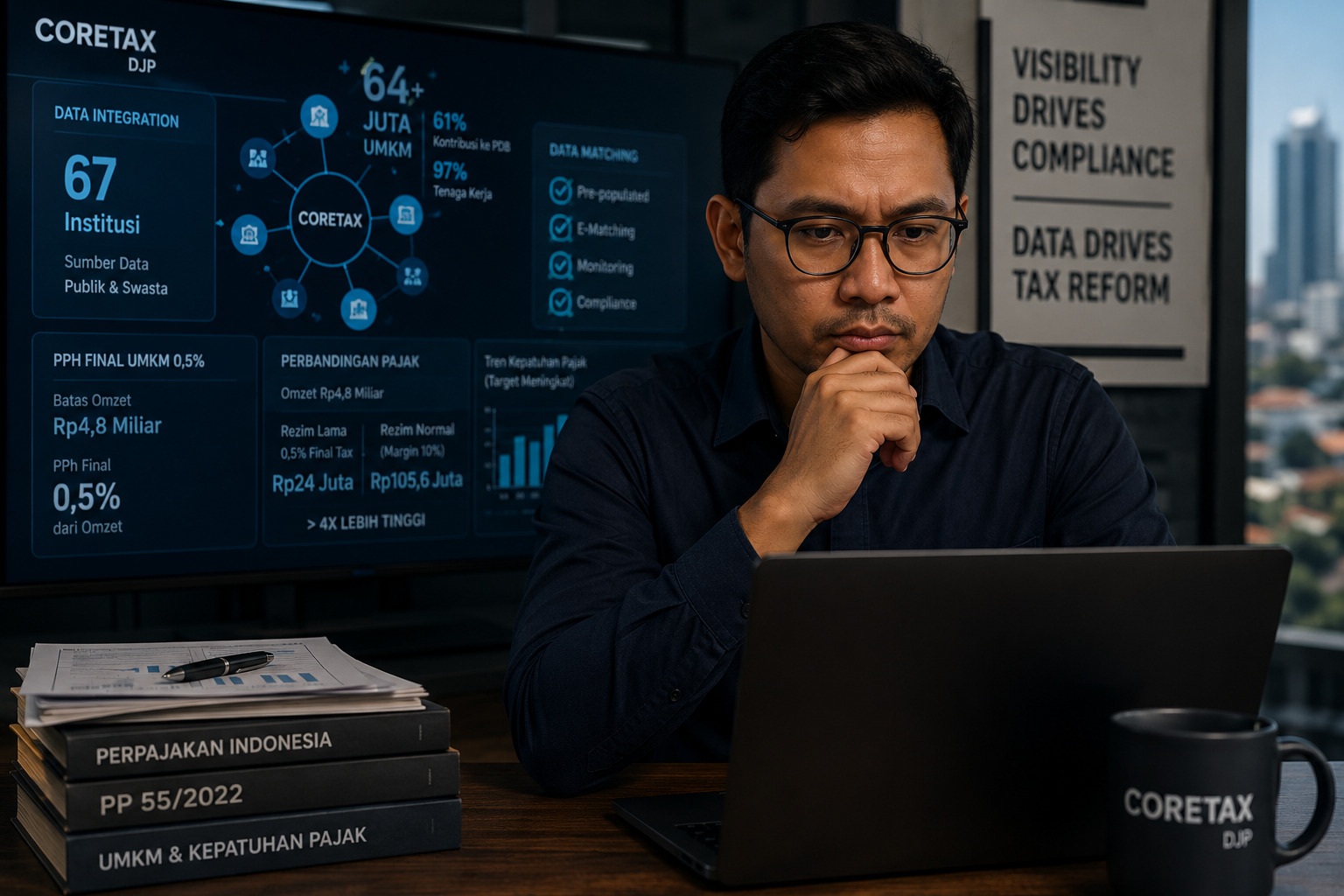
Indonesia’s tax story is shifting from a conversation about rates to a conversation about visibility. The real issue is no longer whether small businesses are paying 0.5% or 22%. The real issue is whether the state can finally see the businesses that have long lived in the space between micro-enterprises and large corporations, profitable enough to matter, but fragmented enough to stay out of sight.
That is why the current moment matters. Under PP 55/2022, the government kept the simplified PPh Final 0.5% regime for taxpayers with annual turnover below Rp4.8 billion, but limited the duration of the facility by taxpayer type. Individual taxpayers can use it for up to 7 years, CVs and other non-PT bodies for 4 years, and PTs for 3 years. The regulation’s stated purpose is not just collection, it is also legal certainty, administrative simplification, convenience, and fairness.
For many businesses, the important date is already here. DJP says the PPh Final 0.5% facility for individual UMKM taxpayers who started in 2018 ended in January 2026. For those who remain within the time limit, the facility still exists; for others, the move is toward normal income tax treatment and fuller bookkeeping. That makes this not a one-day tax shock, but a phased transition into a more formal tax regime.
The Real Test is Not The Rate. It is The Data.
Coretax is what changes the enforcement equation. DJP says 2026 is the first year annual filing is done through Coretax for the 2025 tax year, and that the system uses prepopulated data so taxpayers do not need to manually type in every figure from scratch. DJP also says Coretax brings stronger integration, e-matching, and a broader data environment that improves the quality of the return.
This matters because tax administration is increasingly a data-matching problem, not just a filing problem. DJP says Coretax is part of the broader PSIAP modernization program, and it has also described a system where data from many sources can be validated, matched, and prefilled. In one official DJP explanation, the authority said it receives data from 67 institutions, public and private, that can support matching and compliance work.
That is the hidden shift in the current policy cycle. The missing middle is not necessarily hiding in plain sight because of one single loophole. It is often hidden because it is operationally fragmented: multiple entities, thin books, mixed personal and business cash flows, and reporting habits built around simplicity rather than precision. Coretax, by design, reduces that space. DJP explicitly says the platform cuts manual input and even reduces direct compliance costs such as transport and printing.
For founders and finance teams, the implication is clear: the tax authority is no longer asking only, “Did you file?” It is increasingly asking, “Does the data across your filings, third-party reports, and payment trail actually reconcile?” That is a very different compliance environment.
Why The Missing Middle Will Feel The Pressure First
The economic pressure point is where turnover-based simplicity ends and profit-based taxation begins. Under the current rules, the 0.5% regime is easy to understand: at Rp4.8 billion of annual turnover, the tax is Rp24 million. But once a business moves into the normal corporate tax regime, the burden becomes tied to profit, and the headline rate is 22% for corporate taxpayers. At a 10% net margin, the tax bill would be Rp105.6 million, more than four times the final-tax bill. The breakeven margin is only about 2.27% of revenue.
That spread explains why the issue is not merely technical. It changes business behavior. Companies with healthy margins will feel a sharper jump in tax burden. Businesses with thin margins may actually prefer the normal regime because tax is calculated on profit, not gross revenue. Either way, the old comfort zone of staying small and informal becomes less attractive when the compliance system becomes more complete.
The macro context makes this more consequential. Indonesia’s UMKM sector is not a side story; it is the backbone of the economy, with more than 64 million businesses and a contribution of roughly 61% of GDP and 97% of jobs. A policy that nudges even a fraction of that base into better records, more formal structures, or higher tax compliance can move the country’s revenue architecture over time.
For policymakers, the wager is that a more visible tax base will eventually mean a stronger one. For business owners, the wager is that better bookkeeping, cleaner entity structures, and more disciplined reporting will be the price of growth. For investors, the signal is that Indonesia is entering a phase where the tax system is less tolerant of blurred lines between micro enterprise and scaled business.
That is why Coretax’s first real test is so important. If the system can identify fragmented businesses, align third-party data, and make non-compliance more visible, then Indonesia is not just digitizing tax administration. It is building the infrastructure to tax the missing middle. And in a country where UMKM dominate the economy, that is not a niche reform. It is a structural one.
References:
- PP 55/2022 (official legal database).
- DJP: UMKM rights and obligations under PP 55/2022.
- DJP: 0.5% UMKM tax duration and 2025/2026 transition.
- DJP: Coretax and UMKM filing in 2026.
- DJP: Coretax prepopulated, e-matching, and first full-data SPT cycle.
- DJP: Coretax reduces direct compliance cost.
- DJP: data matching and third-party data environment.
- DJP: corporate income tax rate 22%.
- Government data on UMKM scale and macro contribution.
- Illustrative tax calculations.
