





 Tuesday, 20-10-26








Indonesia’s startup funding market is still feeling the weight of the global tech winter, but one of the country’s biggest financial inclusion players is trying to make the road easier for founders. Amartha has launched a Founder-Investor Matchmaking program as part of The 2026 Asia Grassroots Forum, creating a direct channel between Indonesian startups and international investors at a moment when capital is harder to secure than it was just a few years ago. RM.id reported that startup funding in Indonesia reached only US$355.7 million in 2025, far below the roughly US$6.9 billion recorded in 2021, showing how sharply the funding climate has tightened.
The move matters because early-stage founders do not just need money. They need validation, market access, and a credible network that can help them scale. That is exactly what Amartha says this program is designed to provide. By combining the Founder-Investor Matchmaking session with the Gamechanger Series and the broader Asia Grassroots Forum, the company is trying to create a structured environment where promising startups can be seen, tested, and funded more efficiently.
Why Founder-Investor Matchmaking Matters In A Tight Funding Market
The current funding environment explains why this initiative is timely. RM.id noted that Indonesia’s startup financing landscape remains under pressure because of the global tech winter, weaker governance in some startups, and a persistent gap between product promises and market needs. In practical terms, that means many founders are still building strong solutions, but fewer investors are willing to deploy capital without clearer proof of traction.
That is where Founder-Investor Matchmaking becomes valuable. The format lowers the friction that often blocks startup fundraising. Instead of cold outreach, long email chains, or random conference introductions, founders get direct, pre-arranged one-on-one access to investors who are already interested in the ecosystem. Amartha says the forum will pair 80 selected startups with 40 global investors in one-on-one meetings.
This is not just a networking event dressed up as a summit. It is a deliberately structured fundraising mechanism. The session is part of a larger forum that expects more than 500 participants from government, venture capital, startups, academia, and civil society. That scale matters because fundraising often happens in ecosystems, not isolated meetings. The more aligned the players are around one event, the easier it becomes for capital to move toward credible founders.
Amartha’s own positioning makes the strategy even clearer. The company says many startups in Indonesia have useful innovations, but still need collaboration, validation, and funding to become sustainable businesses. In that sense, Founder-Investor Matchmaking is meant to be a bridge between innovation and capital, especially for startups that solve real problems in financial health, community development, and grassroots commerce.
How The Gamechanger Series Extends The Funding Pipeline
The Founder-Investor Matchmaking session is only one part of a broader system. Amartha also introduced the Gamechanger Series, which it developed with KUMPUL Impact. According to RM.id, this initiative is designed to help startups co-create, test, and implement solutions that have direct impact on MSMEs and grassroots communities. That means the program is not limited to pitch decks and slide presentations. It also includes workshops, pilot projects, and showcase sessions.
This is an important distinction. In many startup ecosystems, funding events reward storytelling more than execution. Gamechanger Series tries to reverse that logic by adding an implementation layer before or alongside investor introductions. KUMPUL says its role is to help entrepreneurs grow through inclusive programs, strong connections, and networking opportunities, while KUMPUL Impact focuses on early-stage entrepreneurs and local communities.
That makes the Founder-Investor Matchmaking session more credible. Investors are not only meeting founders who can sell an idea. They are also seeing founders who have gone through co-creation and field testing. In the current market, that can be a major advantage. When capital is scarce, investors want evidence that a startup can solve a real problem, survive in the field, and scale without depending on hype.
Amartha and KUMPUL are effectively building a two-stage pipeline. First, startups are challenged to prove practical relevance through the Gamechanger Series. Then, the strongest teams move into Founder-Investor Matchmaking and face direct conversations with capital providers. That structure increases the odds that meetings lead to serious follow-up, not just polite introductions.
What Startups Can Gain From The Asia Grassroots Forum
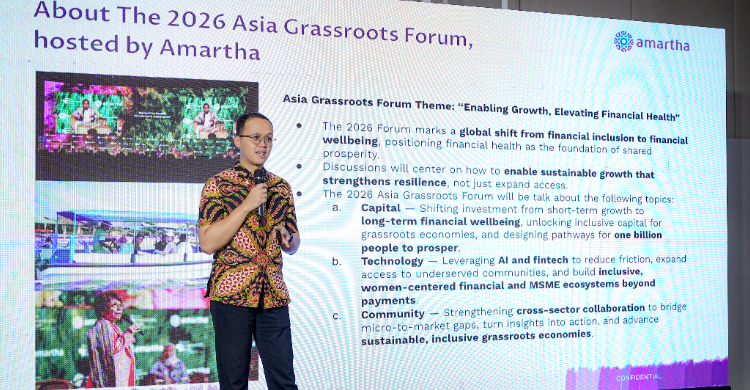
The 2026 Asia Grassroots Forum, hosted by Amartha, is shaping up as more than a conference. The forum will take place on June 3 and 4, 2026, at Shangri-La Jakarta under the theme “Enabling Growth, Elevating Financial Health.” Amartha says the event will bring together more than 500 participants, including investors, policymakers, startups, academics, and civil society groups.
For startups, that environment creates visibility. A founder can take part in the Founder-Investor Matchmaking session, but also benefit from the broader audience, including strategic partners and ecosystem builders. That matters because startup fundraising is rarely only about one conversation. It is about repeated exposure, reputation building, and trust accumulation across a network.
The forum also has a clear mission around financial health. Amartha says it works with rural women-led MSMEs across Indonesia, and the forum is designed to support broader grassroots prosperity. That connection is important because it gives the Founder-Investor Matchmaking session a more specific policy and social context. It is not just about funding digital startups. It is about supporting businesses that can improve financial access and economic resilience at the community level.
This is the kind of ecosystem framing that investors often appreciate. A startup is more compelling when it sits inside a visible network of validated demand, social relevance, and active partners. The forum’s agenda includes roundtables, workshops, field trips, and the Founder-Investor Matchmaking program, which suggests a serious attempt to connect capital with execution rather than speculation.
Why This Could Help Indonesia’s Startup Ecosystem Mature
Indonesia’s startup ecosystem has already gone through a major correction. The question now is not whether there will be another boom immediately, but whether the ecosystem can become healthier, more disciplined, and more connected to real market demand. That is why the Founder-Investor Matchmaking program is interesting: it reflects a shift from growth at all costs toward relevance, validation, and sustainable fundraising.
That shift is healthy. Startups that can survive a tighter funding market tend to become more resilient businesses later. Investors also benefit because they spend less time filtering noise and more time engaging with founders who have already demonstrated traction. If the Founder-Investor Matchmaking model works, it could become a template for future startup capital programs in Indonesia and the wider region.
The event may also help correct a common problem in emerging markets: too many promising founders do not get enough exposure to the right capital providers. A structured Founder-Investor Matchmaking session can reduce that asymmetry by giving investors a curated pipeline and giving founders a better chance to tell their story in a focused setting. That kind of matchmaking is often the missing link between a good product and a scalable company.
KUMPUL’s broader ecosystem role also matters here. As an innovation and ecosystem enabler, it has built programs that help entrepreneurs overcome access barriers and move toward growth. Combined with Amartha’s financing network and social impact focus, the Founder-Investor Matchmaking model could become one of the more practical examples of how private-sector platforms can support startup growth without relying only on large institutional funding rounds.
Conclusion
Amartha’s Founder-Investor Matchmaking initiative arrives at the right time for Indonesia’s startup scene. Funding remains tight, investor caution is high, and founders need more than visibility. They need structured opportunities to show that their businesses solve real problems and can scale responsibly.
By combining the Gamechanger Series, KUMPUL Impact’s ecosystem support, and the Asia Grassroots Forum, Amartha is building a more thoughtful pathway from innovation to capital. If the program succeeds, it could give more Indonesian startups a better shot at meeting the right investors and turning strong ideas into durable businesses.
Read More