


 Monday, 26-10-26


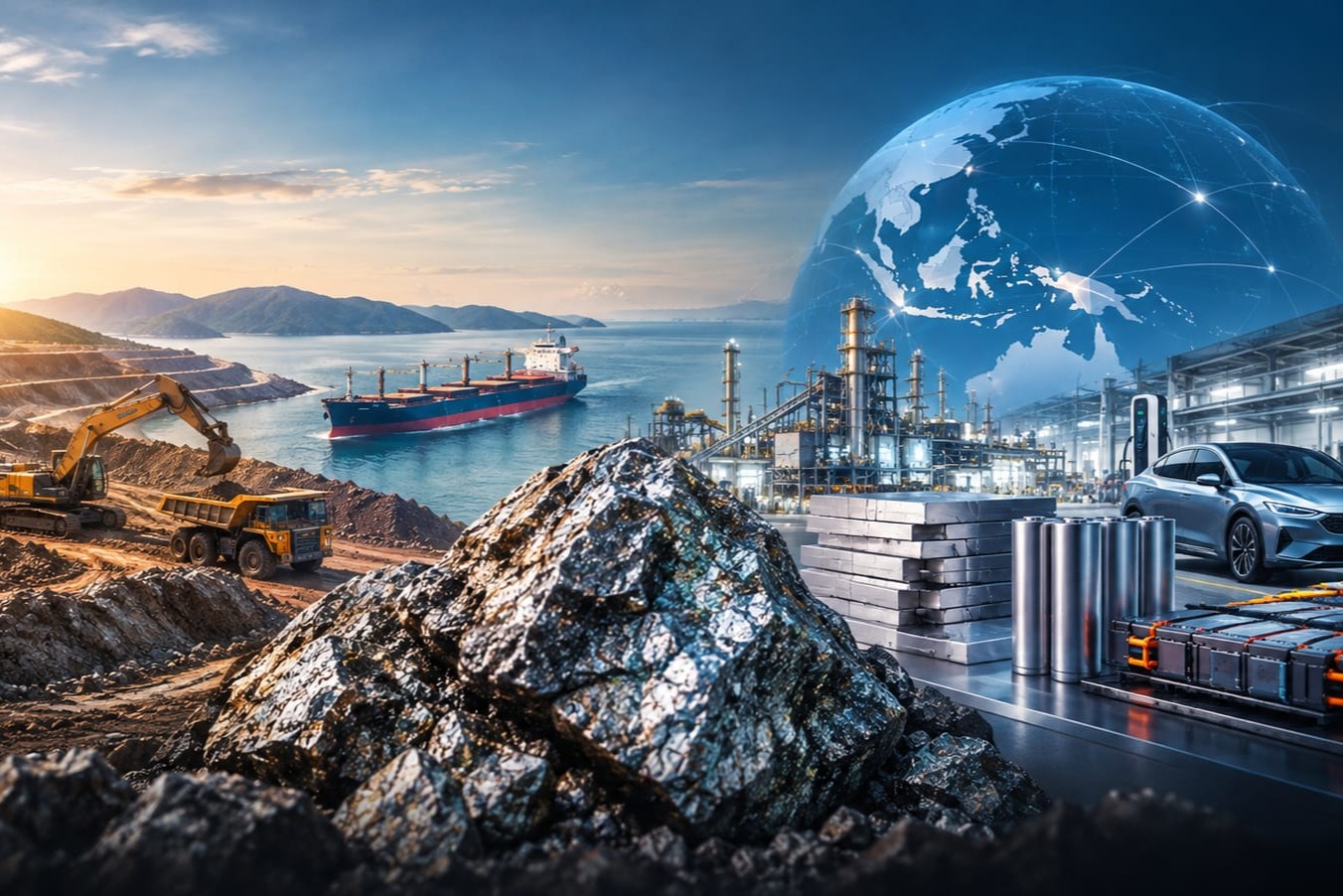
Indonesia has become a major centre of global nickel production and processing. Yet as the country attracts foreign capital and expands its industrial capacity, a bigger question is emerging: how much of the economic value generated by its nickel industry does Indonesia actually control?
The country’s downstreaming strategy has changed the way nickel is processed and traded. However, ownership, access to technology, and control over global supply chains remain important factors in determining who benefits from the industry’s growth.
Pasted text.txt
How Indonesia’s Nickel Industry Became a Global Processing Hub
For years, Indonesia exported nickel ore as a raw material for processing elsewhere. The government changed this approach by banning nickel ore exports and requiring companies to process the resource domestically, encouraging investment in smelters, industrial parks, and facilities producing materials for batteries and other industrial applications.
The policy has helped transform Indonesia from a raw-material supplier into a major processing centre. The CREA–CELIOS report, published on February 20, 2024, describes how the export ban introduced in 2020 reshaped the geography of Indonesia’s metal-processing industry, with major industrial clusters developing in Central Sulawesi, Southeast Sulawesi, and North Maluku.
ID-CREA_CELIOS-Indonesia-Nickel-Development-compressed.pdf
The export figures illustrate the scale of this shift. According to the CREA–CELIOS report, the value of Indonesia’s nickel product exports increased from approximately US$4 billion in 2017 to US$34 billion in 2022, an 8.5-fold rise. The growth reflects the expansion of domestic processing and the increasing role of nickel products in international industrial supply chains.
ID-CREA_CELIOS-Indonesia-Nickel-Development-compressed.pdf
Nickel has also become increasingly important because of its use in stainless steel and battery-related industries. The downstreaming strategy aims to capture more value domestically by processing the resource before it reaches international markets, rather than relying primarily on exports of unprocessed ore.
However, higher export values do not, by themselves, establish how much income remains in Indonesia, how much domestic companies control, or how effectively the benefits reach local communities.
North Maluku illustrates this distinction. A CNA report on the region described economic growth rising from 6% in 2019 to 23% in 2022, amid the expansion of nickel processing and foreign investment. Yet the report also highlighted concerns that the benefits were not being widely felt by local residents.
Pasted text (2).txt
Foreign Investment and Ownership Shape the Nickel Boom
Indonesia’s downstreaming strategy has attracted substantial foreign investment, including capital from China. According to the Netralnews article citing Indonesia’s investment authorities, total realized investment in Indonesia reached IDR 1,931.2 trillion in 2025. The article also reported that downstreaming investment grew by 43.3% year on year and that foreign direct investment accounted for 73.5% of realized investment in the sector.
Pasted text.txt
The same article put China’s investment in Indonesia at approximately US$7.5 billion in 2025. It identified companies involved in the nickel industry, including Tsingshan, Zhejiang Huayou Cobalt, Lygend Resources, GEM, CNGR, and companies connected with CATL.
Pasted text.txt
Tsingshan, for example, has established a significant presence in the Indonesia Morowali Industrial Park (IMIP), which has developed into a centre for nickel processing and stainless steel production. Other companies have moved into the processing of materials used in electric vehicle batteries.
These investments bring capital, production capacity, technology, and connections to international markets. They also help establish industrial facilities that would be difficult to develop without substantial funding and technical expertise.
But investment and ownership are not the same thing. The Netralnews article, citing an OECD report, states that Indonesian companies account for less than 10% of domestic nickel production, while Chinese-owned companies control around 40%. These figures suggest that Indonesia’s position as a leading production location does not automatically mean that domestic companies control a comparable share of the industry.
Pasted text.txt
The distinction matters because multinational companies can draw on resources beyond the facilities they operate in Indonesia. Their capital, technology, production networks, information, and access to global markets can influence their position in commercial negotiations.
Indonesia also brings significant advantages to the relationship. It provides nickel resources, industrial locations, labour, and regulatory authority. The relationship is therefore one of interdependence, although the two sides may not have equal capabilities or bargaining power.
For policymakers and business leaders, the central question is not simply how much foreign investment enters the country. It is whether that investment also strengthens domestic companies, builds local expertise, and creates capabilities that remain in Indonesia over the long term.
The Value Chain Challenge: Moving Beyond Smelting
Indonesia’s nickel industry has moved beyond the export of raw ore, but processing is only one stage in a much larger industrial chain.
Nickel can move from mining to smelting, intermediate products, battery materials, batteries, and eventually electric vehicles. Companies that participate in multiple stages can establish stronger links between raw materials, manufacturing, and end markets.
The Netralnews article cites research from Carnegie Endowment on Chinese investment in IMIP, noting that this investment has helped Indonesia move further into the nickel and electric vehicle value chain. At the same time, the article highlights the risk of a “midstream trap”: a country may expand processing and production without developing sufficient capabilities in higher-value parts of the industry.
Pasted text.txt
These higher-value activities include technology development, product design, advanced manufacturing, financing, distribution, branding, and access to markets. If companies based overseas retain control over many of these functions, Indonesia may remain heavily involved in production without gaining equivalent influence over the broader value chain.
The challenge is not that foreign companies operate in Indonesia. Foreign investment can help accelerate industrial development by providing capital, technical expertise, and access to established production networks.
The more important question is what domestic capabilities emerge from that investment. Technology transfer, skilled workers, stronger Indonesian suppliers, and the ability of local companies to participate in more complex manufacturing processes are among the factors that can determine whether downstreaming delivers lasting benefits.
The experience of North Maluku also shows why industrial growth and local prosperity should not be treated as interchangeable. In the CNA report, Sultan of Tidore Husain Alting Sjah questioned whether the region’s rapid economic expansion had translated into broader improvements for residents.
“The resources are here, but the benefits are not… what is visible here are only smelters and newcomers. We welcome investment, but it is far more important for the people to prosper,” he told CNA.
Pasted text (2).txt
The observation highlights a wider issue for resource-rich regions: the presence of large industrial facilities and rapid economic growth does not, on its own, show how widely the gains are distributed.
For Indonesia’s nickel industry, moving further up the value chain therefore involves more than adding processing capacity. It also requires building domestic expertise and strengthening the position of Indonesian companies within the industry.
Nickel Quotas and the Question of Indonesia’s Bargaining Power
Indonesia’s government retains important policy tools that can influence the nickel industry. The Netralnews article reports that in 2026, the government reduced nickel ore production quotas to help balance supply and prices, affecting smelters that rely on domestic ore for their operations. It also notes that companies raised concerns about production policy, taxes, royalties, and other regulations that could affect their businesses.
Pasted text.txt
These developments illustrate the relationship between government policy and corporate interests. Smelters require reliable access to raw materials, while the government has authority over production quotas, permits, exports, taxation, and other regulatory measures.
That authority gives Indonesia tools to influence the conditions under which the industry operates. However, regulatory power alone does not guarantee that the country will capture a greater share of economic value. The outcome also depends on how effectively policy encourages technology transfer, strengthens domestic suppliers, and improves the capabilities of local businesses.
The Netralnews article argues that foreign investment should not be viewed as inherently harmful or as something Indonesia must avoid. The country needs capital, technology, and connections to global production networks to develop its industrial base. The challenge is to ensure that these investments support national economic objectives rather than leaving domestic industry dependent on external companies for key capabilities.
Pasted text.txt
For business leaders and policymakers, this makes the next stage of downstreaming a question of industrial development as much as resource management. The performance of the nickel industry will not be measured only by the number of smelters built, the volume of nickel processed, or the investment attracted, but also by the capabilities Indonesian companies and workers gain as the industry expands.
This article is a summary of several original articles. The full versions can be read at the following links:
https://www.netralnews.com/nncbisnis/indonesia-punya-nikel-tetapi-siapa-yang-menguasainya
This article was created with AI assistance.
We make every effort to ensure the accuracy of our content, some information may be incorrect or outdated. Please let us know of any corrections at [email protected].
Read More