


 Tuesday, 27-10-26


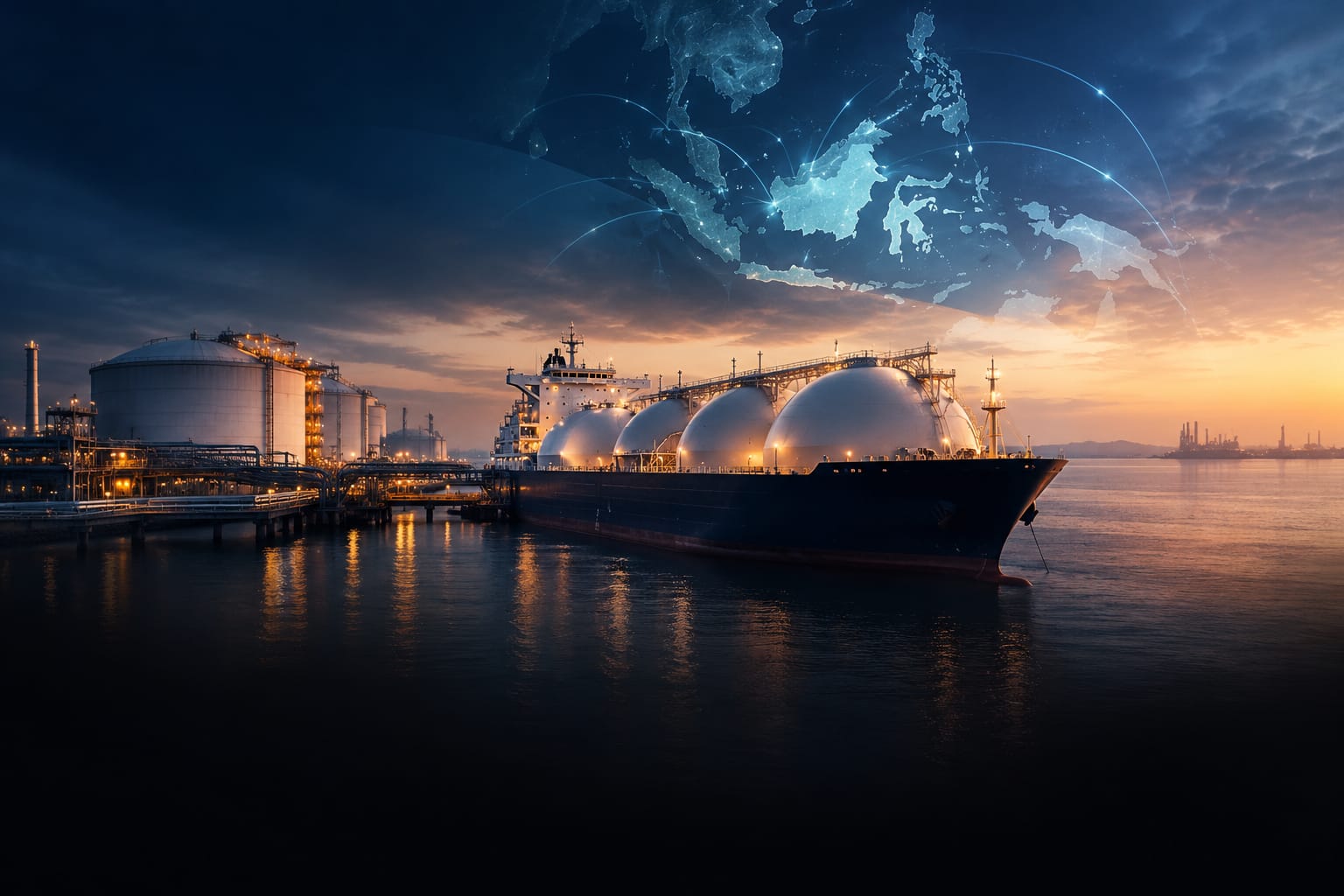
Southeast Asia’s demand for liquefied natural gas (LNG) is continuing to expand despite disruptions in global energy markets, but rising dependence on the fuel is also exposing the region to price volatility and infrastructure constraints.
Industry players and analysts told The Business Times that LNG is expected to remain an important part of Southeast Asia’s energy mix as countries face growing power demand, declining domestic gas production and the need to support renewable energy.
Leong Wei Hung, CEO of gas terminal operator Singapore LNG Corp (SLNG), described LNG as a “mainstay of the region’s energy mix for years to come”.
Lee Rou Urn, Asia LNG pricing analyst at Argus, similarly said the fuel “will very much remain a key part of South-east Asia’s energy mix as it is still the cleanest and most widely available fossil fuel”.
Southeast Asia LNG Demand Set to Accelerate
Southeast Asia is developing 70 million tonnes per annum (MTPA) of LNG import capacity, alongside more than 100 gigawatts (GW) of gas-fired power generation capacity, according to a report by US think-tank Global Energy Monitor.
Demand is also expected to rise rapidly. Fadhlullah Omarali, principal analyst for gas and LNG markets at Wood Mackenzie, expects Southeast Asia’s LNG demand to grow by more than 20 per cent year on year in 2026.
The region is then expected to record average annual LNG demand growth of 10 per cent over the following three years.
S&P Global Energy has a similarly positive outlook for imports, with principal analyst for South-east Asia gas research Amanda Kang expecting regional LNG imports to increase by more than 10 per cent year on year in 2027.
The growth is being supported by several factors rather than a single source of demand.
Data Centres Are Only Part of the LNG Demand Story
Data centres are among the most visible drivers of rising electricity demand in Southeast Asia. KPMG forecast last year that the region’s data centre capacity could triple by 2030.
LNG has become an important consideration for the sector because gas can provide baseload power. Mahadzir told reporters on the sidelines of the Gastech industry conference in Thailand in mid-September that LNG is “top of mind” for the industry as a baseload source of power.
However, Wood Mackenzie’s Omarali said energy-intensive data centres are “only part of the picture”.
Strong economic and population growth are also increasing the region’s overall energy requirements. At the same time, declining domestic gas production is pushing some countries towards imports.
Malaysia and Indonesia, for example, are turning to LNG imports to compensate for falling domestic gas production, according to S&P Global Energy’s Kang.
Kang said LNG is expected to remain critical for decades as Southeast Asian countries pursue a dual-track strategy of expanding renewable energy while using gas to replace coal.
Climate change is also affecting the region’s power requirements.
Thailand, Vietnam, Laos and Cambodia have traditionally relied on hydropower, but increasingly unpredictable weather patterns are encouraging these countries to use LNG for firming generation, according to Argus’ Lee.
This refers to the role of gas as a backup source of power when renewable generation is unavailable or insufficient.
Thailand is expected to record the region’s highest LNG import growth in 2026, with an increase of close to 3 million tonnes, according to Omarali. The growth is expected to come as gas demand in the power sector rises to offset a shortfall in coal generation.
Vietnam, meanwhile, is expected to record the strongest year-on-year percentage growth. The country only began importing LNG in 2023, and its first LNG-fired power plant started commercial operations in January.
Petronas Expands LNG Capacity as Regional Demand Rises
The expected growth in demand is also encouraging upstream companies to expand production.
Malaysia’s Petronas currently has about 40 MTPA of LNG capacity worldwide and aims to increase that figure to 55 MTPA by 2035.
The company plans to achieve the expansion by increasing production capabilities in East Malaysia and Canada.
Ezran Mahadzir, Petronas’ vice-president of LNG marketing and trading, said the company remains optimistic about the long-term fundamentals of LNG.
“In the long run, the fundamentals (of LNG) are strong enough for us to further invest in capacity,” he said.
Canada is becoming an increasingly important part of Petronas’ production strategy. Rosdi Ab Rahman, CEO of Petronas LNG, has described Canada as the company’s “new heartland” for production.
The expansion comes as Southeast Asian countries increase their LNG import capacity and prepare for higher gas demand.
However, stronger reliance on LNG also creates greater exposure to international energy market disruptions.
LNG Price Volatility Creates New Energy Risks
The latest LNG crisis is the second major disruption in four years, following the market turmoil in 2022 after Russia’s invasion of Ukraine.
In 2026, the continued closure of the Strait of Hormuz has disrupted 20 per cent of global LNG flows, according to the source.
The disruption has forced several Southeast Asian countries to introduce energy-saving work-from-home mandates and increase their reliance on alternative suppliers, including Australia and the US.
The impact is also visible in regional prices.
Asian spot LNG prices averaged US$17.50 per million British thermal units (MMBtu) in Q2 2026, representing a 45 per cent increase year on year, according to the Global Energy Monitor report.
Higher LNG prices could create immediate affordability pressures for emerging economies, Leong said.
“For cost-sensitive power systems, higher LNG prices can also increase the economic incentive to fall back on cheaper, more carbon-intensive coal, complicating Asean’s broader decarbonisation objectives,” he added.
Petronas’ Mahadzir acknowledged that the short-term impact of the crisis has been “very difficult, very up-and-down” for the industry.
Asked to forecast LNG prices, he said: “I don’t think anybody in this world today will be able to tell you how long this volatility is going to last.”
The challenge is particularly significant for emerging economies with limited capacity to absorb external economic shocks.
Sam Reynolds, research lead at the Institute for Energy Economics and Financial Analysis, noted that major LNG growth markets are often countries with less ability to mitigate economic shocks and fewer foreign exchange reserves.
At a webinar on September 10, he questioned whether policymakers should link national energy development plans to a fuel whose prices can be highly volatile.
Infrastructure and Energy Transition Complicate LNG Investments
Price volatility is not the only constraint on Southeast Asia’s LNG expansion. Infrastructure gaps and supply chain problems could also limit the region’s ability to translate demand growth into new gas-fired power capacity.
A Wood Mackenzie report in August forecast that Southeast Asia may deliver less than one-third of its planned gas-fired power capacity by 2030.
The report identified volatile fuel costs, equipment shortages, financing issues and infrastructure bottlenecks as constraints.
The shortage of gas turbines is another major obstacle. Reynolds said the global gas turbine industry is dominated by just three manufacturers, creating a significant barrier to meeting Southeast Asia’s LNG-related power needs.
Gas turbine wait times can extend to six years, he said.
Equipment costs are also increasing. A separate Wood Mackenzie report from April expects gas turbine prices to reach US$600 per kilowatt by the end of 2027, nearly three times their 2019 level.
For SLNG’s Leong, logistics rather than gas supply is currently the most immediate bottleneck.
“Supply exists, but the constraint is getting it to where it is needed, at a time when shipping routes, vessel availability and freight costs are all reacting to disruptions,” he said.
These challenges are adding to calls for Southeast Asian countries to balance LNG investment with greater diversification into renewable energy.
Laurent Nery, head of market analysis for supply and energy management at French energy group Engie, views LNG as a complement rather than a competitor to renewables.
He pointed to green energy using domestic feedstock, including biomethane, as a potential hedge against future geopolitical crises. Biomethane can be used interchangeably with fossil-derived natural gas in power plants and can be produced from organic materials such as agricultural waste.
However, the long-term role of LNG remains uncertain.
Kang of S&P Global Energy said faster-than-expected development of renewable energy, battery storage, nuclear energy and grid improvements could eventually displace gas.
Arun Kumar, strategic advisor for power markets and technology innovation at Asia Research and Engagement, said falling renewable and battery storage costs should also be considered when evaluating LNG projects.
He argued that LNG project risk assessments should account for the possibility of supply disruptions through international chokepoints.
For ASEAN governments and market players, the challenge is to develop enough flexible gas infrastructure to strengthen energy resilience without creating assets that could become underutilised as renewable and other lower-carbon energy sources expand.
SLNG’s Leong said governments and market players must make difficult investment choices as the energy transition continues to evolve.
This article was created with AI assistance.
We make every effort to ensure the accuracy of our content, some information may be incorrect or outdated. Please let us know of any corrections at [email protected].
Read More