





 Saturday, 24-10-26








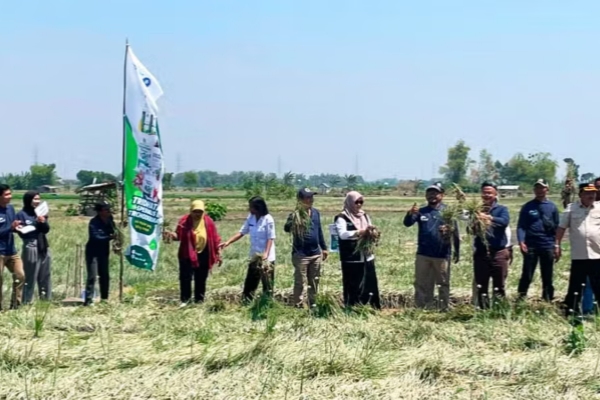
TrichoMeta Thanos, a Trichoderma innovation developed by IPB University-supported startup Planteria, increased shallot productivity by around 40 percent in a demonstration plot in Nganjuk, East Java, while also reducing chemical fertilizer use by 40 percent and improving soil fertility. (12/08)
Planteria’s Trichoderma Trial Raises Shallot Productivity by 40%
The Trichoderma application was carried out on a 7,135.2-square-meter shallot demonstration plot involving eight farmers.
Planteria CEO Bambang Sutrisno said the harvest results showed that TrichoMeta Thanos could increase shallot productivity by around 40 percent, improve soil fertility, and reduce the use of chemical fertilizers by 40 percent.
The results were presented during the Harvest Festival and Field Day of the Trichoderma demonstration plot in Nganjuk, East Java.
“We hope that all parties in Nganjuk can collaborate to increase the production and welfare of shallot farmers through the application of appropriate technology,” Bambang said.
TrichoMeta Thanos Supports Lower Chemical Fertilizer Use
The Trichoderma innovation is part of the downstream development of research by Planteria in collaboration with lecturers and researchers from IPB University.
The program was carried out through the PRIME STeP Startup Business Incubation Program of the Institute for Agromaritime Development and Innopreneurship Acceleration (LPA2I) at IPB University.
Planteria underwent a three-year incubation process at LPA2I IPB through the PRIME STeP program.
The Trichoderma innovation developed by Planteria is aimed at reducing the use of chemical fertilizers while increasing agricultural productivity.
IPB University Develops Agricultural Research Through Startups
LPA2I IPB University Head Dr. Handian Purwawangsa said the activity was a practical example of bringing university research into wider use.
According to Handian, innovation should not stop at the research stage but needs to be implemented to address real problems in the field.
“At present, LPA2I IPB University supports around 72 startups through bootcamps, coaching, mentoring, and business matching to encourage the development of innovations that have an impact on society,” Handian said.
Handian also said he was committed to strengthening the branding of Nganjuk shallots to increase their added value and market competitiveness.
The Trichoderma application will continue to be tested to strengthen evidence of the benefits of the innovation. LPA2I also supports the development of economically valuable rotational commodities such as edamame soybeans.
Nganjuk Highlights Challenges for Shallot Farmers
Nganjuk Regent Dr. H. Marhaen Djumadi welcomed the collaboration between IPB University and Planteria in supporting agricultural development in the region.
He said shallots and soybeans are priority commodities in Nganjuk. He also highlighted fluctuations in shallot prices caused by abundant supply arriving at the same time.
He said planting patterns and harvest timing need to be managed, along with stronger cooperatives, access to financing, and delayed-selling strategies for farmers.
“Farmers have practical land, but they need knowledge and research results from universities, as demonstrated by Planteria through the use of Trichoderma, which can reduce the use of non-organic fertilizers while increasing production,” Marhaen said.
The activity was attended by LPA2I's Business Incubation Assistant and team, the head of the Nganjuk Agriculture Office, the Rejoso subdistrict head, agricultural field extension officers from the Rejoso Agricultural Extension Center, the head of Mojorembun Village, neighborhood representatives, and farmer group representatives.
The activities included a visit to the demonstration plot, a symbolic harvest, and discussions with farmers.
LPA2I IPB University and Planteria will continue to encourage wider application of Trichoderma technology as an environmentally friendly agricultural innovation to increase productivity, reduce dependence on chemical inputs, and support farmer welfare and agricultural sustainability in Nganjuk.
PHOTO: IPB
This article was created with AI assistance.
We make every effort to ensure the accuracy of our content, some information may be incorrect or outdated. Please let us know of any corrections at [email protected].
Read More