





 Friday, 02-10-26








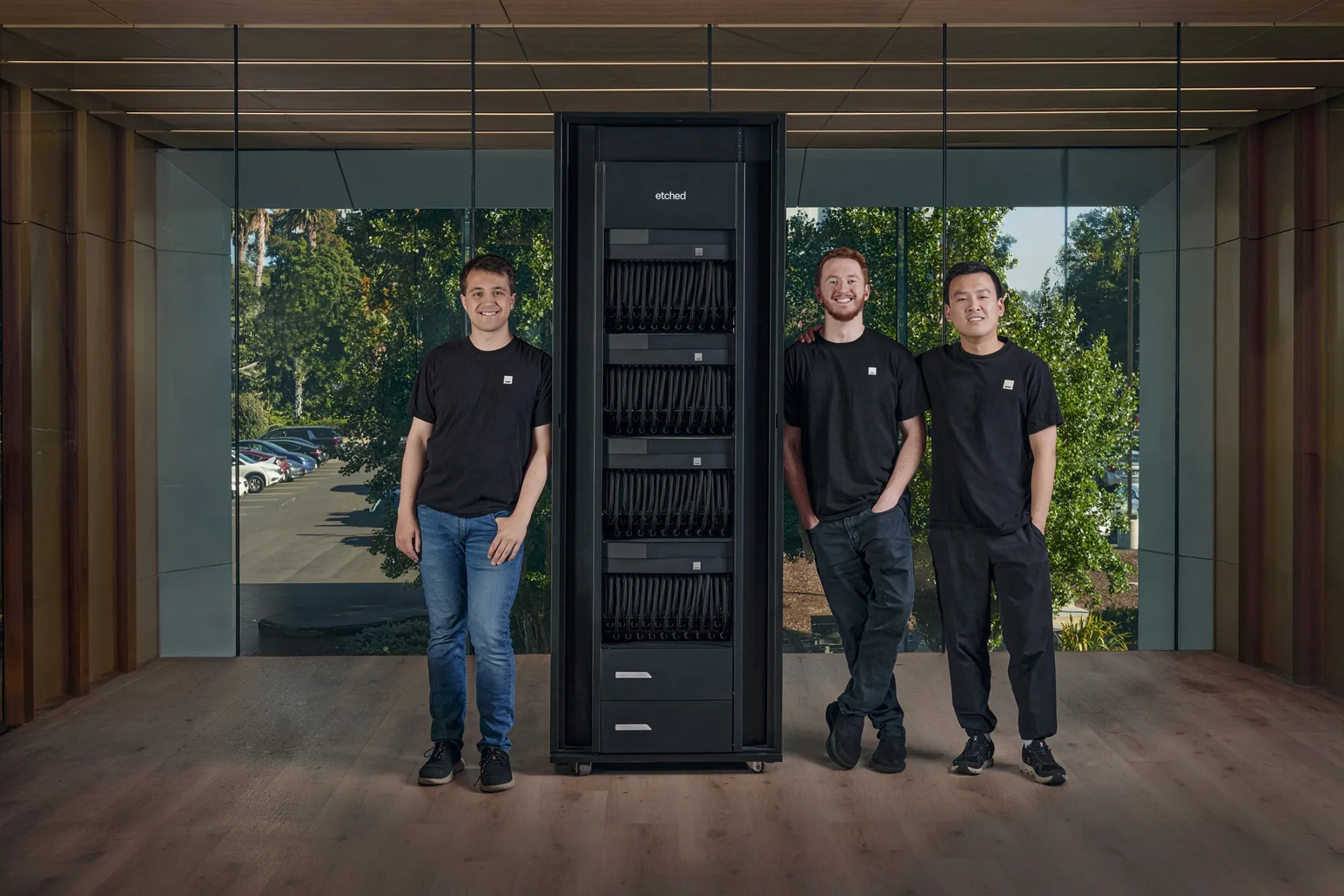
Etched has turned a long-shot thesis into one of the most closely watched stories in AI hardware. The company, which positions itself as a direct challenger to Nvidia in inference silicon, says it has already secured more than $1 billion in customer contracts, raised a total of $800 million, and reached a $5 billion post-money valuation in a financing round closed in December. TechCrunch reported the company’s latest progress update on June 30, 2026, while Etched’s own press release confirmed the financing and contract figures.
That combination of valuation, contracts, and manufacturing progress is why the AI chip startup Etched story matters beyond one company. In a market where training hardware has dominated most of the attention, Etched is betting that inference will become the real bottleneck and the real profit pool. The company’s pitch is straightforward: build a purpose-built chip and full rack-scale system that can run inference faster, cheaper, and with better power efficiency than general-purpose alternatives.
Why Etched Is Drawing So Much Attention
The AI chip startup Etched narrative is compelling because it sits at the intersection of technical ambition and market timing. TechCrunch reported that the startup had TSMC successfully manufacture its chip earlier in 2026 and that Etched is now testing the product with customers. Etched says the first product is a rack-scale system it calls a frontier inference cluster, built to include chips, custom racks, and software.
That matters because the AI infrastructure market is increasingly focused on inference, not just model training. TechCrunch noted that inference is what happens after a user submits a prompt, and it is now one of the biggest bottlenecks and cost centers for AI companies serving customers at scale. Etched is betting that if it can meaningfully improve that layer, customers will pay for the advantage.
The company’s timing is also favorable. TechCrunch pointed out that investors are currently chasing AI-related chip technology, especially systems that improve inference. The same report mentioned other major milestones in the sector, including Cerebras’ breakout IPO, Groq’s new funding, and fresh custom chip activity from large cloud providers and OpenAI. In other words, Etched is not entering a quiet market. It is entering a crowded market where speed, efficiency, and execution matter.
What Etched Says It Has Built
The AI chip startup Etched is not trying to be a generalist silicon company. Etched says it is building frontier inference clusters, and its official release emphasizes full stack co-design across chips, racks, cooling, networking, and software. The company also says its systems are designed to deliver best in class throughput and latency, with a long term path to gigawatt scale.
In Etched’s telling, the product is not just a chip. It is a system. That distinction is important because many hardware startups discover that the hardest part is not proving a benchmark in isolation. It is turning a benchmark into a reliable product that can be manufactured, delivered, integrated, and operated at scale. Etched’s release says it already has a Taiwan factory, a San Jose headquarters lab, and a testing setup that brings design, validation, and production under one roof.
Etched also says its rack-scale product is already being validated with customers and that its systems are running models including DeepSeek, Qwen, Mamba, and Llama. That breadth is important because it shows the company is trying to support modern frontier workloads rather than a narrow demo environment. For an AI chip startup Etched positioning itself as an infrastructure company, that level of operational detail is a strong part of the sales pitch.
Why Investors Are Buying In
The financing backdrop helps explain why the AI chip startup Etched has captured so much attention. TechCrunch reported that the company has raised a total of $800 million to date, including a previously unannounced $500 million round that closed in December at a $5 billion post-money valuation. Etched’s press release and Bloomberg reporting, republished by Investing.com, both confirm that funding history.
The investor list is unusually dense for a young hardware company. TechCrunch said the cap table includes VentureTech Alliance, Jane Street, Hudson River Trading, Two Sigma, Ribbit Capital, Stripes, and major angel investors such as Andrej Karpathy, Geoffrey Hinton, Fei-Fei Li, Arthur Mensch, and Scott Wu. Etched’s own release adds Peter Thiel, Radical Ventures, Primary VC, and Positive Sum to that picture. That kind of backing signals that sophisticated investors believe the company’s bet on inference hardware is worth underwriting.
The reason those investors are interested is not hard to see. Etched says it already has more than $1 billion in signed customer contracts, and Bloomberg’s reporting, cited by Investing.com, says the company is currently testing its products while it prepares to ship chips to customers this summer. A startup with that much contracted demand, even before wide commercial shipment, can attract capital quickly in an AI market hungry for differentiated infrastructure.
What Makes Etched Different From Nvidia
Any story about the AI chip startup Etched inevitably raises the Nvidia comparison. But Etched is not trying to compete on the same terms as a broad GPU vendor. Instead, it is betting on specialization. TechCrunch said the startup’s systems are designed to make frontier models run inference faster, more cheaply, and with better power efficiency than rivals. Bloomberg’s coverage adds that Etched uses low-voltage inference and a memory system that combines high-bandwidth memory with SRAM.
That specialization could be a strength if inference becomes even more central to AI economics. Training gets the headlines, but inference is where businesses spend money every day when they serve users at scale. If Etched can deliver enough performance improvement to lower costs in a meaningful way, then its product may be attractive even if it is less flexible than a general purpose GPU. That is the strategic bet at the heart of this company.
The risk, of course, is that specialization can backfire if the market shifts or if customers want flexibility over raw efficiency. Hardware businesses live and die on execution. Etched has an impressive early signal, but it still has to prove that its rack-scale systems work reliably in real deployments, ship on time, and create enough customer value to justify switching costs. That is why the AI chip startup Etched story is exciting but still early.
Why The Broader Market Should Pay Attention
The broader semiconductor market should pay close attention to this company because it reflects a larger shift in AI infrastructure. Large cloud firms are already building custom chips, OpenAI has announced its own chip with Broadcom, and specialized inference hardware is becoming a serious category rather than a side bet. TechCrunch explicitly noted that hyperscalers such as Amazon, Google, and Microsoft all build their own AI chips, which shows how strategic the market has become.
Etched also represents a new kind of startup narrative. Its founders spent years arguing that specialized chips would be necessary, even when investors were skeptical. TechCrunch reported that in 2023 the company struggled to raise money, with many investors passing on the idea despite a detailed memo. That early skepticism makes the current valuation even more striking, because it shows how quickly the market’s view of AI hardware has changed.
There is a cultural lesson here as well. A lot of AI companies talk about transformation, but Etched is trying to build the physical infrastructure that makes transformation possible. The AI chip startup Etched story is not only about another big valuation. It is about whether a narrow technical thesis, executed with discipline, can become a durable platform in one of the most competitive parts of the technology stack.
What Happens Next
The next milestone is shipping. Bloomberg reporting, cited by Investing.com, says Etched plans to start shipping chips to some customers this summer, while the company is still in testing. That means the market is moving from anticipation to verification. The real test will be whether the product performs in customer environments the way it does in the company’s internal demonstrations and early validation work.
If Etched delivers, it could become one of the clearest examples of how inference specialization reshapes AI hardware competition. If it falls short, the company will become another cautionary tale about the difficulty of turning chip prototypes into scalable businesses. Either way, the AI chip startup Etched has already achieved something unusual: it has forced the market to pay close attention to a very specific vision of the AI future.
For now, the company stands in a strong position. It has capital, a high valuation, major investor support, production progress, and more than $1 billion in contracted demand. That is enough to make it one of the most important AI hardware startups to watch in 2026, especially as the industry keeps shifting from model building to model serving at scale.
Read More