





 Friday, 09-10-26








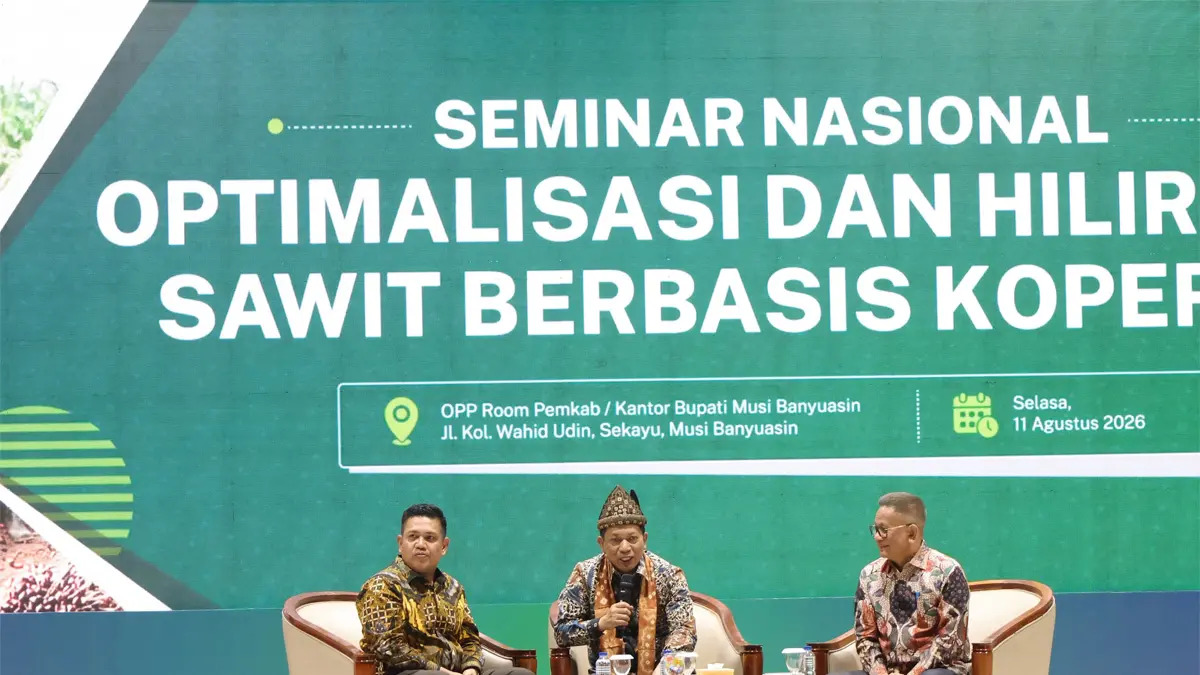
Indonesia's palm oil industry is entering a new phase as the government seeks to gain greater control over plantation assets, strengthen downstream processing, and create a more integrated agricultural ecosystem. Against this backdrop, PT Agrinas Palma Nusantara has been encouraged to study Malaysia's Federal Land Development Authority, better known as FELDA, as a potential model for managing plantations and connecting smallholders to a broader commercial value chain.
The FELDA palm oil model is being discussed at a time when Indonesia is restructuring how strategic commodities are managed. The comparison is particularly relevant because Agrinas Palma has rapidly expanded its plantation management responsibilities while the government is developing Danantara Sumberdaya Indonesia, or DSI, as a state-controlled vehicle for managing strategic natural-resource businesses and exports.
Industry observers argue that Indonesia could gain more value from its enormous palm oil resources by adopting an integrated approach similar to Malaysia's. Rather than focusing only on plantation ownership, such a structure could link farmers, estates, processing facilities, logistics, trading, financing, and downstream industries within a coordinated ecosystem.
Why FELDA Is Being Considered As A Model
FELDA was established by the Malaysian government in 1956 with an original mandate centered on land development, resettlement, and poverty reduction. Its early development programs focused heavily on oil palm and rubber cultivation, with the aim of creating productive economic opportunities for rural communities.
Over time, FELDA developed into a much broader organization. Its official history says the agency eventually placed 112,635 settlers across 317 schemes nationwide. The organization also expanded its commercial activities and created corporate entities intended to build a more complete value chain around its core activities.
That evolution is central to why the FELDA palm oil model has attracted attention in Indonesia. The system was not designed simply to distribute land. It created a framework through which rural communities could participate in a structured agricultural economy while the broader organization developed commercial capabilities.
Malaysia's experience also illustrates the potential advantages of integrating production with processing and marketing. FELDA's ecosystem has been associated with plantations, palm oil mills, logistics infrastructure, trading activities, and downstream businesses. The structure has allowed Malaysia to connect primary production with higher-value activities rather than relying exclusively on the sale of raw commodities.
For Indonesia, which remains the world's largest palm oil producer, that integrated approach could offer a useful reference as policymakers rethink the governance of the sector.
Agrinas Palma Has Become A Major State Plantation Operator
The comparison with FELDA comes as Agrinas Palma's responsibilities have expanded dramatically.
Agrinas Palma Nusantara was initially known for its role outside the traditional plantation industry. However, following the government's efforts to reclaim plantation assets associated with illegal land use and forest-area violations, the company has been given responsibility for increasingly large areas of plantation land.
Agrinas reported that it managed approximately 1.7 million hectares of plantation assets during 2025. As government assignments expanded, the total area under its management had reached about 4.11 million hectares by July 2026. The company said its 2025 plantation asset management generated an operational surplus of Rp2.86 trillion, while emphasizing that this figure was an operational surplus rather than corporate net profit.
The scale is significant. Managing millions of hectares creates challenges that go far beyond plantation operations. Agrinas needs systems for productivity management, replanting, workforce development, supply-chain coordination, processing, distribution, land governance, and commercial sales.
This is where the FELDA palm oil model becomes relevant. The question is not simply how Agrinas can manage more land. It is how the company can turn a large collection of plantation assets into a productive and sustainable economic system.
The Role Of Smallholders Will Be Critical
One of the most important elements of the proposed approach is the relationship between state-controlled plantations and smallholder farmers.
Suroto, chairman of the Strategic Socio-Economic Cadres Association, has argued that Agrinas should be integrated with smallholder farmers under a broader DSI framework. In his view, the Malaysian structure provides an example of how government institutions and commercial entities can work together while bringing rural producers into the formal value chain.
This focus is especially important for Indonesia because the palm oil sector is not dominated solely by large plantation companies. Millions of people depend directly or indirectly on the industry through smallholder farming, transportation, processing, trading, and supporting businesses.
A modern version of the FELDA palm oil model for Indonesia would therefore need to go beyond state plantation management. It would need to improve farmer access to seedlings, fertilizer, financing, agricultural technology, certification, market information, and reliable buyers.
Malaysia's current experience offers another relevant lesson. The Malaysian Palm Oil Board has been promoting Sustainable Palm Oil Growers Cooperatives, or KPSM, as a way to improve the bargaining position of independent smallholders. In April 2026, the Malaysian authorities said more than 242,000 independent smallholder families were involved in the sector across more than 866,000 hectares.
The cooperative model can help farmers sell fresh fruit bunches collectively and obtain more transparent and competitive pricing. Malaysian authorities reported that participating cooperatives had achieved prices 15% to 20% higher than conventional channels in some cases.
For Indonesia, this suggests that the lesson from FELDA is not necessarily about copying a single institution. It is about creating mechanisms that allow smallholders to become active participants in the value chain.
Indonesia Is Moving Toward Greater Integration
The discussion is also closely connected to the creation of Danantara Sumberdaya Indonesia.
DSI officially began operating in June 2026 and is expected to develop a single-gate export system for strategic commodities, including palm oil, with full implementation planned for January 1, 2027. Supporters argue that greater coordination could help the state capture more value from Indonesia's natural resources and improve the management of strategic commodity exports.
Suroto has compared a possible Indonesian structure involving Danantara and DSI with Malaysia's FELDA and its commercial entities. Under this concept, Danantara could provide the broader strategic framework while DSI would operate as a business vehicle responsible for commercial activities, with Agrinas contributing plantation assets and production capacity.
Such a structure could potentially create stronger connections between upstream plantation management and downstream industries.
That matters because palm oil is no longer simply a plantation commodity. It is a feedstock for food products, oleochemicals, cosmetics, personal care products, and biofuels. Indonesia's ambitious biodiesel policies are also increasing domestic demand for palm oil-based feedstock.
The more integrated the system becomes, the greater the opportunity to capture value within Indonesia instead of exporting commodities with limited processing.
Downstream Processing Could Become The Biggest Opportunity
The FELDA palm oil model is particularly relevant to Indonesia's downstream ambitions.
A plantation produces value, but a larger share of economic value can be generated through processing, refining, logistics, trading, and manufacturing. Integrating these stages gives producers greater control over margins and allows businesses to respond more effectively to changes in global demand.
Indonesia has already made substantial progress in palm oil downstreaming. Government policies have encouraged the production of refined palm oil, oleochemicals, biodiesel, and other derivative products. The next challenge is building an ecosystem in which plantation assets and downstream businesses operate as connected parts of the same economic strategy.
Agrinas could potentially play a major role because of its expanding land base. However, scale alone will not guarantee success. The company will need professional plantation management, strong governance, reliable infrastructure, accurate land records, productivity improvement, and commercially viable processing capacity.
The challenge is even greater because some of the assets transferred to Agrinas originated from complex land and regulatory situations. Bringing them into a unified operating system will require clear legal status, transparent governance, and long-term investment.
Sustainability Must Be Part Of The Model
Any attempt to adapt the FELDA palm oil model in Indonesia will also face a major sustainability test.
Palm oil remains a strategically important commodity, but global buyers are increasingly demanding traceability, responsible land management, emissions reductions, and environmental compliance. Indonesia's ability to maintain access to international markets will therefore depend partly on whether plantation expansion and productivity improvements can be aligned with sustainability standards.
Malaysia has continued to emphasize the role of MSPO certification in strengthening the competitiveness of smallholders and palm oil producers. In 2026, the Malaysian Palm Oil Board highlighted certification, productivity, financing access, and technical support as important priorities for smallholders.
Indonesia can take a similar lesson. A large state-controlled plantation network will only become commercially valuable if its output can meet domestic and international standards.
That means sustainability cannot be treated as a separate compliance function. It needs to be built into plantation planning, farmer support, supply-chain management, and downstream production from the beginning.
Rising Palm Oil Demand Adds Pressure And Opportunity
The timing of the proposal is also significant because the global palm oil market is facing a potentially tighter supply environment.
Indonesia's B50 biodiesel program is increasing domestic palm oil consumption, while weather risks could affect production across major producing regions. Analysts have projected that global crude palm oil prices could rise as high as $1,500 per metric ton during parts of the second half of 2026, although market conditions remain uncertain.
These conditions could create opportunities for Indonesia if its producers can increase productivity and capture more downstream value.
At the same time, higher prices can create pressure on domestic supply. A stronger integrated system would therefore need to balance export revenues, domestic biodiesel requirements, food demand, farmer incomes, and long-term industrial development.
That balance will become increasingly important as Indonesia seeks greater control over its strategic commodities.
What Indonesia Can Realistically Learn From FELDA
The idea of adopting the FELDA palm oil model should not be interpreted as a call for Indonesia to reproduce Malaysia's institutions exactly.
The two countries have different land structures, laws, plantation ownership patterns, political institutions, and market conditions. FELDA itself has experienced significant governance and financial challenges throughout its history, meaning that its development should be studied critically rather than treated as a perfect blueprint.
The more useful lesson is institutional integration.
Indonesia could focus on several principles demonstrated by the Malaysian experience: connecting farmers to formal markets, improving productivity through technical support, building efficient processing capacity, developing downstream industries, strengthening logistics, and creating commercial entities that can operate across the value chain.
Agrinas could then become more than a state plantation operator. It could become part of an integrated agribusiness platform that connects land, farmers, processing, logistics, financing, and markets.
Whether that vision succeeds will depend heavily on governance.
Agrinas Faces A Defining Test
The expansion of Agrinas Palma gives Indonesia a rare opportunity to rethink how a national palm oil ecosystem is structured. The company now controls or manages an enormous plantation footprint, giving it the scale to influence production, supply chains, farmer relationships, and downstream development.
But scale can also become a liability if management systems do not develop at the same pace.
The FELDA palm oil model offers one possible direction because it demonstrates how a land development institution can evolve into a broader agribusiness ecosystem. For Indonesia, the key is adapting that experience to local conditions rather than copying its structure mechanically.
Agrinas will need to prove that state-controlled assets can be managed efficiently, that farmers can benefit meaningfully, and that downstream industries can generate sustainable value. It will also need to demonstrate that environmental compliance, transparency, and commercial discipline can coexist with the government's broader strategic objectives.
If those elements come together, Agrinas could become an important pillar of Indonesia's palm oil transformation. If they do not, the concentration of such a large plantation portfolio could create new operational and governance risks.
The debate over Agrinas and FELDA is therefore about more than palm oil. It is about how Indonesia manages strategic resources, how it distributes economic value to rural communities, and whether state-controlled assets can be turned into a competitive, integrated industrial ecosystem.
The coming years will determine whether Indonesia can turn that ambition into a functioning model.
Read More