





 Sunday, 04-10-26








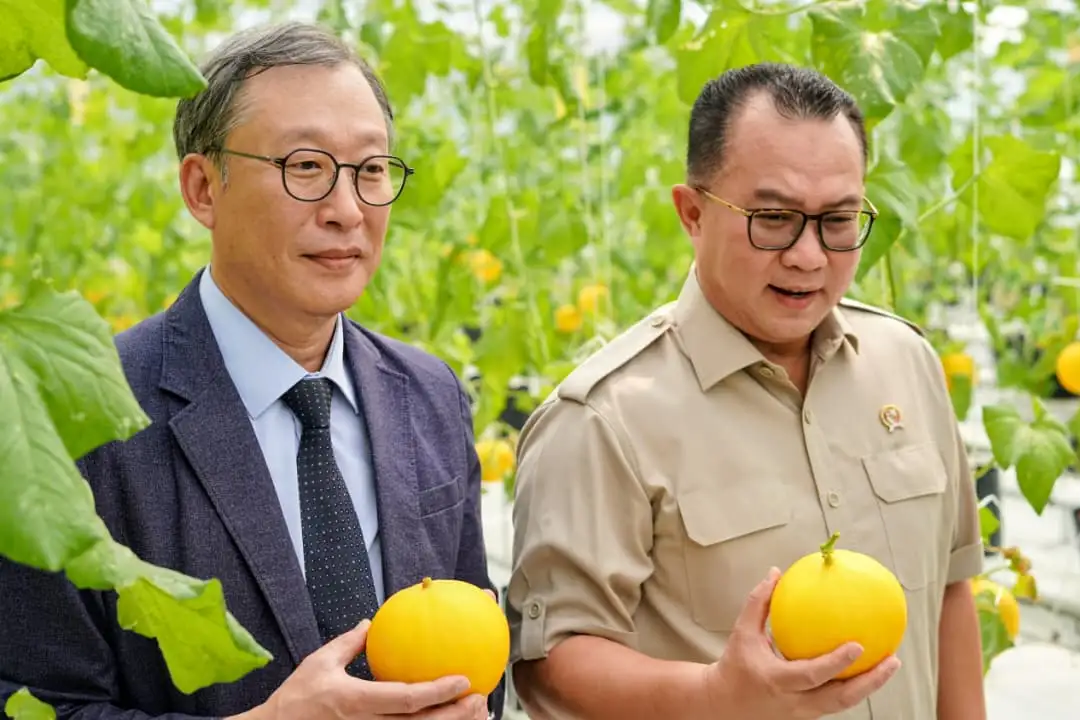
The National Research and Innovation Agency (BRIN) and the Korea Institute of Science and Technology (KIST) have inaugurated a smart greenhouse in Cibinong as a platform for agricultural research, technology testing and demonstrations designed to support solutions suited to Indonesia's conditions.
The facility was inaugurated at the Korean Smart Greenhouse in the Soekarno Science and Technology Area, Cibinong, on Wednesday (12/8).
The facility was developed through the Official Development Assistance (ODA) program of the Government of the Republic of Korea. It is intended not only as research infrastructure but also as a learning facility for Indonesian researchers and engineers to understand the development and operation of controlled-environment agricultural technology.
BRIN-KIST Smart Greenhouse Builds Agricultural Research Capacity
The development of the smart greenhouse is part of cooperation between BRIN and KIST through the Korean government's ODA program. Indonesian researchers and engineers worked with Korean experts from the design and installation stages through commissioning and system tuning.
Head of BRIN's Research Organization for Energy and Manufacturing, Cuk Supriyadi Ali Nandar, said the construction process provided technical experience for the Indonesian team.
“What we are inaugurating today is not merely a physical building, but a capability. A physical building can be brought in from outside, but capability must be built through human resource development,” Cuk said.
The Indonesian team gained experience in operating the smart greenhouse and handling technical problems.
This includes diagnosing system disruptions, adjusting set points and determining component specifications needed for replacement.
Smart Greenhouse Uses IoT, AI and Precision Systems
The smart greenhouse is a controlled environment equipped with systems to monitor and regulate growing conditions.
Its technologies include automated climate control, wireless sensor networks, Internet of Things (IoT)-based monitoring, smart irrigation and fertigation, precision nutrient management and computing systems that enable the use of artificial intelligence (AI) models based on greenhouse data.
The facility has entered a trial phase using premium melon cultivation. Cuk said the choice was based on technical and economic considerations because smart greenhouse technology requires relatively large initial investment.
“Our techno-economic analysis clearly shows that in a tropical climate, electricity costs account for only a small portion of total production costs. The main constraint lies in the large initial capital requirement,” he said.
Cuk said smart greenhouse applications in Indonesia need to consider commodities with high economic value.
Besides melons, potential commodities include strawberries, patchouli, specialty vegetables, and plant seeds and seedlings.
Facility to Support Research, Training and Technology Demonstrations
The smart greenhouse will have three main functions: a research platform to develop and test agricultural technology in a controlled environment, a training center for researchers, students and agricultural extension workers, and a technology demonstration site for industry players and investors.
“Our commitment to KIST and the Korean Government is to ensure that this facility does not merely become a physical monument,” Cuk said.
Further development could be carried out with KIST, the Ministry of National Development Planning/Bappenas and the Ministry of Agriculture.
Potential areas include post-harvest activities and supply chains, as well as opportunities for local manufacturing of components in Indonesia.
KIST Gangneung Director General Kim Joosun said the smart greenhouse could serve as a living laboratory and demonstration platform to develop agricultural solutions suited to Indonesia's tropical conditions.
Kim said the facility's success would depend on the quality of research and solutions produced there. KIST is encouraging collaborative research in crop production, water-use efficiency, environmental control and AI, while the facility is also expected to support training and researcher exchanges between Indonesia and Korea.
“This inauguration is not the end of the project, but an important beginning. The success of this greenhouse will be measured by the quality of the research conducted here and the practical solutions produced for the agriculture of the future,” Kim said.
BRIN Supports Wider Development of Smart Agriculture
BRIN is supporting the facility's infrastructure by providing the greenhouse site, electricity, water sources, internet connectivity, utilities and other supporting facilities.
BRIN Deputy for Research and Innovation Infrastructure Dadan Moh. Nurjaman said the facility is expected to support the development of smart agricultural technologies, including greenhouse technology, automation, sensors, AI, irrigation and vertical farming systems, as well as modern agricultural production technologies.
BRIN Head Arif Satria said the smart greenhouse is part of the partnership between Indonesia and Korea and serves as a facility to develop and test technologies relevant to Indonesia's development needs.
“This smart greenhouse is more than just a research facility. It is tangible evidence of the strong and continuously developing partnership between Indonesia and South Korea in science, technology and innovation,” Arif said.
Arif said smart agricultural technology development is aligned with efforts to strengthen the link between research and innovation and national development priorities, including food sovereignty.
Its application is expected to help increase productivity while supporting more efficient use of water, fertilizer, energy and other resources.
He said the knowledge and experience produced by the facility could support learning, technology validation and development for broader applications.
“The knowledge and experience generated from this facility will not stop inside the greenhouse, but can become a platform for learning, technology validation and development on a broader scale,” Arif said.
The inauguration was followed by visits and demonstrations of smart greenhouse technology, including sensors, IoT-based monitoring, environmental control and automated fertigation.
The activities also included a project showcase and discussion on the facility's use for research, training and technology demonstrations, as well as knowledge exchange between researchers and partners.
PHOTO: BRIN
This article was created with AI assistance.
We make every effort to ensure the accuracy of our content, some information may be incorrect or outdated. Please let us know of any corrections at [email protected].
Read More