





 Sunday, 04-10-26








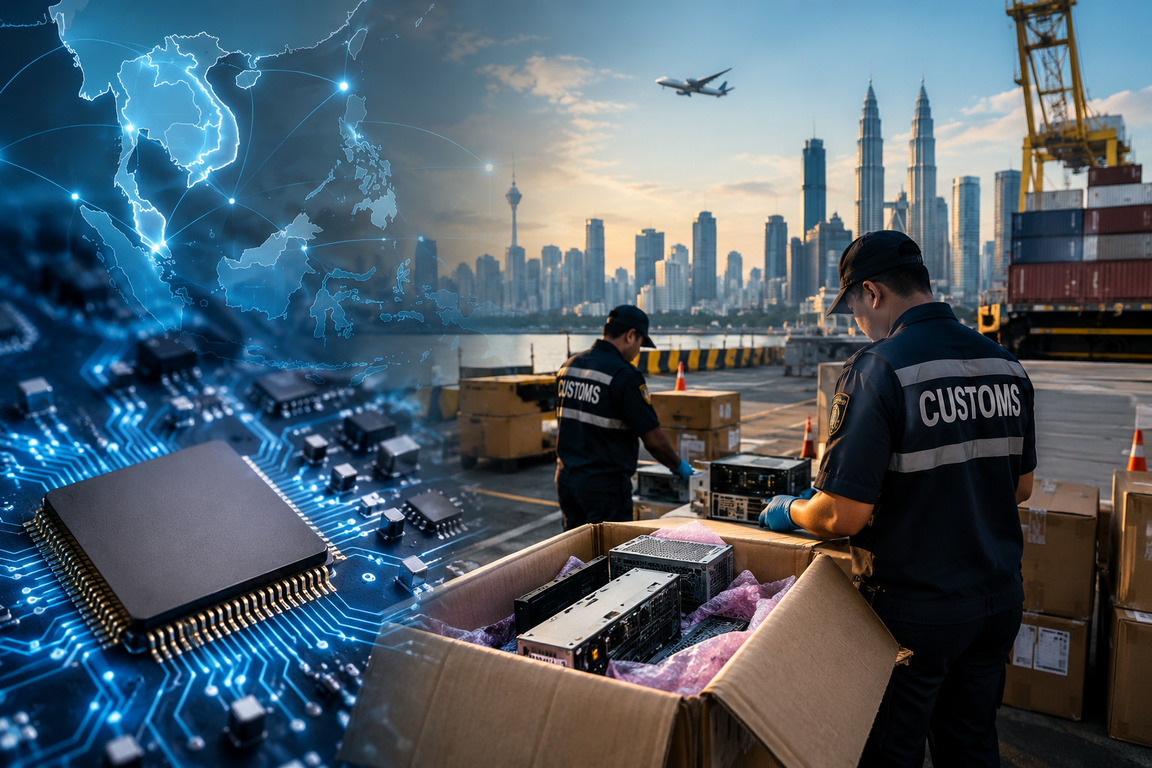
The AI hardware race has changed shape. It is no longer only about who can sell the most powerful GPU; it is about who can control the full stack of inference, memory, networking, power, and logistics. OpenAI’s new Jalapeño chip, built with Broadcom, is designed specifically for LLM inference, was taped out in nine months, and is part of a multi-generation compute platform aimed at gigawatt-scale deployment. TechCrunch’s coverage of the same trend frames it as a broader hedge: companies from OpenAI to Google, Apple, and SpaceX are increasingly building custom silicon to reduce single-supplier risk and gain tighter control over performance.
That does not mean Nvidia is suddenly losing the market. Far from it. Nvidia reported $81.6 billion in first-quarter fiscal 2027 revenue, including $75.2 billion from data centers, after posting $215.9 billion in fiscal 2026 revenue. The more important shift is strategic leverage: the biggest buyers are now trying to lower their cost per token, improve performance per watt, and reduce dependence on one vendor’s roadmap. OpenAI says Jalapeño was built from scratch around its own model and serving needs, and that early testing shows substantially better performance per watt while reducing data movement across compute, memory, and networking.
Why Southeast Asia is suddenly on the front line
Southeast Asia is where this chip transition becomes a real business story, because the region is not just buying AI infrastructure; it is absorbing the physical burden of it. ASEAN’s official guide on sustainable data centers says electricity demand from data centers in the region is projected to nearly double by 2030 versus 2024, while analysis from Bain and Standard Chartered says data centers, EVs, and industrial clusters could add more than 100 TWh of electricity demand by 2030 and require more than $200 billion of investment. The same report warns that grid infrastructure can take five to fifteen years to build, which means power availability, not demand, is becoming the binding constraint.
That matters because the economics of AI infrastructure are heavily shaped by operating costs. The ASEAN guide says electricity typically accounts for 60% to 70% of a data center’s ongoing operating costs, and that AI workloads may increase that share further on fossil-heavy grids. In other words, the move to custom chips is not just about better silicon; it is about survival in a market where cheap and reliable electricity can decide whether an AI project is viable at all.
The region’s physical map is already adjusting. The ASEAN guide says Singapore has more than 1.4 GW of operational data-center capacity, while Johor alone has more than 5 GW of projects in various stages and more than 500 MW of live capacity. It also says growth is spilling into Johor and Batam because Singapore’s limited land and renewable-energy base constrain further expansion. The same guide estimates that data centers already consume about 2% to 3% of national electricity demand in Singapore, Malaysia, and Indonesia, which shows how quickly digital infrastructure is becoming national infrastructure.
Why the Malaysia seizure is the missing piece
This is why Malaysia’s June 26 seizure is more than a customs story. Reuters reported that Malaysian authorities stopped 72 server units containing advanced AI chips worth 52.9 million ringgit (about $12.93 million) at Kuala Lumpur International Airport. The shipment had been falsely declared as “computer components,” and officials said the servers were meant for re-export to another Asian country, which would require a permit under Malaysia’s Strategic Trade Act. Malaysia had already imposed export controls last year on the movement of high-performance U.S.-origin chips, after pressure from Washington to slow the flow of critical AI hardware toward China.
That case reveals the hidden layer underneath the AI chip boom: as demand rises, so does the pressure on transit hubs, free-trade zones, freight intermediaries, and compliance systems. Malaysia is not only a manufacturing and data-center destination; it is also part of the circuit through which scarce AI hardware moves. Reuters also noted that the shipment was routed through Malaysia as a transit point to circumvent restrictions before reaching its destination, underscoring how the hardware race is now creating enforcement risks across Southeast Asia’s logistics network.
For investors, the most interesting conclusion is that the custom-chip wave is widening the AI economy instead of narrowing it. More custom silicon means more demand for servers, HBM memory, networking equipment, secure shipping, energy contracts, and grid capacity. It also means that the winners will not be decided by chip design alone. They will be decided by who can supply land, power, cooling, compliance, and interconnection fast enough to keep inference economics attractive. That is why Southeast Asia is no longer just a customer market for AI infrastructure; it is becoming one of the region’s most important chokepoints.
For Indonesia, the signal is especially clear. The ASEAN guide explicitly points to Batam as part of the spillover from Singapore’s capacity limits, while also naming Jakarta as one of the region’s digital-growth hubs. If Indonesia can pair grid reliability, renewable procurement, and cleaner customs enforcement with its lower-cost land and strategic geography, it could capture more of the AI infrastructure value chain instead of simply hosting the hardware flow. The next phase of AI in Southeast Asia will not be defined only by who builds the smartest model. It will be defined by which markets can power, move, and regulate that model at scale.
Read More