





 Monday, 12-10-26








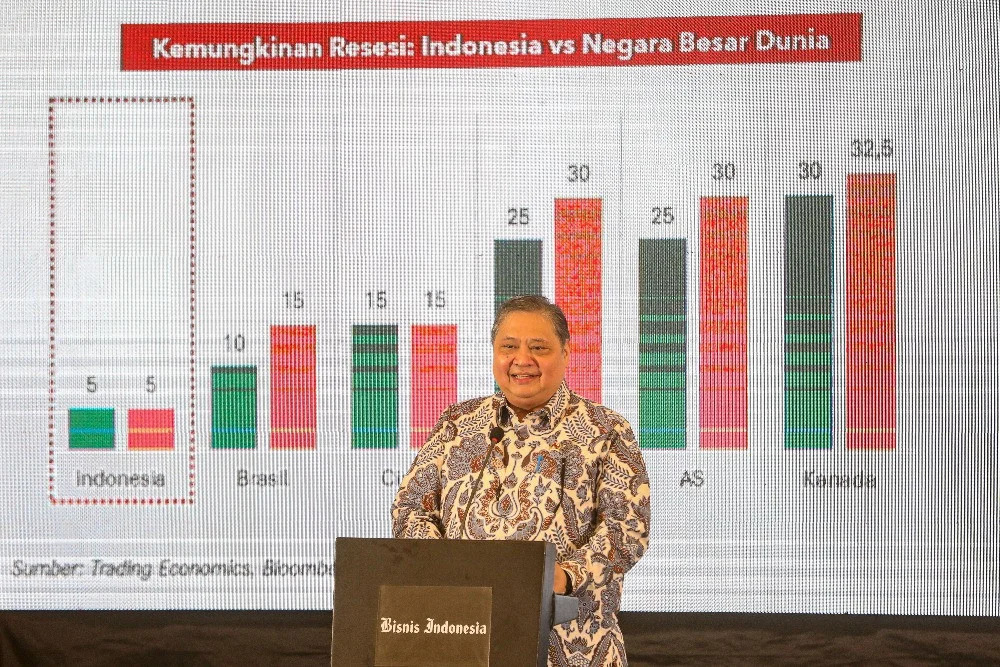
Indonesia enters mid-2026 with a story that looks stable on the surface but more complicated underneath. Recent analysis from CSIS describes the economy as a paradox: headline figures still point to stability, with growth close to 5 percent, inflation broadly contained, and the fiscal deficit staying within acceptable bounds, yet the economy is also increasingly strained by external risks. That tension is exactly why Indonesia economic resilience has become such a useful lens for understanding the country’s current position.
The broader policy environment reinforces that reading. The OECD projects Indonesia’s real GDP to grow by 4.7 percent in 2026 before improving to 5.0 percent in 2027, but it also warns that higher energy costs and policy uncertainty are expected to weigh on consumption and investment. The World Bank, meanwhile, says Indonesia’s economy continues to demonstrate resilience amid heightened global uncertainty, with growth holding at 5.0 percent year on year in the first three quarters of 2025.
What The Latest Economic Review Is Really Saying
The latest strategic outlook does not describe a crisis. It describes a country that still has macroeconomic strength, but not enough insulation from the world around it. In practical terms, that means Indonesia economic resilience is real, but it is being tested by external shocks, softer global demand, and domestic structural weaknesses that are harder to solve quickly. CSIS’s 2026 outlook frames this clearly by noting that the economy appears stable on the surface while strains are building beneath it.
That is an important distinction because resilience is often misunderstood as invulnerability. In Indonesia’s case, the evidence suggests the opposite. The country has enough domestic demand, macro discipline, and policy capacity to keep growth intact, but it still remains exposed to energy prices, trade policy shifts, and weakening labor conditions. OECD’s projection that net exports will make no net contribution to growth in 2026 is especially telling, because it implies that external demand may not provide the usual lift.
For business readers, that means the next phase of Indonesia economic resilience is not about celebrating stability. It is about understanding what keeps that stability from slipping. A resilient economy can still underperform if investment slows, consumer confidence weakens, or global shocks hit the wrong sectors at the wrong time. That is why the new report matters. It is less a victory lap and more a warning sign wrapped in good macro numbers.
Why Indonesia Still Looks Strong
One reason Indonesia remains relatively resilient is that domestic demand has not broken down. The World Bank says growth held at 5.0 percent in the first nine months of 2025 and that the economy has been supported by strong investment and net exports. It also notes that the country’s growth is expected to remain around this level through 2026 and 2027, despite global policy uncertainty. That matters because many economies would already be showing sharper weakness under the same external conditions.
Another strength lies in Indonesia’s scale. As Southeast Asia’s largest economy, the country has a broad domestic market that helps cushion external shocks. That does not remove risk, but it does create room for adjustment when exports, commodity cycles, or trade tensions become less favorable. The World Bank’s recent country overview also points to solid performance in agriculture, services, and net exports during the first half of 2025, which helps explain why Indonesia economic resilience has remained intact even as the world economy has become more volatile.
Policy credibility also matters. Indonesia has kept inflation contained and maintained a fiscal position that still falls within acceptable bounds, according to CSIS. That gives policymakers more room to respond if conditions deteriorate. In many emerging markets, that buffer would already be exhausted. In Indonesia, it is still available, although not unlimited. That is one reason the country continues to look comparatively stable to investors and international institutions.
Where The Vulnerabilities Sit
The main vulnerability is external exposure. OECD says higher energy costs and policy uncertainty will weigh on consumption and investment. That is not a trivial problem. If households spend more cautiously and businesses delay capital expenditure, growth can slow even when aggregate indicators still look acceptable. This is where Indonesia economic resilience starts to look conditional rather than absolute.
A second vulnerability is trade dependence. The OECD expects softer global demand for some of Indonesia’s main export commodities, with weaker imports offsetting the impact only partly. That means the country cannot rely too heavily on the external sector to carry growth. Commodity cycles may still help at times, but they are not a dependable long term strategy. For a resource rich economy, that is a useful reminder that resilience depends on diversification as much as on prices.
A third weakness is structural. CSIS has also published work on Indonesia’s strategic dependencies, mapping critical economic dependencies and assessing their risks to resilience. That kind of analysis matters because it shows vulnerability is not only about short term market shocks. It also lives in supply chains, technology reliance, industrial concentration, and weak links between sectors. Indonesia economic resilience will be stronger if these bottlenecks are reduced over time.
The global backdrop is not helping. The OECD’s June 2026 global outlook warns that energy shock and rising inflationary pressures are worsening conditions for many economies, especially in Asia and other vulnerable regions. Even if Indonesia is somewhat less exposed than countries that import more energy from the Middle East, it is still part of the same global system. When trade slows and financing gets tighter, domestic policy has to do more of the work.
What Policymakers Need To Do Now
The first priority is to protect demand without creating new imbalances. That means supporting household purchasing power, maintaining investment momentum, and avoiding policy mistakes that would undermine confidence. The data suggest that Indonesia economic resilience is still supported by domestic activity, so keeping that engine healthy should be the immediate focus.
The second priority is to reduce exposure to external shocks. That includes energy transition planning, supply chain strengthening, and more diversified industrial capacity. OECD’s warning about energy costs is important because it shows how quickly an external price shock can alter domestic growth dynamics. Indonesia does not need to eliminate all exposure. It needs more flexibility when shocks arrive.
The third priority is structural reform. The country has already shown that it can keep growth around 5 percent, but the real test is whether it can raise productivity and investment quality at the same time. That is where strategic dependency mapping becomes useful. If policymakers know which sectors are fragile, they can direct reform toward logistics, manufacturing depth, digital infrastructure, and industrial upgrading. Indonesia economic resilience will become more durable only if it is matched by structural depth.
Why Investors Should Pay Attention
For investors, Indonesia still looks attractive because the macro base remains relatively sound and the growth profile is better than many peers. The World Bank and OECD both expect growth to remain in the mid 4 percent to 5 percent range over the next few years, which is not spectacular but still solid in a slowing global economy. That combination of scale, stability, and moderate growth is hard to ignore.
At the same time, investors should not mistake resilience for simplicity. The country’s risks are evolving. Energy prices, policy uncertainty, trade fragmentation, and weak external demand can all affect sectors differently. That means the best opportunities are likely to be found in businesses that benefit from domestic demand, infrastructure modernization, productivity gains, and import substitution. In other words, Indonesia economic resilience is not just a macro story. It is a sector selection story too.
The deeper takeaway from the new report is straightforward. Indonesia is not fragile, but it is not fully protected either. Its resilience is credible, but conditional. Its vulnerabilities are real, but manageable. The balance between those two forces will shape the rest of 2026 and probably the next few years after that. For businesses, policymakers, and investors, the smartest reading is neither complacent nor alarmist. It is disciplined. That is the right frame for understanding Indonesia economic resilience right now.
Conclusion
Indonesia’s current economic story is best understood as resilience under pressure. The country still has strong domestic foundations, stable macro indicators, and growth prospects that compare favorably with many economies. But the new outlook also makes clear that external risks are no longer background noise. They are central to the next phase of policy and business planning. If Indonesia can strengthen its structural base while managing external shocks, then Indonesia economic resilience may remain one of the region’s more durable strengths.
Read More