





 Sunday, 27-09-26








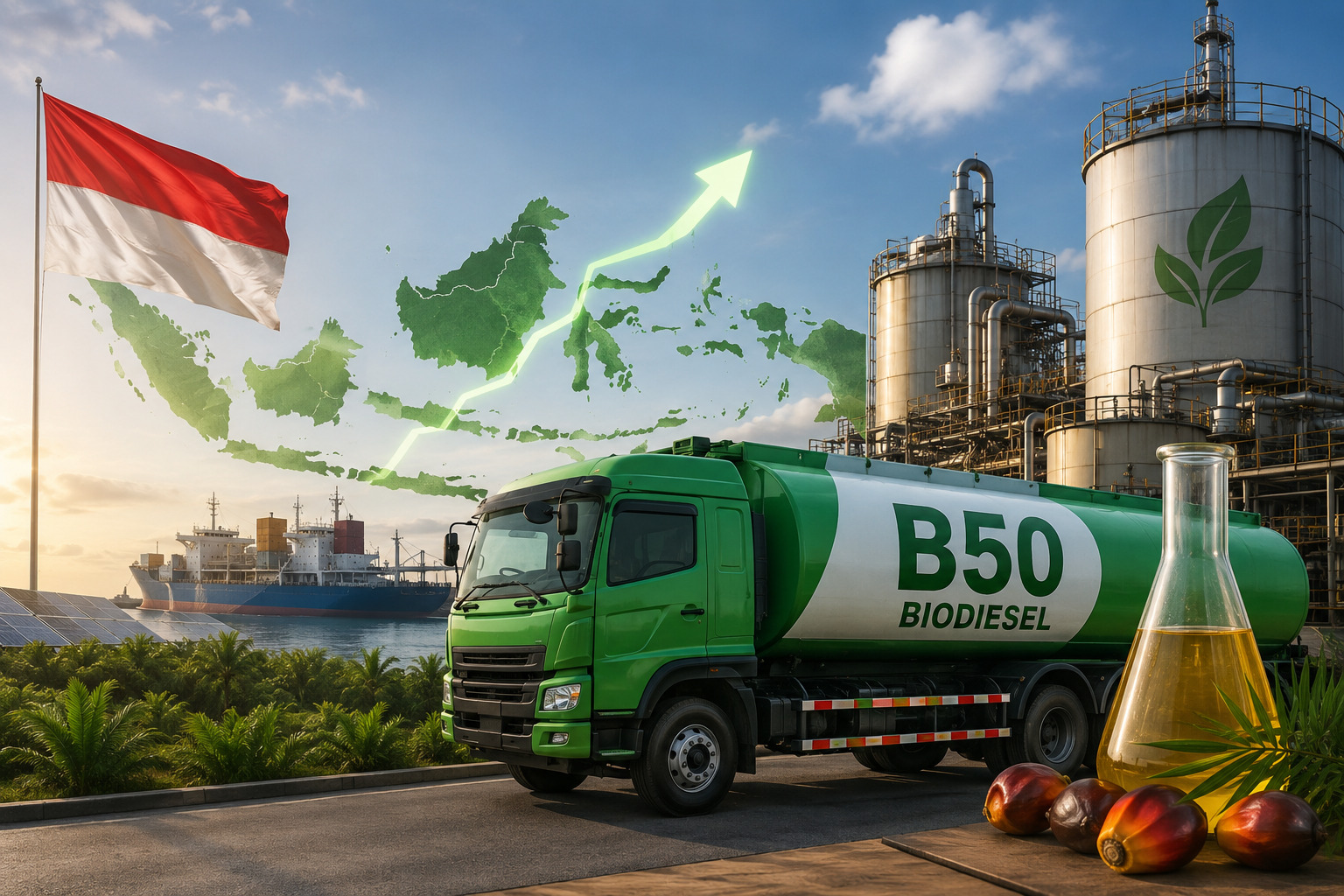
Indonesia is preparing to make one of its boldest energy moves in years. The government says the B50 biodiesel program will begin on July 1, 2026, with officials describing it as a major step toward energy self-sufficiency and lower diesel imports. Reuters reported that the mandate would require a 50 percent blend of palm oil based biodiesel with conventional diesel, while the government has said the policy could save the country about Rp157.28 trillion in import costs in 2026. That is a large number by any measure, and it explains why the policy has become such a central story in Indonesia’s energy debate.
At the same time, the plan is not purely symbolic. It sits inside a broader push to reduce fossil fuel dependence, support domestic palm oil demand, and improve Indonesia’s energy security after a period of volatile oil markets. The government has framed the move as a practical response to external shocks, including global supply disruptions. That is why the B50 biodiesel rollout is being discussed not only as a fuel policy, but also as a national economic strategy.
Why The B50 Move Matters Now
The timing is important. Reuters reported in June 2026 that the government expects the B50 program to begin on July 1, after testing and preparation work. Earlier in the policy cycle, Reuters said Indonesia was targeting B50 in the second half of 2026, while energy officials said tests were underway. That means the July launch is not a sudden announcement. It is the outcome of a longer policy buildout that has been unfolding for months.
The significance of B50 biodiesel is that it pushes Indonesia further than many other countries in blending biofuel into transport fuel. The program builds on the existing B40 mandate, which already made Indonesia one of the world’s most aggressive biodiesel adopters. According to Reuters, the country used 14.2 million kiloliters of biodiesel in 2025 and allocated 15.65 million kiloliters for 2026, with demand expected to rise to 17.6 million kiloliters if B50 is fully implemented. That level of demand would reshape fuel procurement, subsidy planning, and palm oil allocation.
There is also a fiscal logic behind the move. Reuters reported that the Ministry of Energy expects subsidies for biodiesel to fall to around Rp32 trillion, down from Rp47 trillion, if the 2026 program proceeds as planned. Setkab’s official statement also said the policy could reduce fossil fuel use by 4 million kiloliters and generate substantial budget savings. For policymakers, that combination of import reduction and subsidy control makes B50 biodiesel look like more than an energy experiment. It is a budget management tool.
How The Policy Changes Indonesia's Fuel Balance
The clearest effect of the program is on diesel imports. Officials have said the country will no longer need to import diesel once the mandate is fully in place, because domestic palm oil based biodiesel will replace a major share of fossil diesel use. That is the central political promise behind B50 biodiesel. It is also the part of the policy that resonates most with the public, since energy self-sufficiency has long been one of Indonesia’s most visible policy goals.
But the mechanics matter. Reuters reported that the policy depends on the relationship between crude oil prices and crude palm oil prices, because biodiesel subsidies are funded through palm oil export levies. In January 2026, Reuters said the government was even considering a higher export levy to support the program as financial resources tightened. That detail is important because it shows the policy is not simply about blending fuel. It is about balancing commodity markets, subsidy funding, and domestic supply chains.
This is where B50 biodiesel becomes a market signal as much as a fuel rule. The government is effectively saying that palm oil will continue to play a strategic role in energy policy. That may support plantation income, transport fuel security, and domestic refining activity. Yet it also means the state must keep a close eye on price volatility, because a sharp shift in crude palm oil prices can change the economics of the entire scheme. Reuters has repeatedly noted that the launch is sensitive to those price conditions.
What Industry And Market Players Need To Watch
For the palm oil sector, B50 biodiesel is likely to increase domestic demand for crude palm oil and related processing capacity. That can be positive for upstream producers, refiners, and logistics firms. It can also support a broader industrial ecosystem around biofuel blending, storage, and distribution. Reuters said the government had already been preparing the quota and regulatory framework, which suggests that implementation is being treated as an industrial coordination exercise, not just a ministry decree.
For refiners and fuel distributors, the operational challenge is different. A 50 percent blend requires strict quality control, supply coordination, and logistics readiness across the fuel system. Setkab said Pertamina is set to implement the blending system, which indicates that the state energy company will be central to the rollout. That makes implementation capacity just as important as policy ambition. If the supply chain is not ready, the promise of B50 biodiesel could be delayed or diluted in practice.
Industrial users should also watch the policy closely. Even if diesel imports decline, the cost structure of fuel supply can still shift depending on palm oil prices, subsidies, and levy policy. Reuters reported earlier this year that the government was evaluating how much more it could spend on biodiesel support and whether export levies should rise. That means the fiscal burden may not disappear, even if the trade deficit for fuel improves. The balance between cheaper imports and higher domestic support costs will remain one of the policy’s biggest tests.
Why This Policy Is Politically Powerful
The political appeal of B50 biodiesel is obvious. It allows the government to claim progress on three fronts at once: energy independence, fiscal savings, and support for a key domestic commodity sector. That is an unusually powerful combination in a country where fuel imports have long been seen as a vulnerability. The fact that the policy is linked to Prabowo’s broader energy self-sufficiency agenda gives it even more political weight.
It also fits the government’s need to show decisive action in a period of global energy uncertainty. Reuters said the B50 push came in part after oil supply disruptions linked to conflict in the Middle East. In that context, the policy is not just about local economics. It is also a hedge against global instability. For a large importer, that kind of hedge can be politically attractive even if the implementation is complex.
There is still a realistic debate over how much of the promised benefit will actually materialize in the first year. Reuters has already shown that the policy depends on price conditions, subsidy funding, and supply readiness. But the direction is clear. Indonesia wants to move away from diesel imports, deepen the role of palm oil in energy, and use B50 biodiesel as a symbol of industrial independence. That is a major strategic bet, and it could reshape the country’s fuel market if the rollout proceeds smoothly.
Conclusion
Indonesia’s B50 decision is bigger than a fuel blending update. It is a full economic and industrial statement. The policy promises lower diesel imports, reduced subsidy pressure, and stronger energy independence, but it also raises questions about price exposure, levy funding, and supply chain readiness. If the government can execute the rollout on schedule, B50 biodiesel could become one of the defining energy policies of 2026. If not, the gap between ambition and implementation will be hard to ignore. Either way, the country has made clear that diesel import dependence is no longer the preferred long term path.
Read More