





 Tuesday, 27-10-26








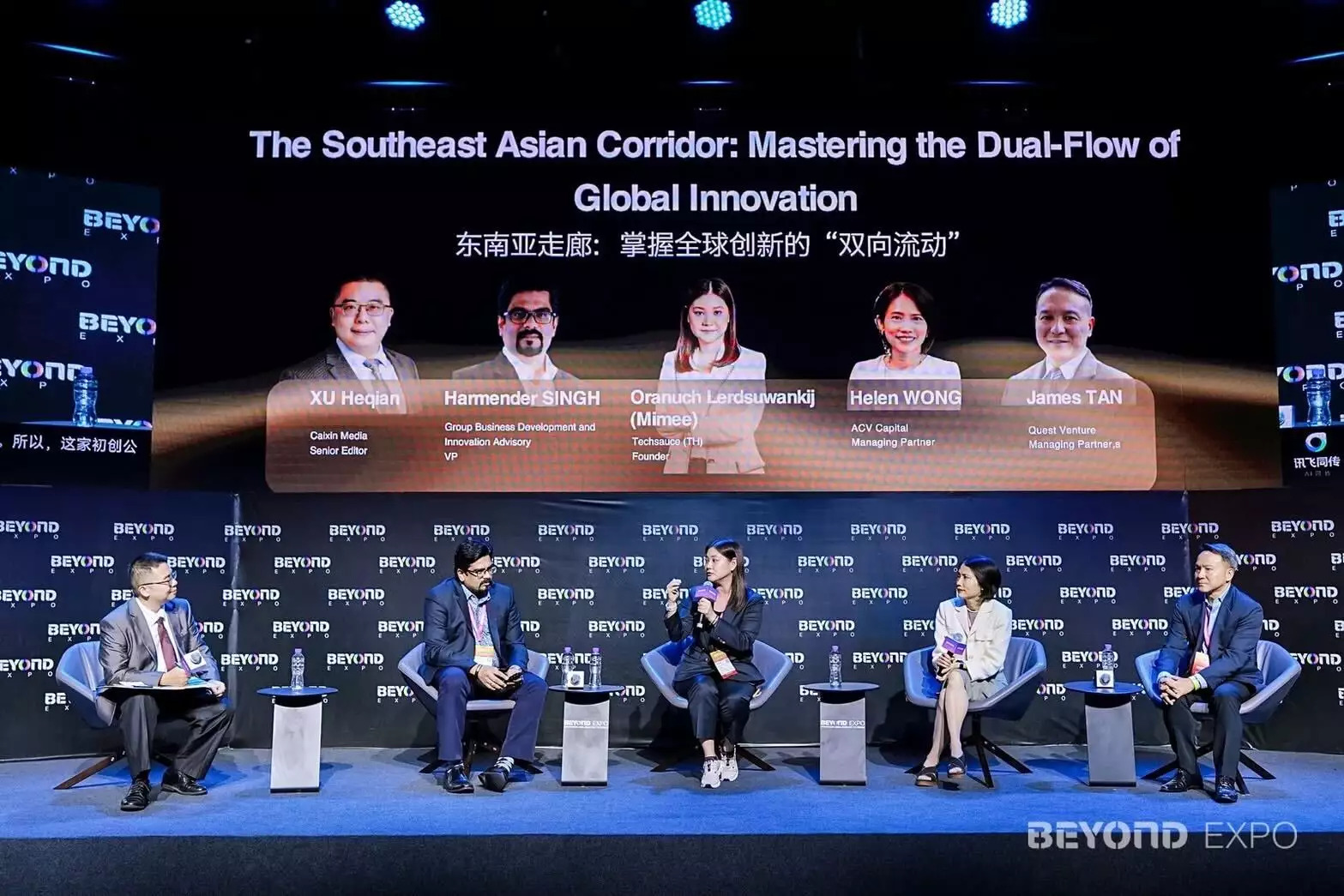
Southeast Asia is no longer being described only as a manufacturing base or an emerging consumer market. In a recent Techsauce panel at BEYOND Expo in Macau, the region was framed as a strategic innovation corridor, a bridge for capital, technology, talent, and ideas moving across global markets. The session, titled “The Southeast Asian Corridor: Mastering the Dual-Flow of Global Innovation,” took place on June 7, 2026, and focused on how artificial intelligence is moving from digital systems into physical applications such as robotics and autonomous systems.
That framing matters because it changes the conversation. Instead of asking whether Southeast Asia can become the next Silicon Valley, the panel suggested a different ambition: the region can become the place where global innovation gets adapted, localized, and scaled. In that sense, the innovation corridor idea is less about imitation and more about translation. It is about turning outside invention into regional advantage.
Southeast Asia’s Shift From Market To Innovation Corridor
For years, Southeast Asia was often viewed through a narrow lens. It was a fast-growing consumer market, a low-cost manufacturing base, and later a startup region that produced several unicorns before the funding winter hit. The Techsauce panel argued that the region has entered a new phase, one in which it plays a more strategic role in the global innovation landscape. The region is increasingly seen as a stable, neutral, and growth-oriented destination where capital and talent can meet.
The phrase innovation corridor captures this shift well. Corridors connect systems. They do not just sit still and wait to be used. By connecting different countries, languages, regulatory environments, and business cultures, Southeast Asia forces entrepreneurs to build with regional complexity in mind from day one. That complexity is inconvenient at first, but it can also become a competitive advantage because it trains founders to build resilient, adaptable businesses.
The article also emphasizes that successful companies in Southeast Asia often have to think regionally much earlier than startups elsewhere. This is not just a slogan. It reflects a hard reality. If a product can work across Thailand, Indonesia, Vietnam, Malaysia, and Singapore, it is usually because the team has learned how to navigate variation in language, regulation, consumer behavior, and market maturity. That makes the innovation corridor not only a geographic concept but also an entrepreneurial discipline.
Why China Still Matters In The Regional Innovation Corridor
The article makes a sharp point about learning from faster-moving markets, especially China. It describes China as one of the world’s largest innovation laboratories, where new consumer behaviors, business models, and technologies often appear before spreading into Southeast Asia over the next four to five years. That observation gives regional businesses and policymakers a practical advantage: they can watch, learn, and prepare rather than waiting to be disrupted.
This is where the innovation corridor becomes more than a slogan. It becomes a flow system. Ideas are tested in one market, observed in another, and then adjusted for local conditions. That kind of cross-border learning is especially valuable in Southeast Asia because no single country dominates the region in the same way that one large domestic market might dominate elsewhere. Instead, the region benefits from proximity, variation, and fast feedback loops.
The panel’s logic suggests that founders and investors should pay close attention to signals from larger and faster markets, not because those markets should be copied blindly, but because they often reveal what is coming next. In practice, the smartest companies are not the ones that move first everywhere. They are the ones that know when a trend is coming and how to adapt it before the rest of the market catches up. That is a core skill inside any serious innovation corridor.
AI Will Define The Next Phase Of The Innovation Corridor
Artificial intelligence sits at the center of the article’s future outlook. The panel argues that AI will likely be the most important catalyst of transformation in Southeast Asia, especially as open models democratize access to advanced capabilities. The key point is not simply that AI is available. It is that organizations can fine-tune models and build solutions suited to local needs without having to compete head-on with the largest global technology firms.
That is a powerful idea for the region. Many Southeast Asian businesses do not need to invent foundation models from scratch. They need practical AI systems that solve real problems in healthcare, tourism, food, and agriculture. The article specifically highlights these sectors as major opportunities for AI-driven innovation. In other words, the best use of the innovation corridor may be to convert global AI progress into industry-specific local value.
The article also makes an important distinction between access and adoption. Giving people AI tools is not enough. The challenge is creating the right environment for entrepreneurs, corporations, and innovators to turn real-world problems into scalable AI-powered businesses. That means the region needs more than enthusiasm. It needs users, test markets, experimentation, and commercial pathways that reward useful innovation.
This is where the article introduces the idea of an Innovation Flywheel. Innovation thrives when there are real users, opportunities to experiment, and markets willing to adopt new solutions. Those conditions reinforce one another and create a self-reinforcing cycle that develops entrepreneurs, technologies, talent, and intellectual property. If Southeast Asia can keep that flywheel turning, the innovation corridor becomes a living system rather than a one-time policy aspiration.
Human Capital Will Decide Whether The Corridor Works
The article is clear that human capital sits at the center of the transformation. It starts with AI literacy across society and extends to the development of AI builders, entrepreneurs, researchers, and innovators who can turn knowledge into products, companies, and impact. That is a subtle but critical point. AI infrastructure matters, but without people who understand how to use it, the infrastructure does not become growth.
This is also why the innovation corridor concept is tied to education and talent retention. The region needs to develop world-class builders and keep them. It also needs more people who can move between technical work, commercial strategy, and industry use cases. In practical terms, that means Southeast Asia cannot rely only on imported know-how. It has to build local tacit knowledge, meaning the kind of experience that is learned by doing and cannot be copied instantly from abroad.
One of the strongest ideas in the article is the call for Southeast Asia to become a Smart Integrator. That means leveraging the flow of global innovation passing through the corridor and turning it into tailored solutions for industries where the region already has competitive strengths. Healthcare, tourism, food, and agriculture are singled out for this reason. These are not abstract sectors. They are practical arenas where AI can improve efficiency, access, and value creation.
If that strategy works, the region will do more than adopt technology. It will build ecosystems around it. The article says the ultimate goal is to become an ecosystem builder in these specialized sectors, so that countries across the region can generate new economic value and create sustainable systems that support entrepreneurs, researchers, and technology builders for decades. That is the deepest version of the innovation corridor thesis. It is not about being a follower. It is about becoming the place where innovation is made useful.
What Success Looks Like For Southeast Asia
The article closes with a useful set of indicators for progress. Success should be measured by the number of AI builders and innovators creating products and businesses, the ability to attract and retain world-class talent, the quantity and quality of solutions and intellectual property that address real economic challenges, and the ability of innovations to scale across Southeast Asia and beyond. These are practical metrics, not vanity metrics.
That matters because the region’s future probably will not be defined by becoming the next global technology superpower. The article argues that Southeast Asia’s real opportunity is to become the world’s most effective innovation corridor, where talent, capital, technology, and ideas converge to produce the next generation of economic growth and innovation. That is a more realistic and possibly more powerful ambition than chasing a single dominant tech identity.
The most compelling part of that vision is its balance. It recognizes that Southeast Asia is not one market, but many. It also recognizes that the region does not need to win every technology race to matter. If it can connect global innovation to local needs, and if it can turn that connection into durable businesses, then the innovation corridor will not just describe the region. It will define it.
Read More