





 Thursday, 08-10-26








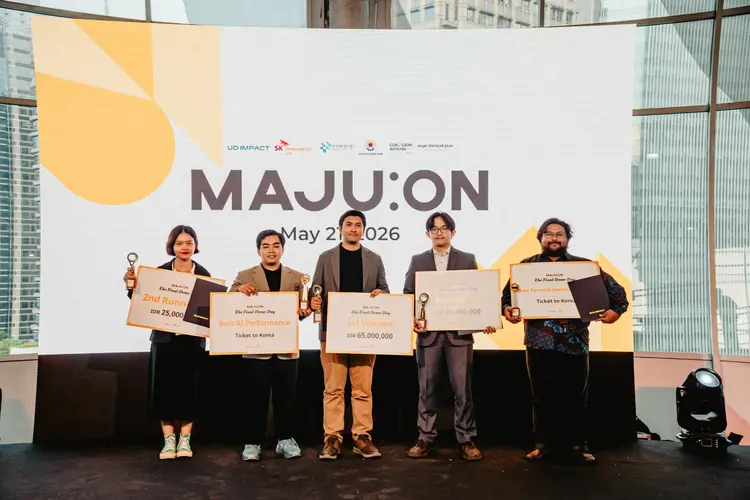
SK Innovation E&S is taking a hands-on approach to building the Startup Ecosystem Indonesia by backing young founders in energy and environmental technology through its MAJU:ON program. The company recently held the MAJU:ON Final Demo Day in Jakarta on May 21, 2026, where startup teams presented their business models, received recognition, and met investors in one-on-one consultation sessions. The event was organized at Garuda Spark Innovation Hub and brought together around 200 participants.
What makes this initiative notable is that it is not a typical corporate sponsorship program. MAJU:ON is designed to support entrepreneurs across the startup lifecycle, from early idea development to investment readiness and broader market exposure. SK Innovation E&S has run the program in Indonesia since 2025 with UD Impact, a Korean ESG solution company, and the final demo day marked the first cohort’s public showcase.
For Indonesia, the timing is important. The startup conversation is shifting away from hype and toward durable business models, practical mentorship, and real market access. A program that connects founders to government representatives, industry experts, universities, and venture investors can help close the gap between innovation and execution, which is exactly where many early-stage ventures struggle.
Why Startup Support Matters For Indonesia's Energy Transition
The Startup Ecosystem Indonesia is increasingly tied to the country’s energy transition, and that connection was visible in the structure of MAJU:ON. The program focuses on the energy and environmental sectors, areas where Indonesia needs new solutions for decarbonization, climate resilience, and sustainable development. During the final demo day, attendees heard special lectures on energy transition and AI technologies, showing that the program is meant to develop founders who understand both climate challenges and digital transformation.
This matters because energy innovation in Indonesia is not just about large infrastructure projects. It also depends on small, flexible teams that can test new business models, build digital tools, and solve local problems faster than large institutions often can. A strong Startup Ecosystem Indonesia gives those teams a path to scale, especially when they are working on areas that affect public welfare such as disaster response, agriculture, and environmental management. The winning team, GISACT, stood out for a spatial intelligence platform that supports data-driven decision making across fields like disaster response and agriculture.
The MAJU:ON format also shows that startup support is becoming more practical. Instead of only offering motivation or generic networking, SK Innovation E&S built a pipeline that included university recruitment, a four-week startup support program, a hackathon, advanced training, business model presentations, and investor consultations. That sequence suggests a serious effort to make the Startup Ecosystem Indonesia more investable, not just more visible.
There is also a broader economic logic behind this. Countries that want to advance their green economy need founders who can translate policy goals into usable products and services. In that sense, entrepreneurship is not separate from sustainability policy. It is one of the delivery mechanisms. SK Innovation E&S is betting that helping young founders early can create long-term value for both Indonesia’s energy transition and Korea-Indonesia business ties.
How MAJU:ON Turned Campus Talent Into Investable Teams
One of the strongest aspects of MAJU:ON is its campus-based pipeline. Over the past 10 months, SK Innovation E&S said it identified and nurtured about 130 startup teams and more than 460 young Indonesian entrepreneurs in the energy and environmental sectors. The company also signed memoranda of understanding with eight regional hub universities in August 2025, then recruited participating teams and provided startup support before hosting a hackathon in November.
That design is important because universities are where many future founders first test their ideas. By connecting campus talent to industry mentors, investors, and government stakeholders, the program makes the Startup Ecosystem Indonesia more structured and more realistic. It helps young entrepreneurs understand that a good idea is only the beginning. They also need product-market fit, governance, capital access, and a credible path to scale.
The final demo day itself was built to mimic the real pressure of entrepreneurship. According to the reports, the event included presentations from 10 startup teams, awards for top teams, and a mock investment session where audience members allocated virtual funds to the teams they believed were most promising. That mechanism is useful because it turns pitch evaluation into a learning exercise. Founders do not just speak to judges. They also learn how investors think.
The top honors went to GISACT, AIGRA, and Lifeguards, with GISACT drawing special attention for its spatial intelligence platform. That kind of recognition matters for the Startup Ecosystem Indonesia because it shows that innovation is being measured by usefulness, not only by novelty. Solutions that can support disaster response, agriculture, and other operational fields are especially relevant in a country as geographically and socially diverse as Indonesia.
The presence of government and institutional stakeholders added another layer of legitimacy. Representatives from Indonesia’s Ministry of Energy and Mineral Resources, Ministry of Investment, Ministry of MSMEs, Ministry of Communication and Digital Affairs, the Korean Embassy, eight regional hub universities, and ANGIN were all in attendance. That kind of mix is exactly what young founders need if the Startup Ecosystem Indonesia is going to move from isolated programs to a connected market system.
What The Program Says About Korea Indonesia Collaboration
SK Innovation E&S framed MAJU:ON not just as an entrepreneurship program, but as a bridge between industrial ecosystems in Indonesia and Korea. That message was repeated by Shon Dong-kun, President Director of SK Innovation E&S Indonesia, who said the initiative revealed the tremendous potential of young Indonesian entrepreneurs and could connect the two countries’ business ecosystems more closely.
This cross-border dimension matters because the Startup Ecosystem Indonesia does not grow in isolation. Access to capital, technology transfer, and regional networks often determines whether a promising startup survives beyond the pilot stage. A Korean corporate partner with energy expertise and ESG-oriented programming can give Indonesian founders a different level of exposure than a local accelerator alone might provide.
The collaboration also reflects a larger pattern in Asian innovation. Corporate-backed startup development is increasingly being used to link strategic industries with entrepreneurship. In this case, the sectors are energy and environment, both of which are under pressure to innovate quickly. By aligning startup support with those sectors, SK Innovation E&S is helping build a more targeted Startup Ecosystem Indonesia, one that is tied to real industrial needs rather than abstract startup branding.
The event also included follow-up mechanisms that matter in the real world. SK Innovation E&S said it plans continued support through future initiatives, including a second cohort of MAJU:ON and additional actions such as joint-fund financing and invitations to bilateral conferences. That is a strong signal that the program is meant to last beyond a single event cycle. Sustainable startup ecosystems are rarely built through one-off showcases. They depend on continuity.
For Indonesia, that continuity could be crucial. Many promising startups fail not because the idea is weak, but because the support ends too early. Mentorship, training, and investor access need time to work. Programs like MAJU:ON show how the Startup Ecosystem Indonesia can be strengthened when corporate partners commit to a longer runway rather than a short publicity window.
Why This Model Could Shape Future Startup Growth
The lesson from MAJU:ON is simple but significant. If companies want to contribute to the Startup Ecosystem Indonesia, they need to support the full journey, not just the headline stage. That means helping founders validate ideas, sharpen business models, connect with experts, and meet investors in ways that increase their odds of real commercial traction. SK Innovation E&S appears to be doing exactly that.
The model is especially relevant for sectors where innovation has high public value. Energy, environment, climate technology, and AI-enabled decision tools are not just commercial opportunities. They are also development tools. When startups in these sectors grow, the benefits can extend to resilience, sustainability, and productivity across the wider economy. That is why the Startup Ecosystem Indonesia deserves structured support from both domestic and international players.
If the second MAJU:ON cohort follows the same path, the program could become a useful case study for how corporate involvement can accelerate entrepreneurship without crowding out local initiative. The balance matters. The best ecosystem-building efforts do not replace local talent. They remove friction, open doors, and create trust. That is the kind of contribution that can compound over time.
Indonesia’s startup future will depend on more than funding rounds and unicorn headlines. It will depend on whether the ecosystem can help young founders build useful businesses in sectors that matter. MAJU:ON suggests that when corporations, universities, government institutions, and investors work together, the Startup Ecosystem Indonesia can become more practical, more inclusive, and more connected to long-term economic value.
Read More