


 Tuesday, 24-11-26


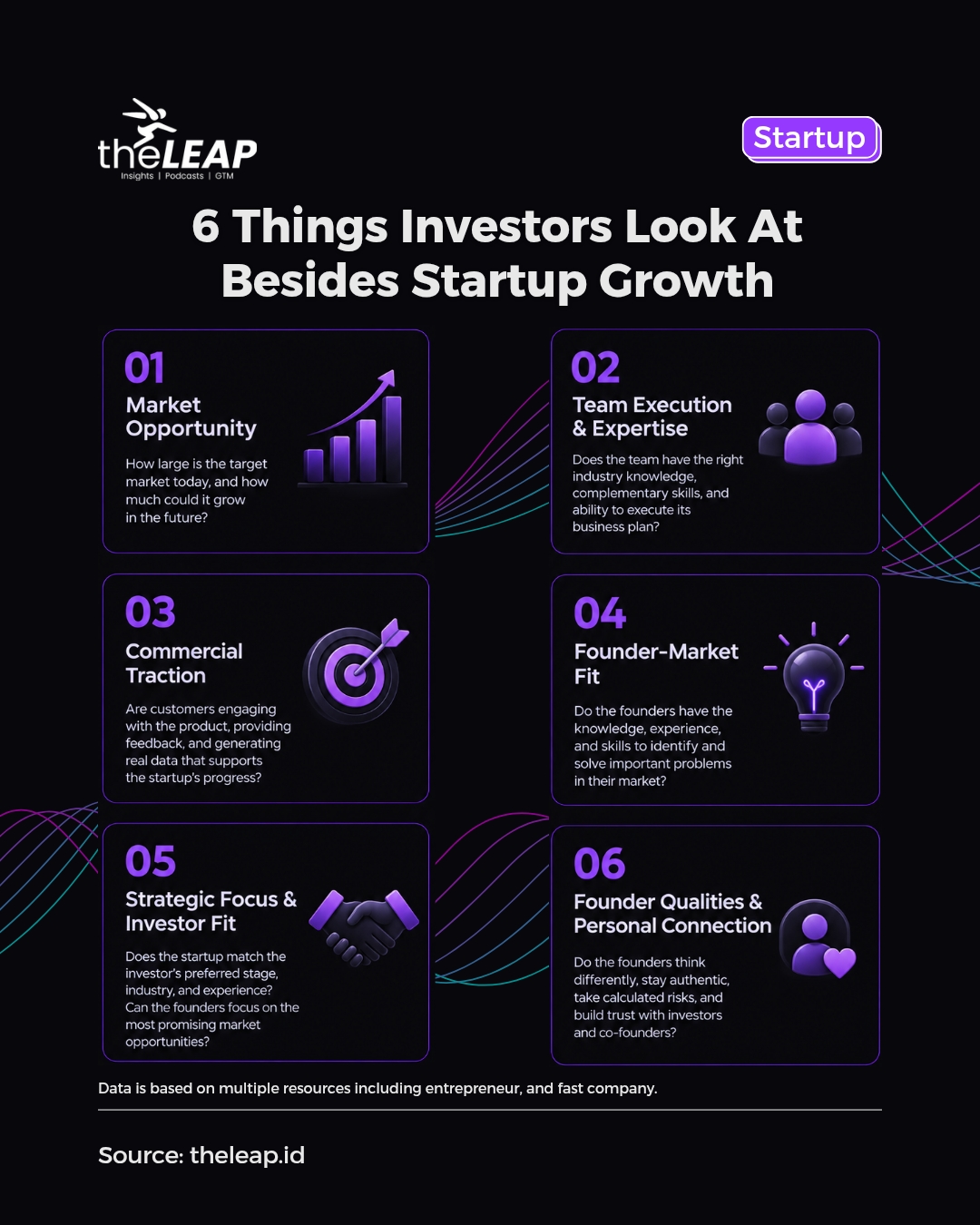
Startup growth can attract investor attention, but it is only one part of the investment assessment. Investors also examine the market opportunity, the team's ability to execute, customer traction, and the founders' capabilities before deciding whether a business is worth backing.
In an article for Entrepreneur, Arie Abecassis identifies five factors investors consider when evaluating startups, including market opportunity, team execution, commercial traction, investor relevance, and personal connection. Kittu Kolluri, a venture capitalist writing for Fast Company, highlights additional founder qualities, such as market expertise, strategic focus, authenticity, and the ability to take calculated risks.
Together, these perspectives outline six areas that help investors assess a startup beyond its growth figures.
1. Market Opportunity: How Much Room Does the Startup Have to Grow?
The size and potential of a target market are important considerations for startup investors. According to Abecassis, investors assess both the current size of a market and how much it could expand in the future.
For startups operating in established markets, differentiation is essential. Investors want to understand what makes a company's product or service distinct from existing alternatives and why customers might choose it over competing offerings.
Startups entering emerging markets face a different opportunity. Investors may be interested in businesses operating in sectors that are still developing but have the potential to expand significantly. In these cases, the appeal lies partly in the possibility of entering a market before it becomes established.
The central consideration is whether the market offers enough opportunity to support the startup's ambitions. Founders need to demonstrate an understanding of their target market and explain where their business fits within it.
2. Team Execution and Expertise: Can the Founders Deliver?
A promising market and business idea are not enough if the team lacks the capabilities to execute its plans. Investors therefore assess whether founders have the experience, knowledge, and complementary skills needed to build the business.
Abecassis emphasizes the importance of domain expertise and a team with strengths across areas such as sales, marketing, product development, and operations. These capabilities help founders address different business needs rather than relying on a single area of expertise.
Team chemistry also matters. Building a startup requires founders to work together through difficult decisions and changing circumstances. Their ability to collaborate can influence how effectively they turn plans into action.
Kolluri reinforces this point by highlighting the importance of relationships between co-founders. Whether they have known each other as colleagues, classmates, friends, or family members, founders need to establish a working relationship that allows them to communicate, listen, and handle disagreements.
He also notes that existing hierarchies can complicate partnerships if they affect how founders work together. Investors may therefore look beyond individual credentials to understand whether the people leading the company can function effectively as a team.
3. Commercial Traction: Is There Evidence of Customer Interest?
Commercial traction helps investors assess whether a startup is making progress beyond developing its initial idea. Abecassis points to customer engagement, feedback, and real data as useful indicators when evaluating a company's progress.
Customer interactions can reveal how people respond to a product or service. Feedback can also help founders understand what works, identify shortcomings, and refine their approach.
For investors, these signals provide a more concrete basis for assessing a startup than the founders' plans alone. They can help demonstrate that the team is taking action, engaging with potential customers, and learning from the market.
Abecassis also highlights the value of real data in supporting a startup's claims. Rather than relying solely on assumptions, founders can use the information they gather to explain their progress and the direction of the business.
Traction is therefore one part of the broader assessment of whether a startup can translate its opportunity into a functioning business.
4. Founder-Market Fit: Do the Founders Understand the Problem?
Beyond evaluating the team as a whole, investors consider whether the founders are well suited to the market they want to serve. Kolluri describes this as founder-market fit: the alignment between a founder's knowledge, experience, skills, and the problem the startup is trying to solve.
Founders with relevant expertise may have a deeper understanding of customer needs and the challenges within their industry. Their experience and professional networks can also help them identify opportunities and navigate the market.
Kolluri acknowledges that some entrepreneurs succeed in industries they have not previously worked in, but characterizes this as uncommon. In his view, founders who understand their market are generally better positioned to recognize meaningful problems and develop solutions.
He also emphasizes the importance of thinking differently. Founders who challenge conventional assumptions, identify overlooked opportunities, or develop a distinct vision for a market may offer investors a compelling reason to pay attention.
This does not simply mean presenting an unusual idea. Founders must also be able to explain their thinking and demonstrate the passion and commitment needed to pursue their vision.
5. Strategic Focus and Investor Fit: Is the Startup Pursuing the Right Opportunities?
Investors assess not only a startup's potential but also whether it fits their own investment focus. Abecassis identifies investor relevance as an important factor, including the startup's stage, industry, and the investor's experience.
Founders can use this understanding to identify investors whose interests and backgrounds align with their business. An investor who understands a startup's industry or stage may be a more relevant potential partner than one whose focus lies elsewhere.
Strategic focus is equally important within the startup itself. Kolluri explains that founders may initially explore different approaches and gather feedback from multiple potential customers. However, they eventually need to concentrate on the most promising opportunities instead of pursuing too many unrelated directions.
He illustrates this challenge with an example of a startup generating $500,000 from five customers, each using its product for a different purpose. Although the business has generated revenue, the diversity of use cases may make it difficult for venture capital investors to see a clear path to scale or understand how the company could raise its next funding round.
The example highlights the distinction between generating revenue and demonstrating a focused business opportunity. Founders need to determine which customer needs and use cases offer the strongest potential, while avoiding distractions that spread their resources too thinly.
6. Founder Qualities and Personal Connection: Can Investors Trust the People Behind the Business?
Investment decisions are not based solely on market analysis and business performance. Abecassis also identifies personal connection as a factor that can influence how investors view founders.
That connection may come from shared professional or educational backgrounds, a trusted mutual contact, or an investor's personal impression of a founder. Abecassis encourages founders to be authentic rather than overly focused on selling themselves, and to understand an investor's background when preparing for a meeting.
Kolluri similarly stresses honesty and authenticity. Founders who pretend to know everything or conceal what they do not understand risk undermining trust. Being willing to acknowledge uncertainty, learn from mistakes, and respond to feedback can help establish credibility.
Another important quality is the ability to take calculated risks. Kolluri argues that founders must be willing to pursue opportunities despite uncertainty, while also understanding the risks involved. This requires making considered decisions, quantifying risks where possible, and acting even when complete information is unavailable.
He also highlights the importance of managing ego. Founders need enough confidence to communicate their vision, but they must remain open to learning, questioning their assumptions, and improving their products. Recognizing mistakes and taking responsibility when things go wrong are part of that process.
For investors, these qualities offer insight into how founders may respond to the challenges of building a company. Alongside market knowledge, execution skills, and customer traction, authenticity, sound judgment, and the ability to build relationships contribute to the broader picture investors consider when evaluating a startup.
This article was created with AI assistance.
We make every effort to ensure the accuracy of our content, some information may be incorrect or outdated. Please let us know of any corrections at [email protected].
Read More