


 Thursday, 19-11-26


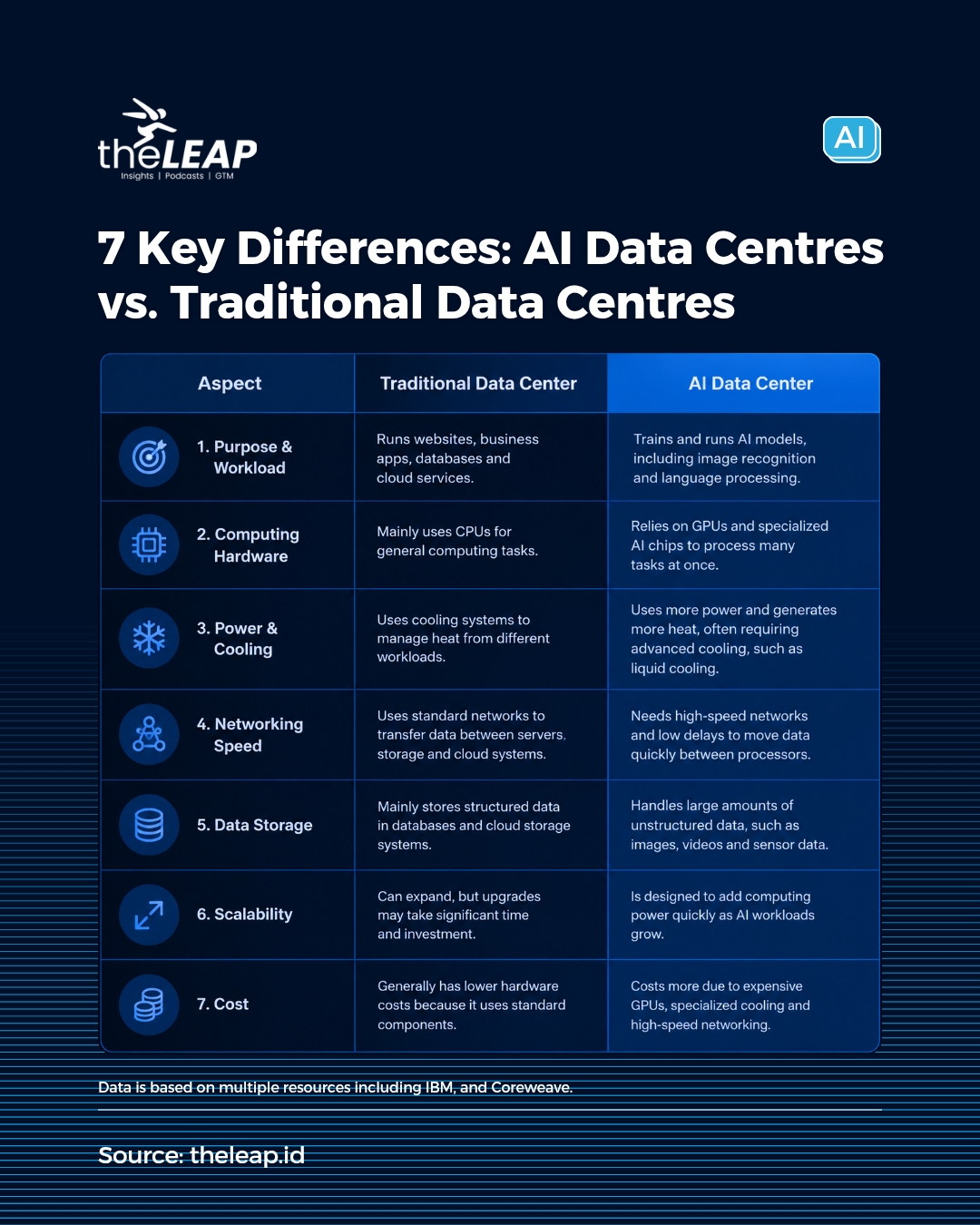
AI data centers are designed to support complex artificial intelligence (AI) workloads, while traditional data centers focus on general computing tasks as AI continues to expand rapidly.
The two types of facilities differ in their purpose, hardware, cooling, networking, storage, scalability, and costs.
1. Purpose and Workload
Traditional data centers support a wide range of computing needs, including web hosting, enterprise applications, databases, and cloud services. They handle diverse workloads that may not require intensive processing power.
AI data centers are built specifically for AI and machine learning (ML) applications. They are optimized to process large volumes of data, run deep learning models, and support AI-driven tasks such as natural language processing and image recognition.
2. Hardware and Infrastructure
Traditional data centers typically use central processing units (CPUs) to handle computing tasks. These processors are efficient for business applications, storage, and networking, but they are not optimized for AI workloads.
AI data centers rely heavily on graphics processing units (GPUs), tensor processing units (TPUs), and other specialized AI accelerators. GPUs can process thousands of tasks simultaneously, making them suitable for AI training and inference.
3. Cooling and Power Consumption
Traditional data centers require substantial cooling systems to manage heat generated by their equipment. Their power consumption is generally balanced across different workloads.
AI data centers generate significantly more heat because of the high processing power of GPUs. As a result, they require advanced cooling solutions, such as liquid cooling, to maintain efficiency and prevent overheating.
4. Networking and Data Processing
Traditional data centers use standard network architectures to transfer data between storage systems, servers, and cloud environments. These networks support their general computing requirements.
AI data centers require high-speed networking and low-latency connections because AI workloads involve rapid data movement between processors. These capabilities support the processing demands of AI applications.
5. Storage and Data Management
Traditional data centers primarily store structured data in databases and cloud storage systems. Their storage infrastructure supports a range of general computing and business applications.
AI data centers handle large amounts of unstructured data, including images, videos, and sensor data. They use high-performance storage solutions such as non-volatile memory express solid-state drives (NVMe SSDs) and parallel file systems to support AI-driven applications.
6. Scalability and Flexibility
Traditional data centers can scale to meet growing computing needs, but expansion often requires significant time and investment.
AI data centers are designed for rapid scaling, allowing organizations to deploy additional computing power quickly as AI workloads grow. Cloud-based AI data centers offer greater flexibility by providing computing resources on demand.
7. Cost Considerations
Traditional data centers generally have lower hardware costs because they use standard computing components.
AI data centers are more expensive because of the high cost of GPUs, specialized cooling systems, and high-speed networking components.
This article is a summary of several original articles.The full versions can be read at the following links:
https://www.ibm.com/think/topics/ai-data-center
https://rcrwireless.com/20250327/fundamentals/ai-data-center-difference
This article was created with AI assistance.
We make every effort to ensure the accuracy of our content, some information may be incorrect or outdated. Please let us know of any corrections at [email protected].
Read More