





 Wednesday, 07-10-26








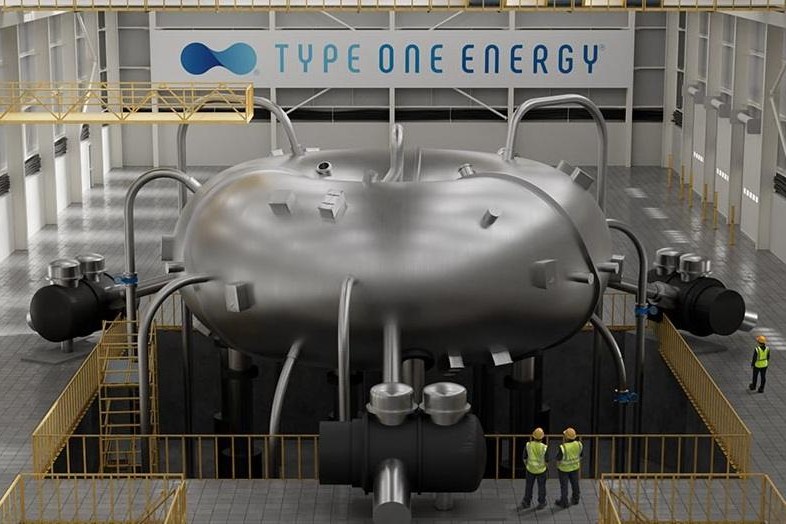
The US is targeting the development of the world’s first commercial fusion power plant, with a planned capacity of up to 400 megawatts (MW) of electricity, enough to power roughly 226,000 US homes based on a Tennessee Valley Authority (TVA) benchmark (06/10).
Known as Project Infinity, the development will be located at TVA’s Bull Run site in East Tennessee and is being developed by Knoxville-based fusion energy company Type One Energy.
Project Infinity will include Infinity One, a stellarator engineering prototype, and Infinity Two, a planned commercial fusion plant designed to generate 400 MW of electricity.
Project Infinity Targets Commercial Fusion Power
Type One Energy has completed a USD 200 million Series B financing round to support the development of its fusion technology for Project Infinity.
“The Series B financing enables us to remain focused on advancing our stellarator technology and Project Infinity design activities, while working with experienced industrial partners to deliver the first commercial fusion power plant at TVA’s Bull Run site,” Type One Energy CEO Christofer Mowry said.
The company plans to use Infinity One as an engineering prototype to design and test the systems needed for a commercial fusion plant.
Infinity Two is planned as the next step, with the facility expected to produce 400 MW of commercial fusion power at the Bull Run site.
Stellarator Technology Designed to Confine Fusion Plasma
Nuclear fusion involves combining two light atomic nuclei into a heavier nucleus, releasing a large amount of energy.
One of the main challenges is maintaining the extremely hot plasma required for fusion while keeping it away from the reactor walls.
Stellarators use complex magnetic fields to confine the plasma. Although the technology has been studied for decades, it has not yet generated electricity on a commercial scale.
According to Type One Energy, the main challenges for stellarator fusion now involve engineering and large-scale deployment rather than plasma physics.
The company’s FusionDirect technology combines advanced manufacturing, computational physics, and high-field superconducting magnets to address these challenges.
Type One Energy Plans Partner-Based Fusion Development
Type One Energy plans to work with existing energy and industrial companies rather than developing every part of the project itself.
The company said this partner-based model could reduce development costs and risks while shortening the time needed to bring fusion plants online.
The approach could also allow several commercial fusion projects to be designed at the same time, rather than waiting for one facility to be completed before starting another.
The latest financing round was co-led by Breakthrough Energy Ventures and Clutterbuck Capital, with participation from Lowercarbon Capital, Siemens Energy Ventures, SiteGround Capital, and other investors.
Carmichael Roberts of Breakthrough Energy Ventures said fusion’s main challenge is deploying the technology rather than making new scientific discoveries.
“We are pleased to deepen our support as the company advances Project Infinity and its international partnerships,” Roberts said.
Project Infinity Extends to International Partnerships
Type One Energy is also pursuing another commercial deployment through the UK Infinity Fusion Consortium.
The company is working with Tokamak Energy, AECOM, Sheffield Forgemasters, and Barclays on the initiative.
“Fusion has the potential to become an important source of reliable, low-carbon energy at scale,” Enrique Gonzalez Zanetich, a partner at Siemens Energy Ventures, said in a press release.
“This investment strengthens our position in the fusion field as we continue to explore the technologies and collaborations that can help advance commercialization.”
PHOTO: ESGTODAY
This article was created with AI assistance.
We make every effort to ensure the accuracy of our content, some information may be incorrect or outdated. Please let us know of any corrections at [email protected].
Read More