





 Monday, 05-10-26








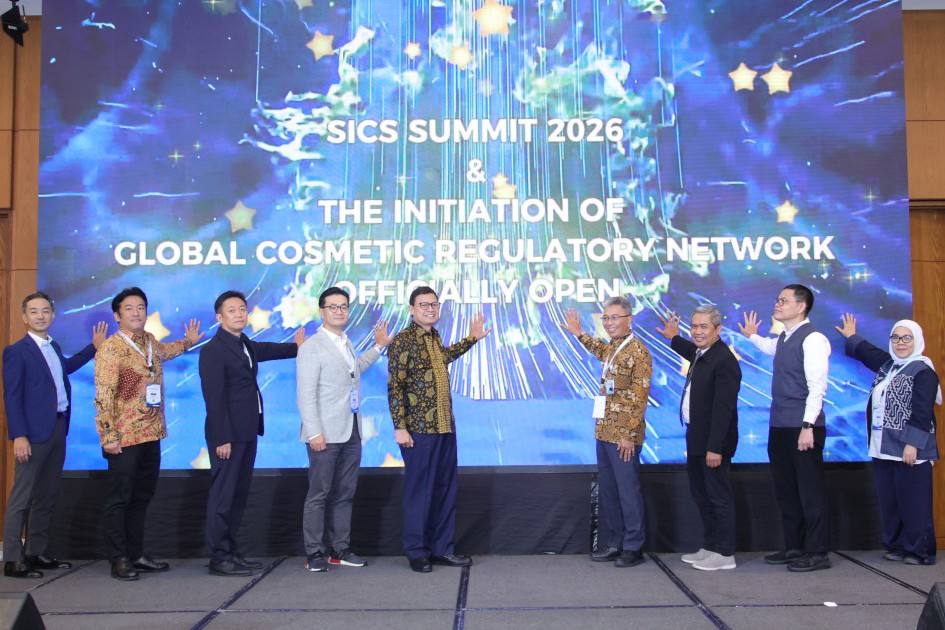
Indonesia’s Food and Drug Authority (BPOM) has strengthened its international regulatory cooperation by initiating the Global Cosmetic Regulatory Network (IGCRN), a forum designed to facilitate dialogue and information exchange among cosmetic regulators, academics and industry players from different countries.
The forum was organized by BPOM in collaboration with the Society of Indonesian Cosmetic Scientists (SICS) and Cosmobeauté Indonesia at the Indonesia Convention Exhibition (ICE) BSD, Tangerang, on October 2–3, 2026.
BPOM Brings Global Regulators and Cosmetics Industry Together
The IGCRN brought together around 160 participants, including regulators, industry representatives, academics, students and BPOM officials.
Regulatory delegates came from the Lao PDR Food and Drug Department, the Ministry of Health, and South Korea’s Ministry of Food and Drug Safety (MFDS). International industry participants included Lao Phanthamit Group Company, Cosmetics Europe and representatives from the Swiss cosmetics industry.
BPOM Head Taruna Ikrar said the IGCRN reflects BPOM’s active role in developing global regulatory cooperation while supporting a cosmetics ecosystem that is innovative, safe, sustainable and competitive.
He said differences between national cosmetics regulatory frameworks should not prevent cooperation. Instead, countries can learn from one another as the global cosmetics industry continues to develop.
“Every country has a different cosmetic regulatory framework, but faces similar challenges. These differences provide an opportunity to build international cooperation to learn from one another, share experiences, strengthen capacity, and develop joint solutions,” Taruna said in his keynote speech at the opening of the SICS Summit 2026 and IGCRN.
IGCRN Highlights Regulatory Differences and Common Challenges
Taruna said the growth of the cosmetics industry needs to be accompanied by stronger cooperation among government, academia and business.
The academia-business-government (ABG) approach is intended to connect research outcomes with industry needs while ensuring that innovation can be developed in line with regulatory requirements.
One example is BRIDGE, or Bersinergi dalam Riset Inovatif, Berdaya Saing Global, dan Ekspansi Pasar. The BPOM platform connects researchers with industry partners to encourage the commercialization of research results, including in the cosmetics sector.
To date, 13 cosmetic product research proposals have been submitted through BRIDGE.
“BRIDGE is one of BPOM’s innovations to directly connect researchers with industry. Through this collaboration, research results are expected to move more quickly toward commercialization and product development,” Taruna said.
I Ketut Adnyana, Director of Research and Community Service at the Ministry of Higher Education, Science and Technology, also highlighted the importance of coordinating research involving multiple stakeholders, including industry, to address challenges and capture opportunities in the cosmetics sector.
“At this important moment, we invite industry to take part in research and development in their respective sectors. We hope science, ecology, and innovation can become strong foundations for economic growth and equitable development in Indonesia,” I Ketut Adnyana said.
Sutriyo, President of SICS, emphasized the importance of connecting science and regulation to support cosmetics innovation.
“Science and regulation are not two separate things. They are two hands of the same body. Science without regulation will not be able to optimally benefit society, while regulation without scientific support will not be able to manage risks while promoting innovation,” Sutriyo said.
Global Cosmetic Regulation Covers Safety, Science and Halal Standards
On the first day, the IGCRN discussed cosmetic regulatory frameworks from Indonesia, South Korea, Europe and Switzerland.
The discussions also examined developments in cosmetic science and technology, including innovations in ingredients, technology, formulations and delivery systems, as well as their relationship with market requirements and halal regulations.
BPOM Deputy for the Supervision of Traditional Medicines, Health Supplements and Cosmetics Mohamad Kashuri presented Indonesia’s cosmetic regulatory framework, including developments in cosmetic supervision and the challenges and opportunities facing the industry.
Kashuri highlighted efforts to simplify the process of obtaining BPOM notification numbers, which have also contributed to an increase in the number of cosmetic notifications.
South Korea’s regulatory perspective was presented by Song Young Me, Director of the Cosmetics Evaluation Division at the National Institute of Food and Drug Safety Evaluation under MFDS.
In her presentation, “Korean Cosmetic Regulation: Current Framework and Advancing Cosmetic Safety Assessment,” Song discussed South Korea’s diverse cosmetics industry and expanding market. In 2025, the country’s cosmetics market was valued at around USD12.7 billion, making it one of the world’s major cosmetics markets.
Yu-Lun Huang, Technical Regulatory & International Affairs Manager at Cosmetics Europe, presented the European Union’s perspective through “EU Regulatory Framework for Cosmetics: Definition, Categorisation, Importation and Market Placement.”
Huang said cosmetics regulations need to be implemented seriously to protect the public while also being adapted to the characteristics and development of the cosmetics industry.
She also highlighted similarities between European and Asian cosmetics regulatory frameworks.
The discussion continued with an update on cosmetic science and technology, focusing on developments in cosmetic ingredients and technology and their connection with market requirements.
RNI General Manager of Cosmax Indonesia and Korean Association Executive Committee member Youngkwan Choyang delivered a presentation titled “The Future of Ingredient Innovation to Market Approval: A Research-Driven Compliance Framework.”
The IGCRN also addressed the Halal Cosmetic Regulatory Framework. Heny Rusmiyati, Director of Halal Standardization at the Halal Product Assurance Agency (BPJPH), presented updates on halal regulations for locally produced and imported cosmetics.
IGCRN Declaration Sets Framework for International Cooperation
Following the presentations and discussions, participants signed a declaration initiating the IGCRN.
The declaration marks an initial step toward establishing a more structured international network for communication, knowledge exchange and regulatory cooperation.
The program also included visits to exhibition booths at Cosmobeauté Indonesia 2026.
On the second day, IGCRN participants visited PT Cosmax Indonesia, a cosmetics manufacturing facility. The visit gave participants an opportunity to observe the application of cosmetics production and product development processes directly.
Through the IGCRN, BPOM is opening further opportunities for cooperation with global regulators and stakeholders to strengthen a healthy, transparent and sustainable national cosmetics ecosystem.
The collaboration is also expected to support the competitiveness of Indonesian cosmetics products in global markets and contribute to national economic growth.
PHOTO: POM.GO.ID
This article was created with AI assistance.
We make every effort to ensure the accuracy of our content, some information may be incorrect or outdated. Please let us know of any corrections at [email protected].
Read More