





 Friday, 25-09-26








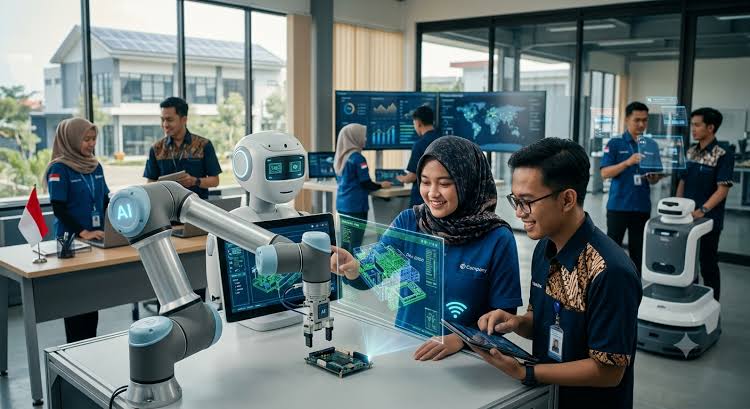
The Southeast Asian digital landscape is undergoing a profound transformation as artificial intelligence tools move from experimental novelties to essential operational drivers. Across Southeast Asia's largest economy, businesses, developers, and government agencies are rapidly integrating advanced machine learning algorithms into daily workflows. Industry reports highlight that artificial intelligence adoption in Indonesia is accelerating at an unprecedented pace, far outpacing regional averages. According to the Microsoft Work Trend Index, over 33 percent of Indonesian professionals are now categorized as advanced AI power users, representing more than double the global benchmark of 16 percent. This rapid uptake underscores a fundamental shift in how the nation approaches technology, labor productivity, and enterprise growth.
This structural evolution is supported by a diverse ecosystem composed of global cloud providers, home-grown tech unicorns, specialized domain startups, and conversational automation platforms. Together, these players are creating the foundation required to support high-density computing and localized algorithm training. As artificial intelligence adoption in Indonesia reaches critical mass, understanding the key market participants and structural drivers provides valuable clarity into the future of the regional digital economy.
Global Tech Giants Anchoring Digital Infrastructure Investment
A crucial foundation for sustained technological expansion is the availability of enterprise-grade cloud computing and data center infrastructure. Recognizing the strategic importance of the Indonesian market, global technology conglomerates have committed billions of dollars toward building localized hyperscale data facilities and AI development centers.
Microsoft made a landmark commitment by announcing a 1.7 billion dollar investment in Indonesia, marking its largest single infrastructure capital deployment in the country over its three-decade presence. This investment funds local cloud data centers, developer training initiatives, and enterprise AI enablement programs designed to ensure low-latency processing and strict compliance with local data residency regulations. Similarly, global infrastructure leaders including Google Cloud and Amazon Web Services continue expanding their local cloud regions to support enterprise workloads. By providing high-throughput GPU clusters and secure cloud frameworks within national borders, these global giants ensure that local enterprises can deploy complex machine learning models without suffering from international bandwidth bottlenecks.
Local AI Startups Pioneering Sector Specific Innovations
While international tech titans supply the essential cloud infrastructure, domestic startups are spearheading localized innovation by solving industry-specific challenges unique to the archipelago. Rather than competing directly against generalized global foundational models, Indonesian entrepreneurs focus on tailored applications across agriculture, customer engagement, smart city monitoring, and supply chain logistics.
A standout pioneer in this domain is eFishery, an aquaculture technology company that achieved unicorn status with a valuation exceeding 1.4 billion dollars. The startup utilizes smart Internet of Things sensors combined with predictive machine learning algorithms to automate fish and shrimp feeding schedules. By analyzing real-time water conditions and behavioral feeding patterns, the platform reduces feed waste by up to 30 percent while maximizing harvest yields for tens of thousands of local aquaculture farmers.
In the sphere of natural language processing and computer vision, local pioneers like Kata.ai and Nodeflux have laid important groundwork. Kata.ai focuses on conversational natural language models specifically optimized for Bahasa Indonesia and regional dialects, allowing major banking and retail enterprises to automate customer service channels. Nodeflux operates as a leading computer vision platform, delivering real-time video analytics for municipal traffic management, public safety, and automated retail analytics across major urban centers.
Open Source LLM Initiatives and National Sovereign AI Development
As digital reliance deepens, national technological sovereignty has emerged as a central strategic priority. Relying exclusively on foreign language models risks diluting local cultural nuances, regional linguistic diversity, and national data security. To address this challenge, leading domestic technology players and telecommunication operators joined forces to launch Sahabat-AI.
Developed through a strategic collaboration between GoTo Group and Indosat Ooredoo Hutchison, Sahabat-AI is an open-source large language model built with up to 70 billion parameters. Unlike global models trained primarily on Western text datasets, Sahabat-AI is specifically trained on extensive corpuses of Bahasa Indonesia alongside multiple regional languages, including Javanese and Sundanese. By offering an open-source model tailored to local linguistic structures, the initiative ensures that developers, academic institutions, and government bodies can build localized applications while preserving national digital sovereignty. The broader ecosystem surrounding artificial intelligence adoption in Indonesia benefits immensely from such open-source frameworks, which democratize access for smaller developers who lack the capital to build massive base models from scratch.
Chat Automation Platforms Transforming MSME Social Commerce
Small and medium enterprises form the backbone of the national economy, contributing significantly to employment and gross domestic product. For these businesses, social commerce conducted via instant messaging applications serves as the primary sales channel. Consequently, specialized conversational automation tools have become major catalysts for operational efficiency.
Platforms like Manychat, alongside local messaging automation providers, have seen widespread adoption among micro-entrepreneurs operating on WhatsApp, Instagram, and Messenger. By integrating automated response flows, product catalog browsing, and basic natural language intent detection directly into WhatsApp API channels, small merchant teams can manage thousands of customer inquiries simultaneously without expanding administrative headcount. The widespread implementation of messaging automation demonstrates how practical artificial intelligence adoption in Indonesia extends well beyond corporate boardrooms down to grass-roots commercial activities.
Financial Technology Platforms Integrating AI for Personal Investment
The financial services and personal investment sectors have also embraced automated analytics to enhance user engagement and financial literacy. Modern retail investment platforms are moving beyond simple transactional interfaces by embedding intelligent decision-support tools directly into their mobile applications.
For instance, multi-asset investment platforms such as Pluang have integrated specialized AI tools, including features like Aura AI, to deliver real-time stock and cryptocurrency analysis. These intelligent systems synthesize complex financial news, market sentiment, and historical price movements into concise summaries for retail investors. By simplifying sophisticated market data into accessible insights, wealth management platforms empower individual traders to make informed decisions while promoting broader financial inclusion across the country.
Future Outlook and Strategic Roadmaps for Regional Digital Transformation
The momentum surrounding artificial intelligence adoption in Indonesia shows no signs of slowing down as institutional capital, regulatory frameworks, and educational initiatives align. Government ministries are actively developing national AI roadmaps aimed at fostering ethical AI deployment, talent development, and data privacy compliance under applicable personal data protection laws.
To sustain this growth trajectory, bridging the digital talent gap remains an essential imperative. Universities, tech incubators, and private tech firms are expanding training bootcamps to cultivate local data scientists, machine learning engineers, and prompt specialists. As localized infrastructure matures and enterprise integration deepens, Indonesia is well-positioned to cement its role as a leading artificial intelligence hub in Southeast Asia, driving economic growth and technological self-reliance across the region.
Read More