





 Wednesday, 23-09-26








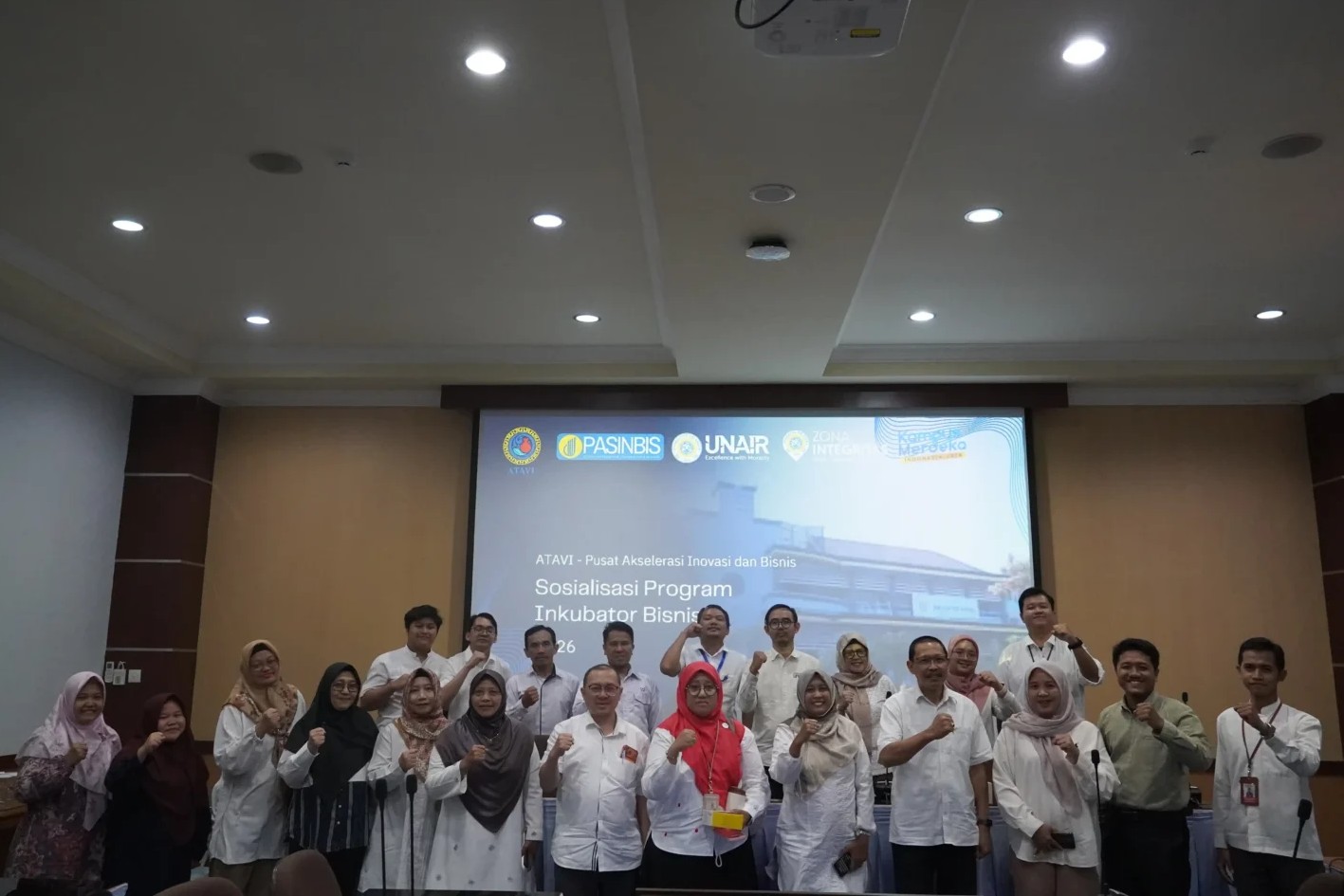
The Center for Innovation and Business Acceleration (PASINBIS) at Universitas Airlangga (UNAIR) held the "Recruitment Start-Up 2026 Batch 2 Registration" socialization to strengthen Indonesia's business ecosystem (18/09). The activity took place in Room 301, Kahuripan Building, MERR-C UNAIR Campus.
PASINBIS UNAIR Secretary Dr. Achsania Hendratmi SE MSi stated that entrepreneurship development is a priority for state universities. She emphasized that this event represents UNAIR's first step toward creating student startup embryos.
"I think this is the first step in entrepreneurship development efforts in various Indonesian universities," she revealed.
Dr. Achsania explained that the startup development process moves through ideation, pre-startup, startup, and post-startup stages. During the startup phase, students receive assistance with prototype testing, market research, and initial product validation.
"Furthermore, we will assist in the business incubation process. Usually, it is contracted for 1 to 3 years. Until then, there are various facilities such as bootcamps, business matchmaking, and early funding. There is also some sort of assistance for the institution," she stated.
The startup development ecosystem receives support from multiple entities across the university. Study programs and faculties offer project-based entrepreneurship courses to generate prototypes and early startup ideas.
The Directorate of Education assists by hosting exhibitions to showcase student creations. Finally, Airlangga Enterprise acts as the terminal unit responsible for expanding the economic scale of student ventures.
This organizational synergy aims to maintain business idea continuity from initial concept generation through final market distribution.
PASINBIS UNAIR is currently evaluating startup units based on their potential and direct contributions to the university. Five startups are currently linked with Airlangga Enterprise to advance entrepreneurship development.
Out of 144 active startup units, 103 have successfully secured funding. Several student-led businesses have launched products, executed market research, and reached initial sales milestones for market validation.
"In line with the Rector's mandate, if possible, the owners can also produce various large startups that not only pass, but contribute directly to industry, whether in the form of share ownership, dividends, or convertible mechanisms," she concluded.
PHOTO: UNAIR
This article was created with AI assistance. We make every effort to ensure the accuracy of our content, some information may be incorrect or outdated. Please let us know of any corrections at [email protected].
Read More