





 Tuesday, 22-09-26








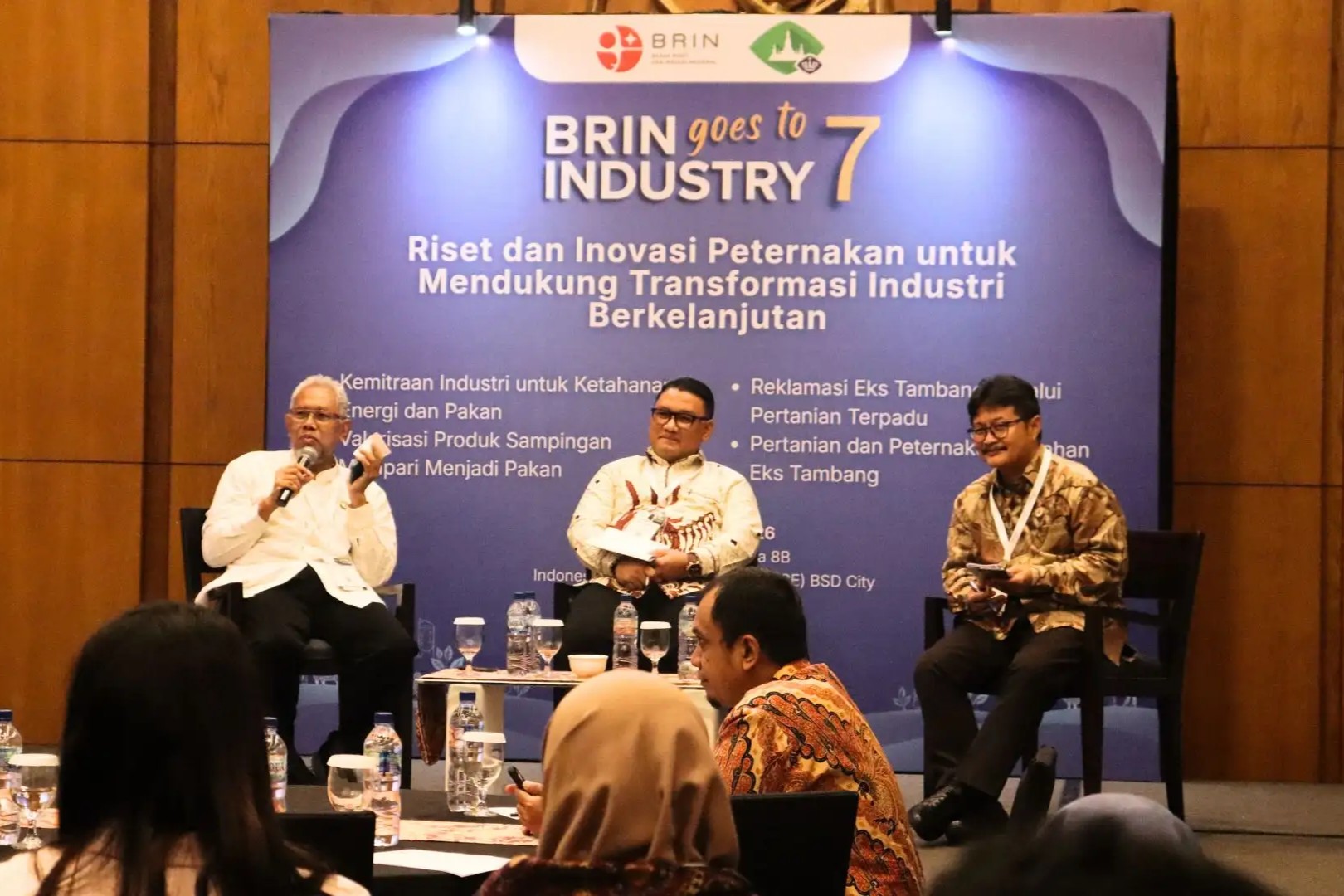
Indonesia’s National Research and Innovation Agency (BRIN) is promoting the use of post-mining land for integrated livestock areas through a circular bioeconomy approach, supporting ecosystem recovery while creating new food and economic opportunities for local communities, according to BRIN Principal Researcher Sindu Akhadiarto at BRIN Goes To Industry 7 in South Tangerang (16/09).
Sindu, a Principal Researcher at BRIN’s Research Center for Animal Husbandry, presented the concept at the Indonesia Convention Exhibition (ICE) BSD City, South Tangerang, on Wednesday, September 16.
He said livestock farming has a broader role than producing meat, eggs and milk. Under the concept being developed by BRIN, livestock can become part of a biological system that helps restore the ecological functions of former mining areas.
“Livestock does not only produce meat, eggs, and milk, but also becomes a biological engine that accelerates the recovery of ecosystem functions and former mining areas,” Sindu said.
Integrated Livestock Farming Connects Several Sectors
BRIN’s Integrated Livestock Farming concept combines livestock, fisheries, horticulture, food crops and plantations. The approach resembles an Agro Techno Park, connecting production activities from upstream to downstream with the support of technology and innovation.
The area is designed not only as a production center but also as a location for research, education and agrotourism. Through this approach, post-mining land can be developed into a smart agro pilot area with ecological and economic functions.
The development potential is particularly large in East Kalimantan. Sindu said coal mining areas in the province cover more than 1.5 million hectares, or around 40% of the national coal mining area.
Former Mining Voids Can Support Fisheries and Agriculture
One of the approaches being studied is the use of mining voids, which are former mining pits that have filled with water. Under the integrated livestock concept, the voids can be used for fisheries, while other parts of the land can be used for horticulture and food crops.
Sindu said experience in developing fisheries in former mining lakes has shown promising results. After almost five years of maintenance, voids have produced commodities such as giant freshwater prawns and tilapia that can benefit surrounding communities.
Post-mining land can also be used for plants suited to the characteristics of the soil. At the Green Belt of PT Semen Indonesia’s Tuban Plant in East Java, horticultural crops such as oranges, grapes and longan have been developed.
For food crops, BRIN has several superior varieties that can be developed under certain land conditions. These include new superior rice varieties that can adapt to acidic soils.
BRIN Collaborates With Industry on Land Rehabilitation
BRIN is strengthening the development of the model through cooperation with industry. In 2026, BRIN worked with PT Bramasta Sakti on the rehabilitation of former mining land through revegetation and phytoremediation to support the development of ruminant livestock farming in East Kalimantan.
PT Bramasta Sakti Director Wiwin Suhartanto said the cooperation has an institutional framework through a memorandum of understanding with BRIN’s Organization for Agricultural and Food Research, followed by a cooperation agreement with the Research Center for Animal Husbandry.
The cooperation could later be expanded to include other research centers, including the Research Center for Fisheries.
“The potential of the land we have and BRIN’s research capabilities can be collaborated so that new innovations can emerge,” Wiwin said.
The collaboration was followed by a BRIN team visit to the company’s site in August 2026. The team assessed the condition of the land and identified potential areas for research.
Wiwin said two water-filled voids were among the sites that could be studied for fisheries research. The BRIN team also collected soil samples from several locations to determine the characteristics and content of the soil as a basis for further research.
The model focuses on recovering former mining land while also developing productive activities based on research and innovation. It integrates livestock, fisheries, food crops, horticulture, education and agrotourism within the proposed development of post-mining areas.
PHOTO: BRIN
This article was created with AI assistance.
We make every effort to ensure the accuracy of our content, some information may be incorrect or outdated. Please let us know of any corrections at [email protected].
Read More