





 Friday, 09-10-26








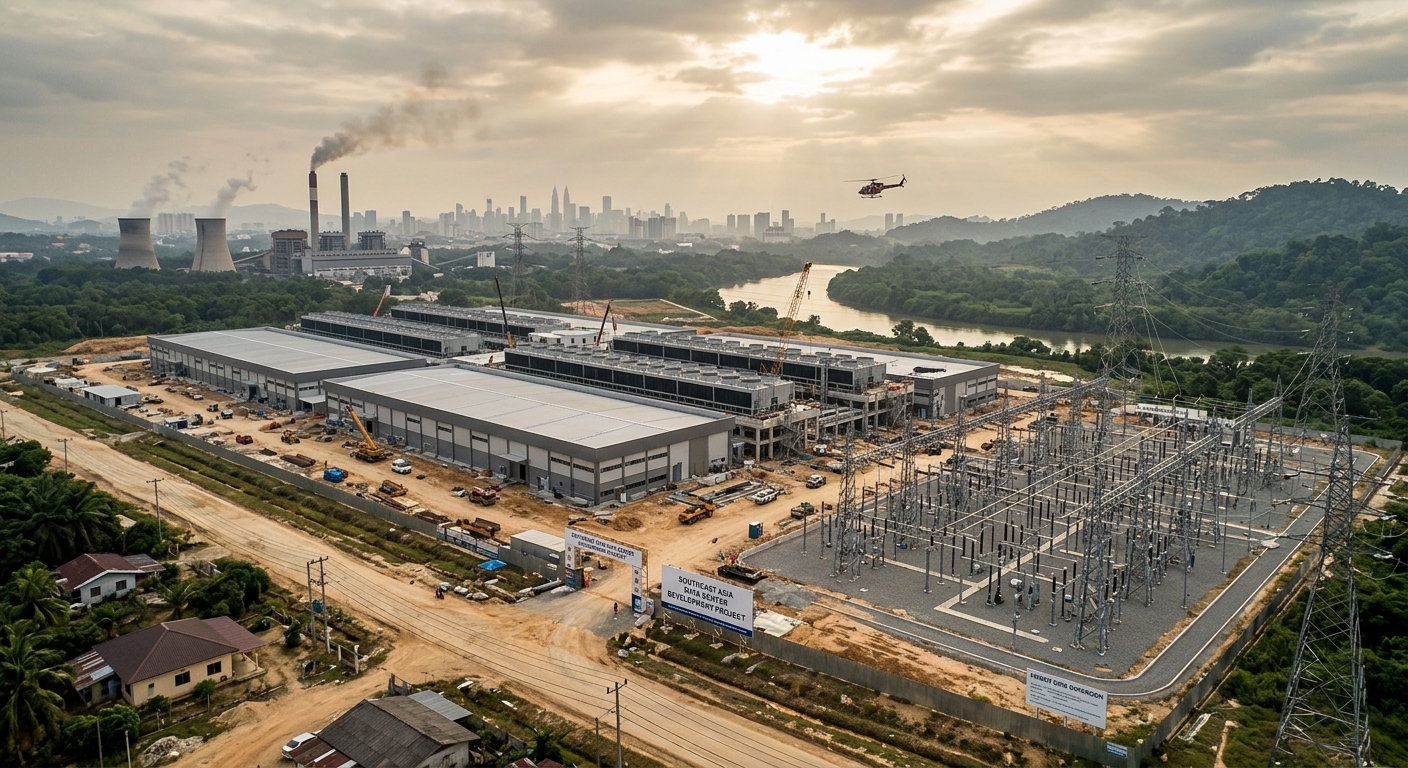
Southeast Asia data center power demand has become the central question in the region's AI infrastructure race this month, and the shift in tone is hard to miss. A few years ago, every headline about data centers in Malaysia, Indonesia, Thailand or Vietnam was framed around the size of the check being written. Amazon, Microsoft and Google were the story, and the number that mattered was the investment figure attached to their announcements. That framing is changing fast. Regulators, utilities and even finance ministries are now asking a blunter question: once these facilities are actually built, who keeps the lights on, and who pays for it.
The timing is not an accident. Thailand's government ordered a full review of its national data center strategy in the third week of August, explicitly citing pressure on electricity, water and the environment. Around the same time, regional analysts pulled together the clearest snapshot yet of how much capacity is now under construction across Southeast Asia, and the numbers made it obvious why governments are getting nervous. This is no longer a story about attracting capital. It is a story about whether the grid can keep up with the capital that has already arrived.
The Investment Numbers Driving The Boom
The scale of what has already been committed to the region is genuinely large. During the first half of 2026, Southeast Asia accounted for roughly half of all data center capacity under construction across the entire Asia Pacific, an outsized share for a region that still lags mature markets in overall digital infrastructure penetration. Malaysia alone had close to 1,039 megawatts under construction, while Thailand had 859 megawatts. Johor's development pipeline, driven largely by overflow demand from land-constrained Singapore, has swelled to roughly 3,088 megawatts. Jakarta, benefiting from Indonesia's sheer population size and digital consumer base, sits near 1,699 megawatts of its own pipeline.
Behind those numbers are some very familiar names. Amazon has said its planned cloud and AI infrastructure spending across Indonesia, Malaysia, Singapore and Thailand will exceed 33 billion dollars through 2039. Microsoft has committed 2.2 billion dollars to Malaysia and 1.7 billion dollars to Indonesia. Google has put 2 billion dollars behind a Malaysian data center and cloud region. None of this is speculative money sitting in a slide deck. Land is being cleared, substations are being planned, and in some cases the GPUs are already running.
What has changed is not the size of these commitments. It is the growing recognition that a headline investment figure and a functioning electricity grid are two very different things, and one does not automatically produce the other.
Why Power Has Replaced Land As The Real Constraint
For most of the last decade, conversations about data centers in this region revolved around land, connectivity and tax incentives. AI has quietly rewritten that hierarchy. Training and running large AI models requires packing far more computing power into the same physical footprint, and that shows up directly in electricity demand. Industry guidance now suggests rack densities in the region could climb from roughly 8 to 12 kilowatts today to as much as 50 kilowatts by 2027, a jump that fundamentally changes what a single facility needs from the grid.
Malaysia illustrates the trajectory most clearly. Data center electricity consumption there is projected to rise close to sevenfold, from around 8.5 terawatt hours in 2024 to roughly 68 terawatt hours by 2030, a figure some analysts say could account for as much as 30 percent of national power demand at the upper end. JPMorgan has put Malaysia's overall data center pipeline at close to 13 gigawatts of IT load, larger than the combined pipelines of Indonesia, Thailand and Singapore. Yet operational facilities in the country are already running below 20 percent of capacity, which means the real strain on the grid has not even started.
Regional forecasters now describe the broader Asia Pacific market as entering a period of power constrained execution. CBRE has projected a shortfall of somewhere between 15 and 25 gigawatts across the region by 2028. That is a striking number given that roughly 70 percent of the ASEAN grid still runs on coal and gas, with commercial nuclear power still years away in every market that has discussed it. Southeast Asia data center power demand is no longer measured only in megawatts of construction activity. It is increasingly measured in terawatt hours of electricity that grids simply do not have yet.
Who Actually Pays For The Electricity
This is where the story gets genuinely uncomfortable for policymakers. Building new grid capacity is expensive, and someone has to fund it. The World Economic Forum estimates ASEAN needs at least 200 billion dollars a year in energy investment through 2030, while current annual investment sits closer to 8 billion dollars. Across the broader power, grid and electric vehicle value chain, the region faces a capital expenditure gap estimated at around 225 billion dollars between now and 2030.
Regional industry guidance has already flagged the uncomfortable mechanism by which some of that gap could quietly get filled. Grid upgrades built specifically to serve large data center clusters are sometimes financed by public utilities and later recovered through general electricity tariffs, meaning ordinary households and small businesses can end up subsidizing infrastructure built primarily for hyperscale computing customers. That imbalance is exactly why Southeast Asia data center power demand has turned into a fiscal and regulatory question, not just an engineering one. Regulators are under growing pressure to write clear rules for grid connection charges, dedicated substations and renewable energy procurement, so that the cost of powering AI does not simply get spread invisibly across everyone else's electricity bill.
Vietnam already offers a preview of what happens when this balance is not managed carefully. The country needs an estimated 128.3 billion dollars in grid investment through 2030, and state utility EVN has spent much of 2026 preparing contingency measures, including demand response programmes and a push to cut consumption by around 10 percent during the dry season peak between April and July, to avoid localized shortages in Ho Chi Minh City. That is a warning sign for neighbors still in the earlier stages of their own data center buildouts.
Thailand's Policy Reversal Signals A Regional Shift
Thailand's move in August is worth dwelling on, because it marks a genuine change in posture rather than routine bureaucratic caution. The country's deputy prime minister and finance minister ordered a comprehensive review of the national data center strategy, stating plainly that investment needed to deliver real economic value while minimizing pressure on electricity, water and the environment. Thailand's Board of Investment has separately revised its incentive framework so that only projects meeting specific technology, energy efficiency and domestic contribution requirements can access the most generous tax breaks, which can run up to eight years of corporate income tax exemption.
Thailand's policy reversal is the clearest sign yet that governments are treating Southeast Asia data center power demand as a risk to actively manage, not simply an investment figure to chase. Other markets in the region are likely to follow with similar reviews in the coming months, especially wherever hyperscale announcements have outpaced visible grid planning.
The Water Problem Hiding Behind The Power Problem
Electricity gets most of the attention, but water is quietly becoming just as contentious. Cooling dense server racks in a tropical climate consumes enormous volumes of water, and regional guidance suggests a single mid sized facility can use more than a million liters a day. Malaysia has already seen public pushback over water availability near major data center clusters in Johor, prompting some developers to shift toward recycled water and closed loop cooling systems. Any government reviewing its data center policy because of electricity pressure will almost certainly find water sitting right behind it on the same list of concerns.
What This Means For Value Capture Across The Region
The deeper question underneath all of this is whether Southeast Asia ends up owning a meaningful share of the AI economy it is helping to build, or simply hosts the physical infrastructure for computing power that is designed, owned and monetized elsewhere. A large share of what makes a data center expensive, from the GPUs to specialized networking gear to advanced cooling systems, tends to come from international supply chains rather than local ones. Data centers also employ far more people during construction than during ongoing operation, so headline job announcements can overstate the lasting local economic benefit.
Every forecast of Southeast Asia data center power demand assumes stable, affordable electricity will be available when needed, an assumption regional grid operators are no longer willing to make quietly. Governments that tie their data center strategies to renewable energy procurement, domestic supplier development and local AI research stand a far better chance of capturing lasting value than those competing mainly on cheap land and generous tax breaks.
The Road Ahead
Southeast Asia is not going to stop building data centers, and it should not. Digital demand from its own consumers, let alone the broader AI race, is real and still growing fast. But the easy phase of this story, in which the only question was how many billions of dollars a country could attract, appears to be ending. How governments answer the harder question over the next two years, of who actually pays for the electricity behind Southeast Asia data center power demand, will determine whether the region ends up with a genuine AI economy or an expensive lesson in what happens when infrastructure ambition outruns the grid supporting it.
Read More