





 Thursday, 09-07-26








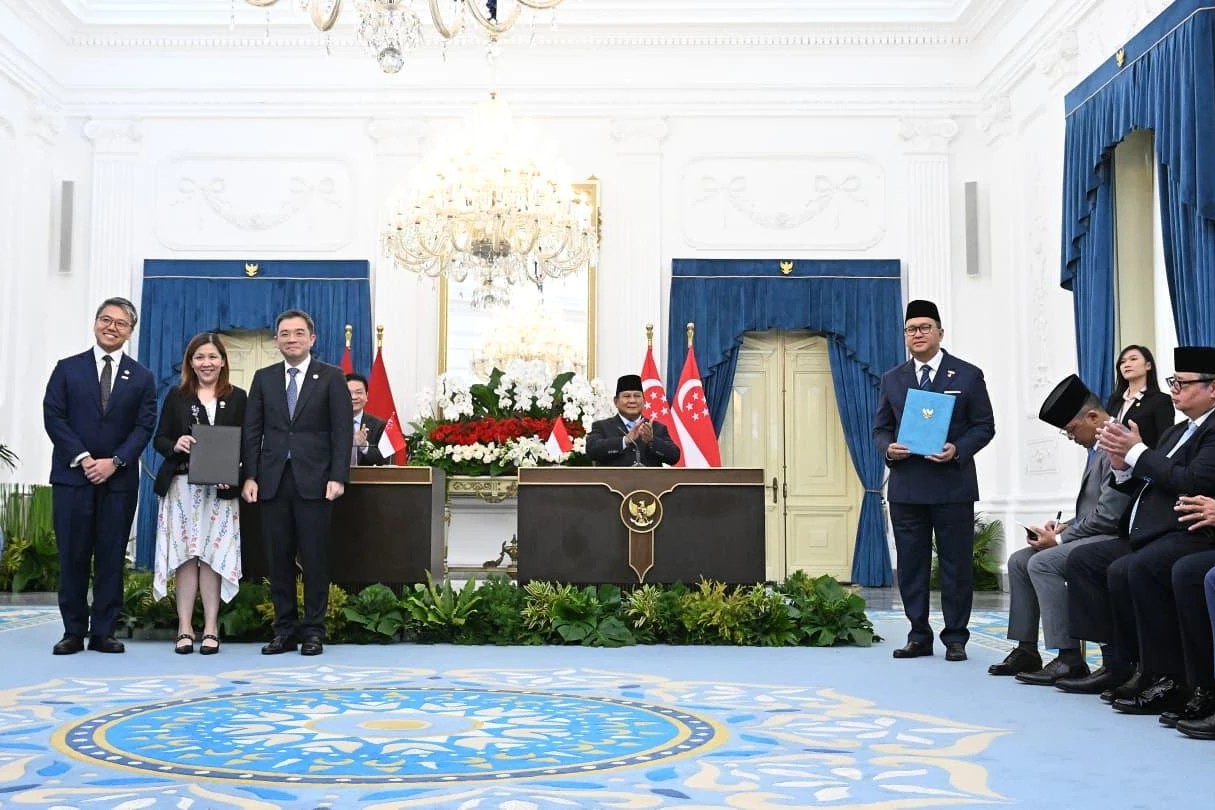
Indonesia and Singapore reaffirmed their commitment to strengthen and accelerate cooperation on cross-border electricity trade (CBET) during the Singapore-Indonesia Leaders' Retreat, where Danantara Indonesia was also designated by the Indonesian Government to spearhead CBET between the two countries (16/06).
The commitment was reaffirmed by Indonesian President Prabowo Subianto and Singapore Prime Minister Lawrence Wong as part of efforts to strengthen bilateral cooperation in low-carbon electricity trade.
Danantara Signs Three MOUs to Advance Low-Carbon Electricity Cooperation
Through its investment arm, Danantara Investment Management (DIM), Danantara Indonesia signed two Memoranda of Understanding (MOUs) with Keppel Electric and Sembcorp Utilities, a wholly owned subsidiary of Sembcorp Industries.
The agreements will explore potential collaboration on the offtake of imported low-carbon electricity, reflecting commercial interest and demand for imported low-carbon electricity in Singapore.
Danantara Indonesia also signed an MOU with Singapore Energy Interconnections (SGEI) to facilitate information sharing and explore potential collaboration on commercial and technical matters related to the development of cross-border electricity interconnections.
Indonesia and Singapore Target 3.4GW or More of Projects by 2035
Singapore's Minister-in-charge of Energy and Science & Technology, Dr. Tan See Leng, and Indonesia's Minister of Investment and Downstream Industry as well as Danantara Indonesia Chief Executive Officer, Rosan Perkasa Roeslani, welcomed the signing of the MOUs.
Both ministers expressed their expectation that the collaboration would lead to the commercial delivery of 3.4 gigawatts (GW) or more of projects by 2035.
According to the joint statement, the projects are expected to strengthen energy connectivity between Indonesia and Singapore while supporting decarbonisation in both countries, including by catalysing new investments and jobs in Indonesia's clean energy sector.
Governments to Develop Regulatory Frameworks for Cross-Border Electricity Trade
To support the projects, Indonesia and Singapore will develop their respective regulatory frameworks, policies, and requirements related to cross-border electricity trade, including enabling conditions for investment based on agreed milestones and timelines.
The two governments will also develop and adopt a Cross-Border Renewable Energy Certificate (REC) Framework that aligns with international standards to support the tracking and accounting of cross-border RECs before the first flow of electricity.
Minister Tan said, "Several potential electricity export projects in Indonesia have made good progress. With political will from our two governments and close coordination between the Ministry of Trade and Industry (MTI) and our Indonesian counterparts, I am confident that these projects can successfully navigate the remaining hurdles and commence operations within the decade. This will usher in greater energy security and sustainability for our peoples, generate spin-off benefits for our economies, and put us a step closer towards realising our regional vision of the ASEAN Power Grid."
Minister Rosan said, "I fully share Minister Tan's confidence. Political will is the foundation, but execution is what delivers. Indonesia is fully committed to addressing the regulatory and infrastructural priorities on our side to ensure the project moves before the decade's end. Importantly, this is new, additional generation capacity, distinct from our domestic supply. At its core, this is a catalyst for Indonesia's domestic green industrialisation, the interconnection with Singapore is one expression of a far larger strategic transformation. By building this interconnection, Indonesia envisions to be the champion of the ASEAN Power Grid along with Singapore, and we are proving that regional decarbonisation and high-value economic growth can, and will, happen simultaneously."
PHOTO: DANATARA
This article was created with AI assistance.
We make every effort to ensure the accuracy of our content, some information may be incorrect or outdated. Please let us know of any corrections at [email protected].
Read More