





 Wednesday, 10-06-26








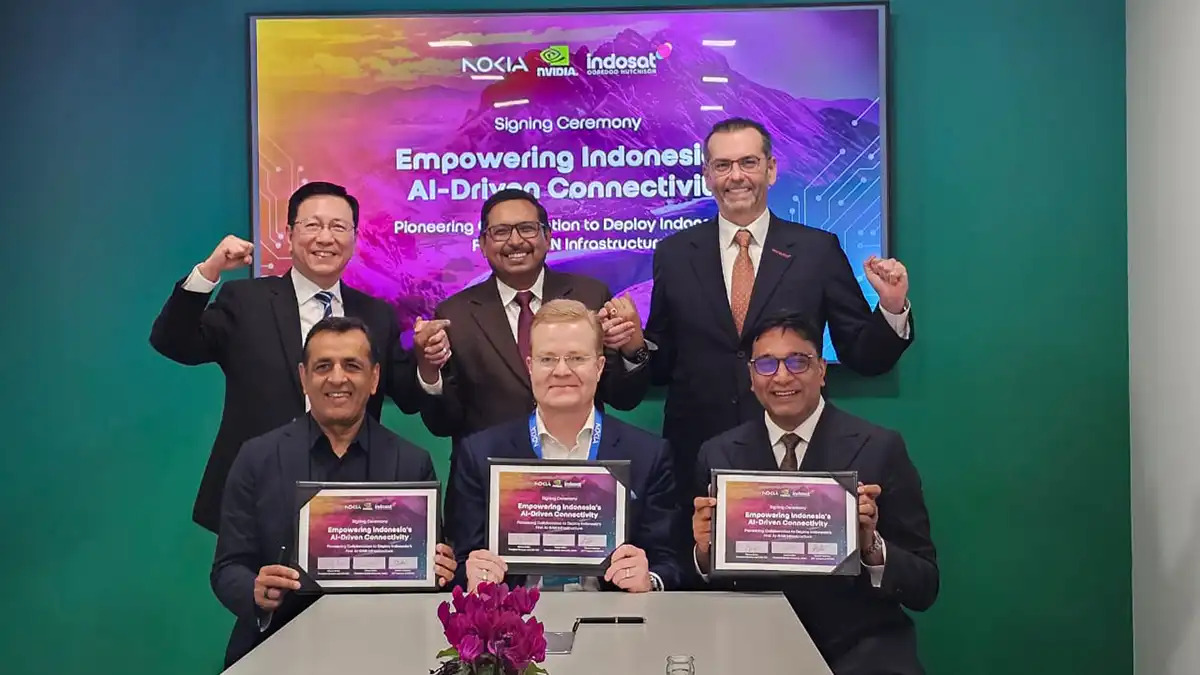
Indosat Ooredoo Hutchison is no longer treating network modernization as a simple capacity upgrade. In the latest agreement with Nokia and NVIDIA, the operator will modernize its nationwide mobile network in Indonesia using advanced 5G radio access network technologies, with Nokia deploying low-band 5G across the full network and mid-band 5G to about 80 percent of the footprint over the next three and a half years. The companies also said AI-RAN field trials in Indonesia are targeted for the end of 2026.
That scope matters because the partnership goes beyond coverage expansion. The agreement also ties Indosat’s network roadmap to AI-integrated capabilities developed with NVIDIA, while Indosat is building an AI Grid that combines centralized AI factories with distributed AI-RAN infrastructure. According to the report, practical applications are already underway in government services, healthcare, education, and agriculture, supported by the AI-RAN Innovation Center in Surabaya. In other words, this is not just about faster mobile speeds. It is about building an operating model for an AI-powered telecom network.
Why This AI-RAN Partnership Matters Now
The timing is important. Nokia’s own AI-RAN strategy frames the radio network as a software-driven platform that can support AI workloads, improve performance, and create new monetization opportunities beyond connectivity alone. In its March 2026 press release, Nokia said its strategic AI-RAN partnership with NVIDIA had already reached significant progress, including customer integrations and functional tests with Indosat, and it described AI-RAN as a foundational step toward AI-native networks and 6G.
That is a major shift in how telecom infrastructure is being understood. For years, network upgrades were judged mostly on coverage, throughput, and congestion relief. Nokia now argues that mobile networks must also be built to host AI applications at the edge, not just move traffic from one place to another. Its AI-RAN materials say operators can use the architecture to run AI workloads, optimize the radio network with AI, and support ultra-low latency services that are increasingly required by modern applications.
The business logic is clear. If a network can carry data, compute AI workloads, and automate operations on the same infrastructure, then the operator is no longer selling only connectivity. It is also selling intelligence, efficiency, and service quality. Nokia says AI-RAN can help operators move from validation to commercial deployment, while NVIDIA’s leadership has described the model as a way to make the network support business needs rather than forcing business needs to fit the network.
Indosat’s earlier work with Nokia also shows that this is not a sudden pivot. Nokia said in July 2025 that it had deployed Nokia Energy Efficiency across Indosat’s nationwide RAN, using artificial intelligence and machine learning to reduce idle equipment and cut energy demand without harming performance. That means the current AI-RAN push sits on top of an existing pattern of AI-based network optimization, not on a blank slate.
What The Rollout Actually Includes
The rollout itself is wide in scope. According to Technode Global’s report on the agreement, Nokia will deploy low-band 5G across Indosat’s full network footprint, while mid-band 5G will cover about 80 percent of the network over the next three and a half years. Nokia will also provide Habrok and Pandion radio families, Levante basebands, centralized RAN, and advanced network management and automation platforms. Those components are what turn the AI-RAN idea into a working telecom architecture.
This is important because the value of AI-RAN depends on the underlying radio stack. Nokia’s March 2026 release said its AI-RAN tests with Indosat were run on NVIDIA GPU-accelerated infrastructure, and that AI and RAN workloads could run simultaneously on shared GPU resources. In practical terms, that means the network can support radio functions and AI tasks at the same time, which is the technical foundation for the new model Nokia is promoting.
The field-trial timeline is also revealing. The companies said AI-RAN field trials in Indonesia are targeted for the end of 2026, which suggests the partnership is moving through a staged implementation process rather than trying to commercialize everything at once. That is sensible for a national network upgrade of this size, especially in a market as geographically complex as Indonesia.
The broader strategic message is that Indosat wants to modernize from the core of the network outward. By combining low-band coverage, mid-band expansion, AI-integrated infrastructure, and automation platforms, the company is setting up a network that can scale service quality while preparing for future AI-enabled products. Nokia’s framing of AI-RAN as part of the AI supercycle and a bridge toward AI-native 6G makes the intent even clearer.
The AI Grid And The Monetization Opportunity
The most interesting part of the deal is the AI Grid concept. According to the report, Indosat is building a structure that links centralized AI factories with distributed AI-RAN infrastructure, and the first use cases are already being explored in government services, healthcare, education, and agriculture. That matters because it connects the network directly to sectors where better latency, better reliability, and better edge processing can create tangible public value.
This is also where the monetization story becomes more concrete. Nokia says AI-RAN creates new monetization opportunities by enabling operators to host AI workloads at the edge and support more advanced AI services. The company’s own materials describe AI-RAN as a way to transform the RAN into a software-driven platform optimized for AI, which can support everything from improved spectral efficiency to external AI workloads. That is a different business model from traditional connectivity, and it explains why operators are taking the architecture seriously.
Indosat is particularly well placed to test that model because it has already been positioning itself as an AI-powered tech company rather than a standard telco. In Nokia’s July 2025 announcement, Indosat said the energy-efficiency deployment reflected its commitment to sustainability and its transformation into an AI-powered TechCo, while Nokia said the solution helped optimize energy savings and network performance at the same time. That continuity suggests the AI-RAN rollout is part of a longer corporate shift, not a one-off technology purchase.
There is also a clear operational upside. AI-based network automation can reduce idle equipment, improve efficiency, and make it easier to manage traffic patterns in real time. Nokia’s sustainability announcement said the solution can lower energy costs and carbon footprint without negative effects on network performance or customer experience. If that logic scales into AI-RAN, Indosat could improve both economics and service quality at once.
What This Means For Indonesia’s Digital Economy
For Indonesia, the partnership carries a larger policy message. A nationwide AI-RAN rollout suggests that digital infrastructure is moving toward a model where connectivity, compute, and automation are increasingly integrated. That could help close service gaps, support local innovation, and make advanced digital services more viable outside the country’s biggest business centers. Nokia and NVIDIA both emphasized that the architecture is intended to support digital transformation at scale, while Indosat said the collaboration reinforces inclusive and sustainable digital transformation.
It also shows that 5G is no longer being sold as a standalone upgrade. In Nokia’s framing, AI-RAN is already part of the route to AI-native 6G, and the company says the shift is being driven by the explosive growth in mobile AI traffic. That means operators have to prepare now for a network environment where AI services are not a side effect, but a core workload.
For enterprises and public institutions, the stakes are equally high. If AI-RAN performs as planned, it can support use cases that need low latency, high efficiency, and better edge intelligence. That is relevant for healthcare delivery, education access, government services, and agriculture, especially in a vast country where network quality can determine whether digital services are actually usable. The AI-RAN Innovation Center in Surabaya gives this vision a concrete base for testing and development.
The bigger conclusion is simple. Indosat’s agreement with Nokia and NVIDIA is not just a network modernization contract. It is an attempt to redefine what a telecom network is supposed to do. Instead of being a passive carrier of data, the network is becoming a place where intelligence is processed, services are created, and value is captured closer to the user. That is why AI-RAN is becoming one of the most important phrases in Indonesia’s telecom roadmap.
Read More