





 Monday, 08-06-26








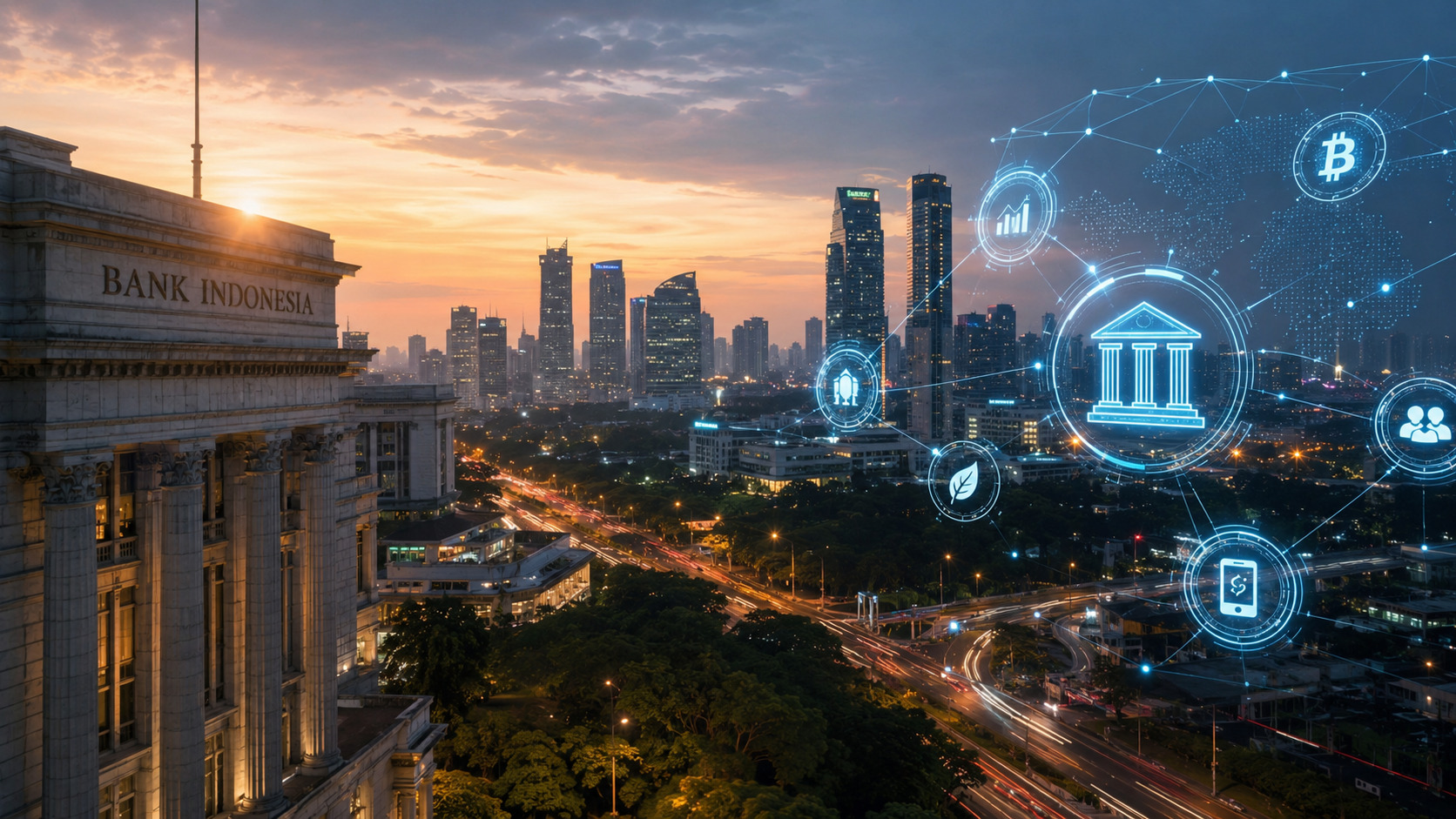
Indonesia’s revised Undang-Undang Pengembangan dan Penguatan Sektor Keuangan (UU P2SK) is not just another regulatory update. It is a major redesign of the country’s financial architecture, passed by the DPR on 4 June 2026 and framed by lawmakers as a way to strengthen governance, deepen markets, and support economic growth. The law builds on Law No. 4 of 2023, which already set out a broad reform agenda for financial-sector stability and institutional coordination among Bank Indonesia (BI), OJK, LPS, and the Ministry of Finance.
For business leaders, the real story is bigger than the headline fight over central bank independence. The revised P2SK suggests Indonesia is moving from a bank-centric system toward a more layered financial stack, where capital markets, digital assets, derivatives, carbon markets, and non-bank platforms matter more than before. That is an inference, but it follows directly from the law’s expanded scope and the way regulators are already implementing it.
The End of the Bank-Centric Economy
For decades, Indonesian finance has revolved around banks: deposits in, credit out, and policy transmission through conventional monetary channels. BI’s own website still describes its core mission as maintaining rupiah stability, while the revised P2SK expands the institution’s role into supporting economic growth and job creation as well. That shift matters because it broadens the policy lens from pure stability to a more growth-oriented mandate.
That change is not happening in a vacuum. Reuters reported that the revised law was passed while the rupiah was under pressure and investors were already uneasy about market conditions and the independence of financial institutions. The same reporting noted that the bill gives lawmakers new mechanisms to make binding recommendations to BI, OJK, and LPS, which is why global investors are reading this as a governance story, not just a technical rewrite.
Kemenkeu’s own explanation of the revision is more measured: it says the purpose is to keep the financial system resilient, secure, and able to absorb shocks. That official framing matters, because it positions the revision as an attempt to strengthen the foundation rather than to change the direction of policy. In practical terms, though, the direction is already changing.
Why OJK Is Becoming Indonesia’s Most Powerful Economic Institution
Among the most consequential effects of P2SK is the widening of OJK’s reach. OJK has already published rules that place it at the center of Indonesia’s next-generation financial perimeter, including digital financial assets, crypto, derivatives, and carbon markets. In January 2025, OJK said the transition of digital assets and crypto supervision from Bappebti to OJK was being carried out under the mandate of P2SK, with Bank Indonesia taking over supervision of certain FX and money-market-linked derivatives.
This is a major signal for founders and investors. OJK is no longer just the watchdog for banks and listed securities. It is becoming the regulator of the infrastructure layer where digital finance, tokenized markets, and new forms of risk management converge. That matters because the next generation of financial products will not fit neatly into one silo. They will sit at the intersection of payments, capital markets, digital assets, and data-rich distribution platforms.
The revised P2SK also gives lawmakers a broader role in evaluating financial authorities. Reuters said Parliament will be able to issue binding recommendations to BI, OJK, and LPS, while the DPR’s own post-vote summary said the revision covers 17 material items, including institutional strengthening, crypto regulation, and enforcement in financial services. That combination makes OJK not just more powerful, but also more exposed to political and policy scrutiny.
The Coming Battle for Financial Infrastructure
The deepest implication of P2SK is not about one institution winning more authority. It is about Indonesia building financial infrastructure the way it once built digital infrastructure: through layered rules, interoperable systems, and clearer ownership of each part of the stack. BI’s 2030 payment-system blueprint already says that, under P2SK, BI is mandated to maintain payment-system stability in support of economic growth. The law is therefore shaping the rails, not just the riders.
For the market, this is where the real opportunity starts. The revision and its implementation pull together capital-market development, derivatives, carbon trading, and digital-asset supervision into a single institutional framework. DPR said the package also includes Danantara bonds, an international financial center, UMKM bad-debt treatment, mineral and strategic commodity exchanges, and banks in recovery processes. That is a broad menu, but the strategic pattern is clear: Indonesia wants more funding channels than traditional bank lending alone.
This is especially relevant for companies hunting capital. A richer financial infrastructure can lower financing friction, broaden investor participation, and create more instruments for hedging and funding. For technology companies, it also opens room for embedded finance, new distribution models, and product architectures that rely on regulated digital assets or derivatives. That is an inference, but it is a reasonable one given how the law is already being translated into OJK and BI rules.
Who Wins: Banks, Fintechs, Big Tech, or Digital Asset Platforms?
The short answer is: not one winner. The longer answer is that the revised P2SK redistributes advantage across the ecosystem. Banks still matter, especially because the law also addresses business expansion and bank recovery. But they are no longer the only gateways to financial scale. OJK’s derivative and crypto rules show that non-bank products are moving into the mainstream regulatory perimeter, while BI’s role in market infrastructure keeps payment and hedging innovation close to the central bank.
For fintechs, this creates both opportunity and discipline. The opportunity is clearer licensing, better institutional legitimacy, and more room to build products on top of regulated rails. The discipline is higher compliance cost and a tighter supervisory environment. For crypto players, the message is even clearer: the era of regulatory ambiguity is shrinking. OJK’s 2025 rule makes explicit that digital-asset supervision is becoming part of the formal financial system, not a side market.
For banks, the threat is subtler. They are not being displaced overnight, but the privileged position of banks in the financial value chain is weakening as capital markets, digital assets, and platform finance gain legal infrastructure. In that sense, the revised P2SK is less about deregulation than about reallocation of financial gravity.
What Every CEO Needs to Know About Indonesia’s Next Financial Decade
Executives should read P2SK as a long-term operating manual for Indonesia’s financial economy. The law signals that future growth will be more policy-coordinated, more data-driven, and more institutionally mediated. It also suggests that the most important competitive advantage will increasingly belong to firms that understand regulation as product design, not just legal risk.
The practical takeaway is simple. If your business depends on payments, treasury, financing, asset tokenization, carbon markets, insurance, or capital formation, P2SK is now part of your strategy layer. The law is shaping the channels through which money moves, how risk is priced, and which institutions can scale new financial products. That makes it one of the most important policy shifts for founders, CFOs, and investors in Indonesia’s next decade.
Read More