





 Friday, 10-07-26








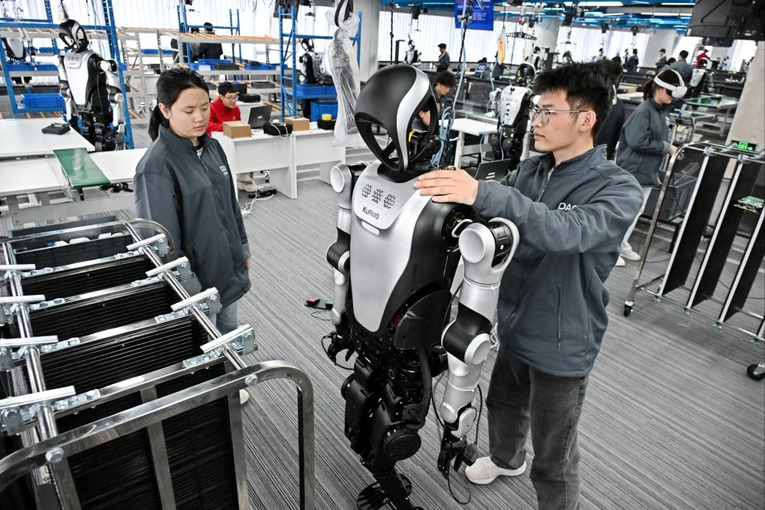
China is rapidly strengthening its position in the global artificial intelligence race through aggressive investment in advanced computing systems, robotics, and next generation digital infrastructure. From offshore underwater data centers powered by renewable energy to autonomous tea picking robots operating in agricultural fields, the country is demonstrating how artificial intelligence is moving beyond software and becoming deeply integrated into physical industries.
The latest developments highlight how China AI Infrastructure is evolving into a strategic national priority. Beijing is not only focused on building large language models and semiconductor capabilities, but also on creating sustainable infrastructure capable of supporting massive AI workloads. This includes green data centers, industrial automation, intelligent robotics, and energy efficient computing systems.
As global competition around artificial intelligence intensifies, China is positioning itself as a leader in scalable and environmentally conscious AI deployment. The combination of renewable energy integration, robotics innovation, and industrial digitization could significantly reshape the future of manufacturing, agriculture, cloud computing, and smart cities.
Underwater Data Centers Become China’s New AI Strategy
One of the most striking examples of China AI Infrastructure development is the launch of the world’s first commercial offshore wind powered underwater AI data center near Shanghai. The project reflects China’s ambition to solve one of the biggest challenges in artificial intelligence development, namely the enormous energy consumption required to power advanced computing systems.
Traditional AI data centers consume vast amounts of electricity because modern GPU clusters generate intense heat. Cooling systems alone can account for nearly half of a data center’s energy usage. China’s underwater solution attempts to address this issue by using naturally cool seawater as a passive cooling mechanism.
The underwater facility located in Shanghai’s Lingang Special Area reportedly houses nearly 2,000 servers inside pressure resistant subsea modules. These servers support AI workloads, cloud computing, large language model development, big data processing, and 5G infrastructure services. The project integrates directly with offshore wind farms, allowing renewable energy to supply the majority of the facility’s electricity demand.
Developers claim the underwater data center achieves a Power Usage Effectiveness ratio below 1.15, significantly better than many traditional land based facilities. Lower PUE ratings indicate greater energy efficiency because more electricity is used for computing rather than cooling operations.
The rise of China AI Infrastructure in underwater environments also reflects the growing urgency surrounding sustainable computing. As artificial intelligence models become larger and more computationally intensive, countries worldwide are searching for ways to reduce energy costs and carbon emissions associated with AI operations. China’s experiment may inspire similar projects globally, especially in regions facing land shortages, energy constraints, or environmental concerns linked to hyperscale data center expansion.
Smart Robotics Transform Traditional Industries
Beyond data centers, China AI Infrastructure is also expanding aggressively into robotics and industrial automation. One example attracting significant attention is the deployment of AI powered tea picking robots in agricultural regions. Tea harvesting has traditionally depended on manual labor because delicate tea leaves require precise handling. However, labor shortages and rising operational costs are encouraging agricultural companies to adopt intelligent automation technologies.
China’s tea picking robots use advanced computer vision systems, sensors, and machine learning algorithms to identify mature tea leaves and harvest them with minimal damage. These robots can operate continuously, improve harvesting consistency, and reduce dependence on seasonal labor.
The use of robotics in agriculture demonstrates how China AI Infrastructure is extending beyond urban technology hubs into rural industries. Artificial intelligence is increasingly becoming a tool for productivity enhancement across multiple sectors, including farming, logistics, healthcare, and manufacturing.
China has been investing heavily in industrial robotics as part of its broader modernization strategy. The country is already one of the largest markets for industrial robots globally. Government support, local manufacturing capabilities, and growing AI research ecosystems are accelerating the development of intelligent machines capable of handling complex real world tasks.
This robotics expansion could have significant implications for global supply chains. As automation improves efficiency and reduces labor dependency, Chinese manufacturers may further strengthen their competitiveness in high value industries. At the same time, the adoption of AI powered robotics raises important questions regarding employment transitions, workforce reskilling, and digital inequality. Governments and businesses worldwide will likely face increasing pressure to prepare workers for a more automated economic landscape.
Renewable Energy Powers the Future of AI
Another defining characteristic of China AI Infrastructure is the growing integration between artificial intelligence and renewable energy systems. AI development requires enormous computing power, which in turn demands reliable and scalable electricity supplies. China’s underwater data center strategy directly connects renewable offshore wind power with digital infrastructure. Reports indicate that more than 95 percent of the facility’s electricity may come from renewable sources. This approach reflects a broader trend in which technology companies seek greener methods of powering AI operations.
Globally, the expansion of AI has intensified concerns about electricity demand. Large AI models require massive GPU clusters running continuously for training and inference tasks. Data centers supporting these systems consume significant amounts of power, contributing to rising emissions and pressure on energy grids.
By combining offshore wind farms with subsea cooling systems, China AI Infrastructure projects attempt to create a more sustainable computing model. If successful, this approach could reduce freshwater usage, minimize land requirements, and lower carbon emissions.
The focus on green AI infrastructure is also strategically important for China’s long term economic goals. The country aims to position itself as a leader not only in artificial intelligence but also in renewable energy technology and low carbon industrial development.
This dual strategy may help China strengthen its influence in emerging industries where sustainability and digital transformation increasingly overlap.
China’s AI Race Intensifies Global Competition
China AI Infrastructure development is occurring amid intensifying technological rivalry between major economies. Artificial intelligence is now viewed as a critical component of economic competitiveness, military capability, industrial modernization, and geopolitical influence.
The United States continues to dominate several areas of advanced AI research and semiconductor innovation. However, China is aggressively investing in domestic alternatives, including AI chips, cloud infrastructure, robotics, and smart manufacturing systems.
The underwater data center project highlights China’s willingness to experiment with unconventional infrastructure solutions in pursuit of technological leadership. While companies such as Microsoft previously tested underwater data center concepts through Project Natick, China appears to be among the first countries to move toward large scale commercial deployment integrated with renewable energy systems.
China’s progress in AI infrastructure also reflects strong coordination between government agencies, state backed enterprises, and private technology firms. This ecosystem enables rapid deployment of experimental technologies that may take longer to commercialize elsewhere.
At the same time, challenges remain significant. Underwater facilities face engineering risks including corrosion, maintenance difficulties, cable reliability issues, and operational complexity. Robotics adoption may also encounter technical limitations in unpredictable real world environments.
Nevertheless, China’s aggressive push into AI infrastructure demonstrates how artificial intelligence is increasingly becoming an industrial and energy challenge rather than purely a software issue.
The Future of China AI Infrastructure
The future of China AI Infrastructure will likely depend on how effectively the country balances technological expansion with sustainability, energy efficiency, and economic resilience. Underwater data centers, AI powered robotics, and renewable energy integration represent only the early stages of a broader transformation. China is expected to continue investing heavily in smart manufacturing, intelligent logistics, autonomous transportation, and AI enabled industrial systems over the coming years.
As artificial intelligence becomes central to economic competitiveness, infrastructure innovation will play a decisive role in determining which countries lead the next phase of digital transformation. China’s recent breakthroughs suggest the country is pursuing a long term strategy that combines industrial scale deployment with environmental considerations. Whether these projects ultimately become global models or remain experimental initiatives, they clearly signal that the future of AI infrastructure may look very different from today’s conventional data center landscape. The rapid evolution of China AI Infrastructure is therefore not merely a domestic story. It is becoming a key part of the global conversation about energy, automation, sustainability, and the future direction of artificial intelligence itself.
Read More