





 Monday, 12-10-26








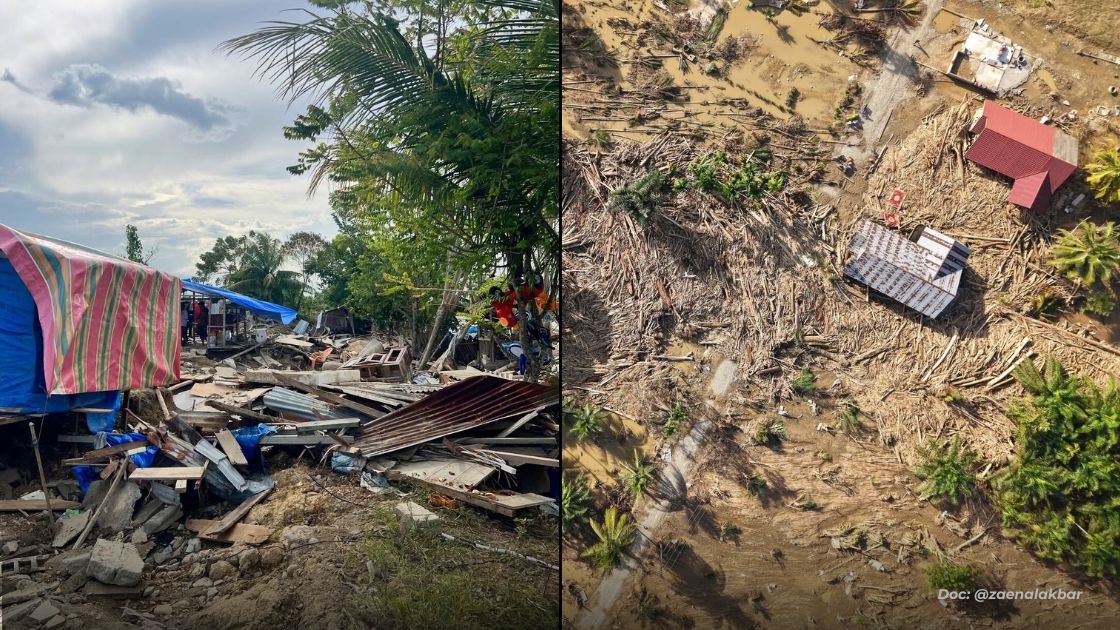
In the flooded lowlands of Aceh Tamiang and parts of North Sumatra, white flags flutter from rooftops, not as symbols of surrender, but as desperate calls for survival. Since late November 2025, Tropical Cyclone Senyar has unleashed one of Indonesia’s deadliest climate disasters in recent memory. More than 1,000 lives have been lost. Around 900,000 people have been displaced. At least 158,000 homes lie damaged or destroyed, many buried under nearly two meters of mud.

Behind these numbers are small farmers, informal workers, and MSME owners, families who once formed the backbone of Sumatra’s agricultural and local trading economy. Today, many are cut off by collapsed roads and bridges, struggling to find food, clean water, or access to markets. This is a humanitarian crisis, but it is also an economic shock with national implications, one that demands immediate compassion and long-term strategic thinking from Indonesia’s business and technology leaders.
Sumatra’s agriculture and mining sectors, valued at more than US$10 billion annually, have been severely disrupted. In a US$1.3 trillion national economy increasingly exposed to climate risk, Aceh’s tragedy is not a regional issue, it is a warning signal.
Immediate Corporate Lifelines: Acting Now to Stabilise Lives and the Economy

On the ground, the situation remains fragile. Entire transport corridors have disappeared. More than 414 health centres are struggling to reopen, while damage to roughly 1,200 schools has left children without access to education, nutrition, or psychological support.
The economic toll is already visible. Total losses are estimated at Rp68.67 trillion (US$4.1 billion). Household consumption in Q4 has fallen by 0.31%, equivalent to Rp18.58 trillion. North Sumatra alone has recorded losses of Rp11.8 trillion, dragging national GDP growth down by an estimated 0.29%.
MSMEs, representing 99% of Indonesian businesses, are among the most exposed. Around Rp12.5 trillion in loans are now at risk, with banks such as BRIS reporting a 5% increase in non-performing loans linked to Aceh exposure. These are not abstract balance-sheet risks; they represent livelihoods that may not recover without swift intervention.
This is where corporate leadership matters. Immediate actions, donations through credible humanitarian channels, repurposing logistics fleets to deliver food and medical supplies, or deploying employee volunteer teams, can save lives in the short term. For technology founders, pro bono tools can have outsized impact: lightweight apps to track urgent needs, or real-time maps identifying households signaling distress with white flags.
Such actions do more than deliver aid. They build trust with local communities, strengthen brand credibility, and demonstrate that business can be a stabilising force in moments of national crisis.
Repairing Broken Supply Chains with Green, Profitable Solutions
The floods have also exposed how fragile Sumatra’s supply chains have become. Palm oil farmers in Aceh report export disruptions of 20–30%, as trucks remain stranded and access roads washed away. The effects ripple through global food and commodity markets, even as local families lose income and food security simultaneously.
Reconstruction needs are estimated at Rp51.82 trillion (US$3.1 billion), with Aceh accounting for Rp25.41 trillion. Poor and rural communities are likely to wait the longest for rebuilding unless alternative models emerge. Environmental analysis indicates that deforestation has amplified rainfall impacts, turning 300mm of rain into a lethal force and eroding at least 1,550 hectares in critical watersheds.
Forward-looking business leaders have an opportunity to intervene differently. Investments in hybrid rail–sea logistics corridors, supported by solar-powered warehouses on higher ground, could reduce future disaster-related losses by an estimated 2–5% of GDP. Partnering with cooperatives to develop “green logistics” platforms, using open data to predict floods and reroute supply chains, can help farmers maintain income continuity even during extreme weather.
Elevated, climate-resilient depots can serve a dual purpose: functioning as emergency aid hubs today and commercial storage facilities tomorrow. These assets can unlock insurance premium discounts of up to 15% while accelerating MSME recovery. As online searches for “Aceh supply chain disruption business solutions” rise sharply, early movers also stand to capture reputational and SEO advantages.
Technology That Connects, Predicts, and Saves Lives

For many flood survivors, the most immediate loss was electricity and communication. In parts of Aceh plunged into darkness, even a signal bar became a lifeline. Starlink’s temporary free internet access in Lhoksukon reached around 40,000 people, enabling families to request help, students to continue learning, and aid groups to coordinate more effectively.
Technology has already proven its value. AI mapping teams and drone deployments, led by university experts and hospitals such as RSUD, have reduced aid delivery delays by up to 50% for nearly 900,000 displaced residents. Satellite imagery from NASA has helped visualise the scale of Senyar’s flooding, highlighting areas most at risk of becoming long-term mud traps.
This momentum should not stop at emergency response. Tech founders can build open-source AI platforms that fuse satellite data with IoT sensors to create predictive flood alerts for Aceh, systems that warn communities early and save lives at minimal cost. Solar-powered drone fleets can deliver food and medicine to isolated areas, using blockchain-based tracking to ensure transparency and prevent diversion.
Over time, these pilots can evolve into scalable “climate tech Sumatra 2025” platforms, integrating disaster response, supply chain resilience, and even psychosocial support applications linked to gig-worker and community wellness. With ESG capital seeking impact-driven returns, such ventures could unlock 15–20% ROI within Indonesia’s rapidly expanding US$100 billion digital economy.
Rebuilding Greener: Turning Recovery into Long-Term Opportunity
Beyond relief and logistics lies the deeper challenge of ecological repair. Large swathes of farmland in Aceh have been rendered unusable. White flags remain visible reminders that climate adaptation has become a matter of survival. Government tenders worth Rp25.41 trillion are now open for reforestation, watershed rehabilitation, and MSME revival, alongside emerging opportunities in carbon markets growing at roughly 15% annually.
Academic research, including studies from UGM, confirms that forest degradation has intensified flood impacts. With Indonesia experiencing an average of 2,726 hydrometeorological disasters each year, incremental fixes will no longer suffice.
Entrepreneurs can lead transformative solutions. Drone-based reforestation programs could seed one million trees annually in critical areas such as Batang Toru, using bio-engineered seeds designed for rapid growth and soil retention. “Sponge city” concepts, featuring permeable pavements, restored wetlands, and AI-monitored mangroves, could absorb up to 70% of runoff, protecting villages while modernising infrastructure.
In agriculture, innovations such as drought- and flood-resistant palm varieties, potentially developed through advanced breeding technologies, could stabilise farmer incomes and link directly to green bonds offering 10–20% returns. In the short term, deploying solar-powered water purification systems to replace damaged facilities can prevent secondary health crises. In the long term, these projects can create new green jobs, turning disaster-affected communities into active participants in Indonesia’s climate-resilient economy.
A Call to Lead with Empathy and Strategy
Aceh’s crisis is a human tragedy first, but it is also a strategic inflection point. Business and technology leaders who respond with empathy, data-driven insight, and sustainable innovation can help rebuild lives while safeguarding critical sectors worth billions of dollars.
The choice is clear: act now to stabilise communities, invest wisely to reduce future risk, and lead Indonesia toward a more resilient economic future. In Aceh, the white flags are still waving. How the business community responds will shape not only recovery, but credibility, for years to come.
Read More