





 Monday, 12-10-26








Strengthening National Food Independence
Indonesia’s ambition to achieve food independence has become a strategic national priority as global risks intensify. The government’s push toward greater self sufficiency aims to reduce vulnerability to global price volatility, logistics disruptions, and import dependence. Yet as the country approaches 2026, the agricultural sector faces persistent structural issues that threaten this goal. Agricultural GDP growth continues to lag behind national economic growth, post pandemic recovery remains uneven, productivity has stagnated, and technology adoption across the sector is still progressing slowly.
These challenges are underscored by widening disparities across key commodities. Rice output has remained relatively stable and corn production continues to improve. However, soybeans and sugar have shown weakening performance. The importation of more than 223 thousand tons of special rice between January and July 2025 further highlights the domestic production gap that Indonesia has yet to resolve. With global economic pressures and high food price volatility expected to continue, the Food Energy Water Nexus approach has become increasingly crucial to ensure policy coherence from upstream to downstream.
Building a Resilient Food System
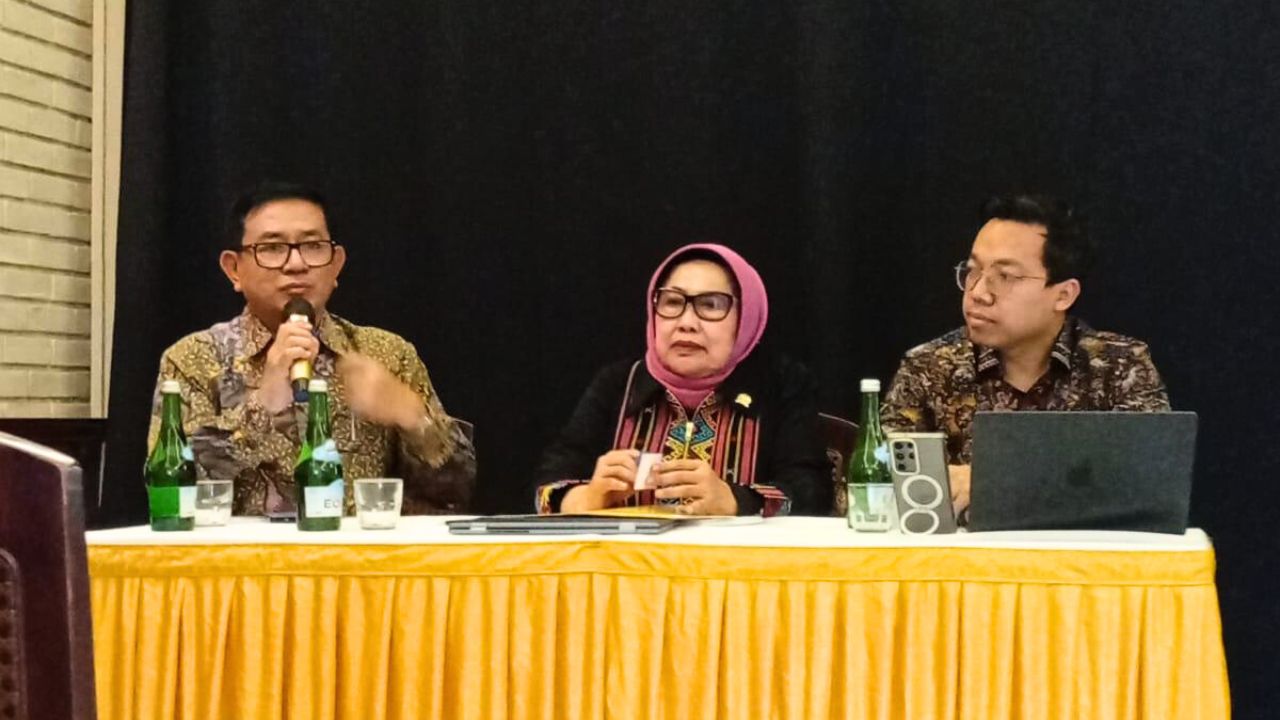
Endang Setyawati Thohari, a member of Commission IV of the Indonesian House of Representatives, emphasized that food security is not merely a matter of boosting production. A resilient food system requires consistent regulation, certainty in land governance, and strong protections for smallholder farmers. She noted that global risks such as fluctuating food prices, geopolitical tensions, and supply chain uncertainties demand that Indonesia strengthen its domestic systems to withstand future shocks.
A holistic agricultural transformation is needed. Endang highlighted several priority areas: strengthening research and seed innovation, modernizing logistics, enhancing input efficiency, and revitalizing irrigation infrastructure. These steps are essential to generating broad based productivity gains. She also underscored the importance of the legislative, budgeting, and oversight functions of Commission IV in ensuring sufficient funding for agricultural programs and accelerating the implementation of the national one map policy to prevent land conflicts.
Equally important is empowering farmers, local communities, and younger generations as central actors within the food ecosystem. This requires expanding access to capital, technology, and fair partnership schemes. Without such inclusion, long term food independence will remain out of reach.
Ensuring Fertilizer Availability and Modernizing Production
Dwi Satriyo Annurogo, Director of Operations at PT Pupuk Indonesia Holding Company, underlined that fertilizer availability, especially nitrogen based fertilizers, plays a critical role in increasing the productivity of rice and other staple commodities. As Indonesia accelerates its vision toward Indonesia Emas 2045, an additional 5.69 million tons of rice production is needed a target that relies heavily on effective and sustainable fertilization.
Dwi Satriyo noted that national fertilizer production capacity remains strong and continues to be strengthened through improvements in distribution governance. Digitalization is being implemented through command centers, monitoring dashboards, and electronic recording systems to ensure that fertilizer subsidy distribution becomes more transparent, accountable, and accurately targeted down to the farmer level.
Looking forward, the transformation of Indonesia’s fertilizer industry will focus on improving energy efficiency, developing precision fertilization practices, and constructing new factories in eastern Indonesia to strengthen national supply chains. These strategic efforts are expected to provide a solid foundation for long term food self sufficiency while supporting the transition toward modern, lower emission agriculture.
Understanding Structural Agricultural Trends
Abra Talattov, Head of the Center for Food, Energy, and Sustainable Development at INDEF, presented a detailed analysis of agricultural sector performance using quarterly data since 2015. He noted that agricultural sector growth stood at around 4.9 percent in the third quarter of 2025, showing higher volatility than national GDP growth, which remained stably above 5 percent. This indicates that agriculture has not yet achieved structural recovery from the impacts of the pandemic.
Rice and corn have shown improving output, but strategic commodities such as sugar and soybeans remain stagnant or in decline. Meanwhile, demand for imported food products including wheat, sugar, and soybeans continues to rise without adequate domestic production capacity to offset it. This situation increasingly strains Indonesia’s 2025 food balance, particularly concerning availability and price stability.
Given these ongoing pressures, the government’s commitment to strengthening food independence is timely, but substantial reform and accelerated implementation are necessary. Addressing productivity challenges, modernizing the food system, and reducing import dependence will be key to ensuring that Indonesia enters 2026 with a more resilient and sustainable agricultural foundation.
Read More