





 Monday, 12-10-26








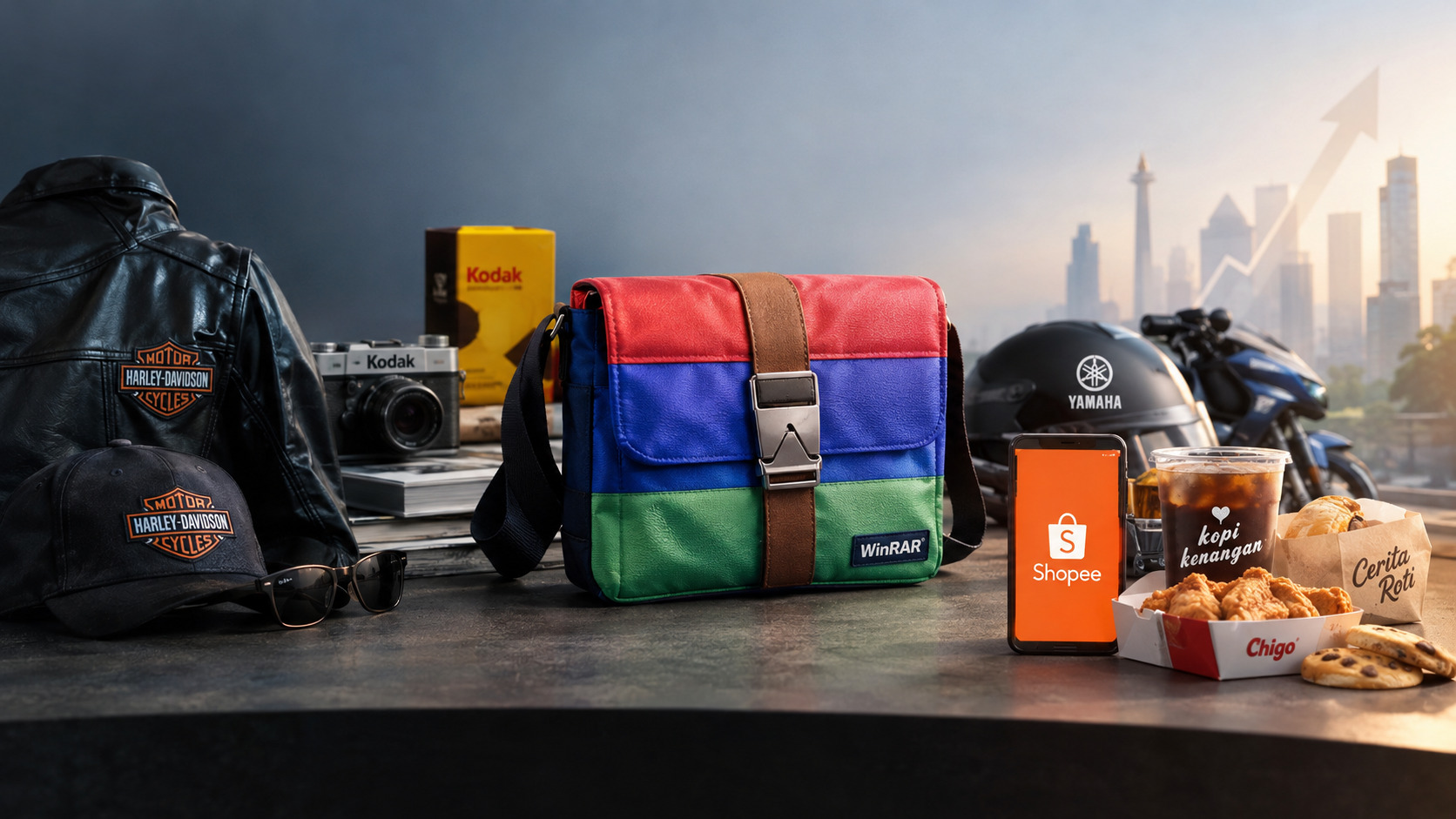
In September, French label tern restocked a $150 messenger bag shaped like the WinRAR icon, about the price of five software licenses, and WinRAR told its famously non-paying users to buy it instead. Tern's announcement drew more than a million views. It is the internet's favorite brand extension story. The data behind the strategy is less cute: an extension amplifies the brand it comes from, and it rarely rescues a business whose core is shrinking.
Licensing is booming, yet most extensions fail
Licensed merchandise and services reached $389.8 billion in global retail sales in 2025, up 5.45% against 4.52% for retail overall, according to Licensing International. Online channels made up 32% of those sales, and for the first time the study tracked social media, which generated 16% of online sales.
Survival is the catch. A study of 83,719 new products across 31 US packaged-goods categories found one in four was no longer bought after a year, rising to about 40% after two. Among 36,994 line extensions, roughly half failed within a year, a rate that halves once seasonal items are removed. A Journal of Marketing meta-analysis of 2,134 effect sizes found that fit with the parent brand matters slightly more than the parent's brand equity, though each still helps a little when the other is weak.
Harley-Davidson: the extension that followed the core down
Harley-Davidson made "growth beyond bikes" a pillar of its Hardwire strategy, and in the third quarter of 2022 apparel grew 41% and licensing 26%. Then the core slid. SEC filings show apparel revenue fell from $271.1 million in 2022 to $215.8 million in 2025, a 20.4% drop, while licensing fell 45% to $21.7 million. Motorcycle revenue dropped 29.8%, from $3.79 billion to $2.66 billion. Apparel and licensing together stayed near 6% of the motorcycle company's revenue throughout: 6.4% in 2022, 6.6% in 2025. They never became a hedge, because they ride on the same brand heat as the bikes.
Today's reset points back to the core. CEO Artie Starrs' Back to the Bricks plan prioritizes dealers, parts and cheaper models, and in July Harley named merchandise agency BDA licensee for dealer apparel, handing design, manufacturing and distribution to a partner.
Kodak and WinRAR: monetizing goodwill, not rebuilding the business
Kodak shows the licensing logic at its cleanest. A New York Times report put its brand-licensing revenue at about $20 million against roughly $1 billion in total revenue, around 2%, spread across 44 licensees. In South Korea, Highlight Brands' Kodak Apparel sold 17 billion won in its first year. The licensee makes and sells the clothes; Kodak collects royalties and relevance.
WinRAR pushes the idea further. Its software revenue is reportedly around $20 million a year, mostly from businesses, since individual users rarely pay for the roughly €36 license. The bag, made by tern, monetizes that audience another way: fans who never bought the software will buy the nostalgia. Each sale contributes to WinRAR, though the amount has not been reported.
Yamaha and Sea: pivots built on capability, not on a logo
Yamaha is the only true pivot among these cases. It began with reed organs in 1887. After the war, president Genichi Kawakami redirected idle wartime machinery and the metal-casting skills used for piano frames toward engines, ordering a confidential prototype in November 1953. Yamaha Motor was spun off in 1955 with the YA-1 motorcycle; its 2025 revenue forecast stood at ¥2.57 trillion.
Singapore's Sea followed the same logic. Its gaming platform Garena launched Shopee in 2015, and Shopee became Southeast Asia's largest e-commerce marketplace by gross merchandise value. Both reused an asset, manufacturing skill in one case and a large gaming audience in the other, not a logo.
What Southeast Asian startups can do
Kopi Kenangan is the closest regional example. The Indonesian coffee chain added Cerita Roti bread in November 2020, then Chigo fried chicken and Kenangan Manis cookies in 2021. In December 2021 it became a unicorn on a $96 million Series C, saying sales had more than doubled in 12 months. Its parent, Kenangan Brands, has reportedly added the affordable Satu Kenangan franchise brand. Public data does not show how each spin-off performs, so the case proves ambition more than success.
Founders without brand equity can borrow it. Jakarta IP Market 2026 opened a Licensing Deal Room for IP owners, brands and manufacturers, with 28 exhibitors, more than 66 properties and a transaction target above Rp100 billion. Indonesia's deputy creative-economy minister advised creators to keep early licensing fees low to build reach.
The cases fall into three models: equity-led licensing (Kodak, WinRAR, Harley), capability-led pivots (Yamaha, Sea) and adjacent-product growth (Kopi Kenangan). Startups with little brand equity should lean on the second and third, and treat collaborations as a megaphone, not a revenue engine. Four rules follow.
- Extend what you do well before you extend your logo. Pick adjacencies where your supply chain, data or distribution already gives an edge, as Yamaha and Sea did.
- Test fit, then trial. A 2025 study of 12,489 line extensions found similar repeat-buyer rates for survivors and failures, but survivors reached more buyers. Budget for trial in year one.
- Share the risk. License out or collaborate once fans exist, and let partners carry production, as Kodak and Harley's BDA deal do.
- Protect the core. Harley's merchandise held near 6% of revenue and fell with the bikes.
Bottom line
Brand extension works when it reuses something real: skill, audience or affection. It fails when it is asked to replace demand the core no longer generates. WinRAR can sell a bag because the icon is instantly familiar, and Yamaha could sell motorcycles because it knew how to cast metal. For founders in Jakarta, Bangkok or Manila, the order is clear: build the core until people care, extend where you already have an edge, and measure whether buyers try the new product before you scale it.
Read More