





 Sunday, 25-10-26








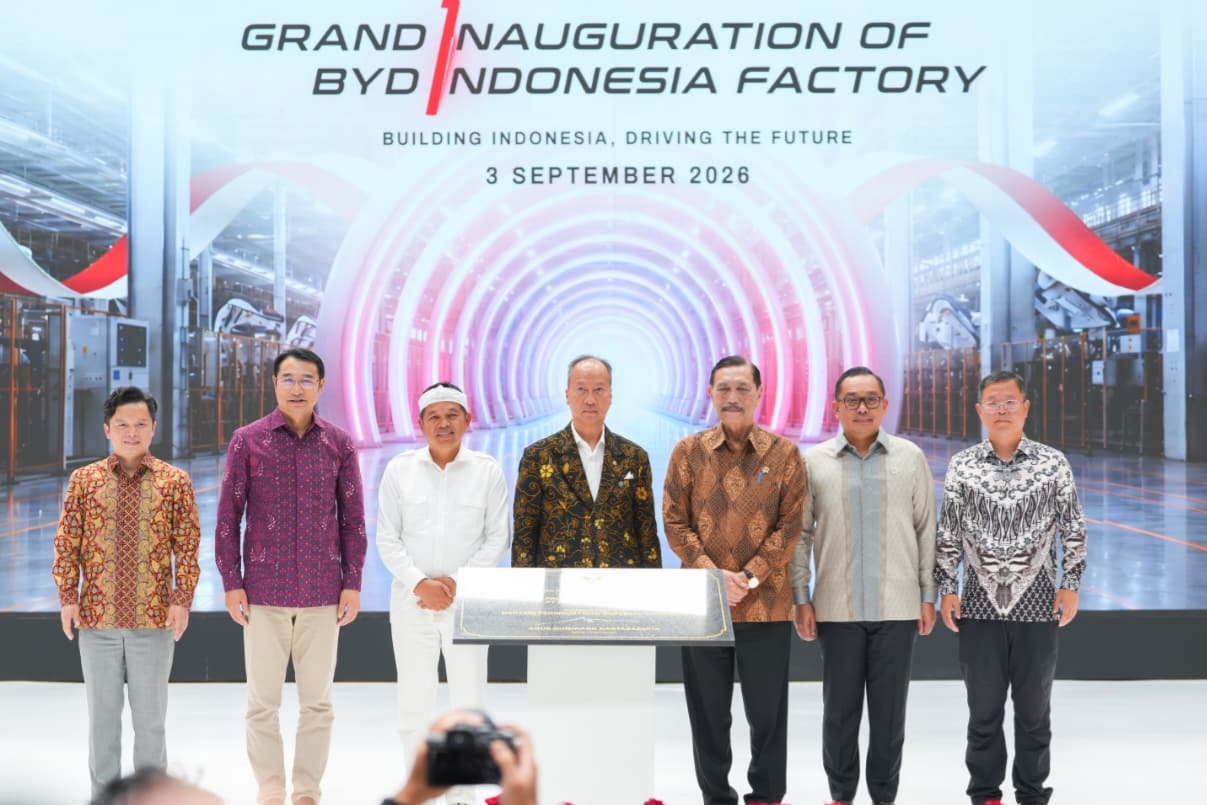
The operation of PT BYD Motor Indonesia’s production facility in Subang, West Java, is expected to strengthen Indonesia’s domestic electric vehicle (EV) manufacturing base and accelerate the development of an integrated national EV industry (3/9).
Industry Minister Agus Gumiwang Kartasasmita said the facility marks an important step in moving Indonesia’s EV sector beyond market growth toward stronger manufacturing capabilities and deeper domestic industrial structures.
BYD Indonesia Factory Marks Shift to Domestic EV Manufacturing
The Ministry of Industry is continuing to accelerate the development of Indonesia’s national EV ecosystem as part of the transformation of the automotive industry into a more competitive, sustainable and integrated sector.
Agus said BYD’s production facility represents a strategic moment for Indonesia to strengthen its manufacturing base and deepen the domestic industrial structure.
“On behalf of the Government of the Republic of Indonesia, we express our highest appreciation to BYD for its trust and commitment to investing and developing electric vehicle manufacturing activities in Indonesia. We are very confident that BYD will continue to grow and succeed in Indonesia,” Agus said at the inauguration of the BYD Motor Indonesia production facility in Subang on Thursday, September 3.
Agus also specifically praised Luhut Binsar Pandjaitan, who attended the event, for his role in facilitating BYD’s investment in Indonesia.
According to Agus, the investment and establishment of the production facility were the result of a lengthy process of diplomacy and government support for strategic investment.
While serving as Coordinating Minister for Maritime Affairs and Investment, Luhut actively supported efforts to bring strategic investments into Indonesia, including through direct diplomacy with BYD’s headquarters in Shenzhen, China.
“I witnessed the process directly and how Mr. Luhut fought so hard to bring the investment into Indonesia, including BYD’s investment. That long process can finally be seen in the establishment of BYD’s production facility in Indonesia,” Agus said.
The development also aligns with Indonesia’s commitment to addressing climate change following the Paris Agreement reached at the 21st UN Climate Change Conference, or COP21.
The government considers EV development an important part of the transition toward a low-carbon economy while optimizing national resources.
The development of Battery Electric Vehicles, known in Indonesia as KBLBB, was further supported by Presidential Regulation No. 55 of 2019 on the acceleration of the battery-based electric motor vehicle program for road transportation.
The regulation was followed by various technical policies covering investment, industry, fiscal measures and EV market development.
These instruments are intended to ensure that EV growth does not only increase domestic consumption, but also creates production capacity and strengthens the national industrial structure.
Indonesia’s Manufacturing Sector Shows Stronger Growth
BYD’s production facility began operating as Indonesia’s manufacturing sector continued to show positive fundamentals.
Data from Statistics Indonesia, or BPS, showed that the non-oil and gas processing industry grew 5.32 percent year-on-year in the second quarter of 2026. The figure was higher than national economic growth of 5.29 percent.
“Manufacturing industry growth of 5.32 percent is already above national economic growth of 5.29 percent. The last time manufacturing growth was above national economic growth was around 14 years ago. This is a very positive signal for our industry,” Agus said.
Other indicators, including the industry’s contribution to gross domestic product, export performance, investment realization and employment, also showed positive developments.
Indonesia’s manufacturing performance was also reflected in its Manufacturing Value Added, or MVA.
According to World Bank data, Indonesia’s MVA reached USD275.61 billion in 2025, up from USD265.07 billion in 2024. The increase moved Indonesia from 13th globally in 2024 to 12th in 2025 in terms of manufacturing value creation.
“This is not data from the Ministry of Industry nor BPS data, but World Bank data. This means Indonesia’s manufacturing industry’s ability to create added value continues to increase,” Agus said.
Within ASEAN, Indonesia recorded the highest MVA. Agus said Indonesia’s manufacturing value added was approximately twice that of Thailand.
Across Asia, Indonesia ranked fifth, behind China, Japan, India and South Korea.
“If we are disciplined in implementing the industrialization programs and policies that have been established, I believe that in the future we can increasingly approach the MVA achievements of the major industrial countries in Asia,” Agus said.
EV Market Expands as Consumer Adoption Rises
The inauguration of the BYD facility comes as Indonesia’s EV market continues to expand.
As of April 2026, Indonesia had approximately 486,000 electric vehicles, consisting of around 242,000 two-wheel vehicles and 223,000 four-wheel vehicles. The remainder consisted of other types of electric vehicles.
The growth was also visible in the four-wheel electrified vehicle market.
During the first half of 2026, sales of Battery Electric Vehicles, or BEVs, reached approximately 70,000 units, representing a market share of around 16 percent.
Meanwhile, Hybrid Electric Vehicle, or HEV, sales reached approximately 40,400 units, with a market share approaching 10 percent.
“The large share of electrified vehicles shows that Indonesian consumers’ acceptance of low-emission vehicle technology is becoming stronger. Therefore, the government continues to introduce affirmative policies that are not only aimed at building the market, but also strengthening the industrial structure and production capacity domestically,” Agus said.
The government believes the expanding market should be used to increase the value created in Indonesia.
As a result, EV investment is being directed toward greater integration with the domestic components industry and supply chain.
Government Pushes Higher Domestic Content in EVs
The government is also seeking to deepen Indonesia’s EV industrial structure by increasing the use of domestic products and components.
The national KBLBB development roadmap sets progressive minimum requirements for domestic content, known as Tingkat Komponen Dalam Negeri or TKDN.
The minimum TKDN is set at 40 percent through 2026, rising to at least 60 percent during 2027–2029 and at least 80 percent from 2030.
Agus said higher TKDN is important to ensure EV investment goes beyond vehicle assembly and increasingly involves domestic component, material and supplier industries.
The Industry Minister also disclosed an idea to develop an incentive scheme that would be increasingly linked to TKDN achievements.
“There is a direction from Mr. Luhut that we try to study providing an incentive program based on strengthening TKDN value. So the higher the TKDN value, the more it needs to receive attention from the government, including preparations for providing incentives,” Agus said.
The Ministry of Industry will design and coordinate the proposal with relevant ministries and government agencies.
The scheme is expected to encourage EV manufacturers to increase domestic component use while attracting global suppliers to establish production facilities in Indonesia.
BYD Expected to Strengthen Indonesia’s EV Supply Chain
The Ministry of Industry expects BYD’s investment to extend beyond vehicle production and become a driver of the broader national EV industrial ecosystem.
The ecosystem covers raw material processing, battery cell and battery pack manufacturing, component industries, EV manufacturing, domestic market development and battery recycling.
This approach is intended to strengthen the upstream-to-downstream integration that has become part of Indonesia’s national EV development plan.
Agus said battery recycling would become increasingly strategic as the number of electric vehicles grows. The industry is expected to support a more sustainable EV ecosystem while improving the efficiency of resource utilization.
“We hope BYD’s presence can further strengthen the links between these industrial chains, including by increasingly involving domestic component industries and suppliers,” he said.
Strengthening the domestic supply chain is also expected to increase the broader economic impact of EV investment, including through higher value creation, job creation, technology acquisition, industrial human resource development and increased exports.
Agus is optimistic that BYD’s production facility in Subang will become an important foundation for the transformation of Indonesia’s automotive industry and strengthen the country’s position in the global EV supply chain.
“The inauguration of BYD Indonesia’s production facility is not merely the operation of a new factory. This is a momentum to strengthen the manufacturing base, deepen the industrial structure, and build an increasingly integrated national electric vehicle ecosystem,” Agus said.
“On behalf of the Government of the Republic of Indonesia, we congratulate BYD Indonesia on the operation of its production facility. We are confident that this investment will provide the greatest possible benefit, not only for BYD, but also for the advancement of the national industry and ultimately support Indonesia’s economic growth,” the Industry Minister concluded.
PHOTO: MINISTRY OF INDUSTRY
This article was created with AI assistance.
We make every effort to ensure the accuracy of our content, some information may be incorrect or outdated. Please let us know of any corrections at [email protected].
Read More