





 Friday, 18-09-26








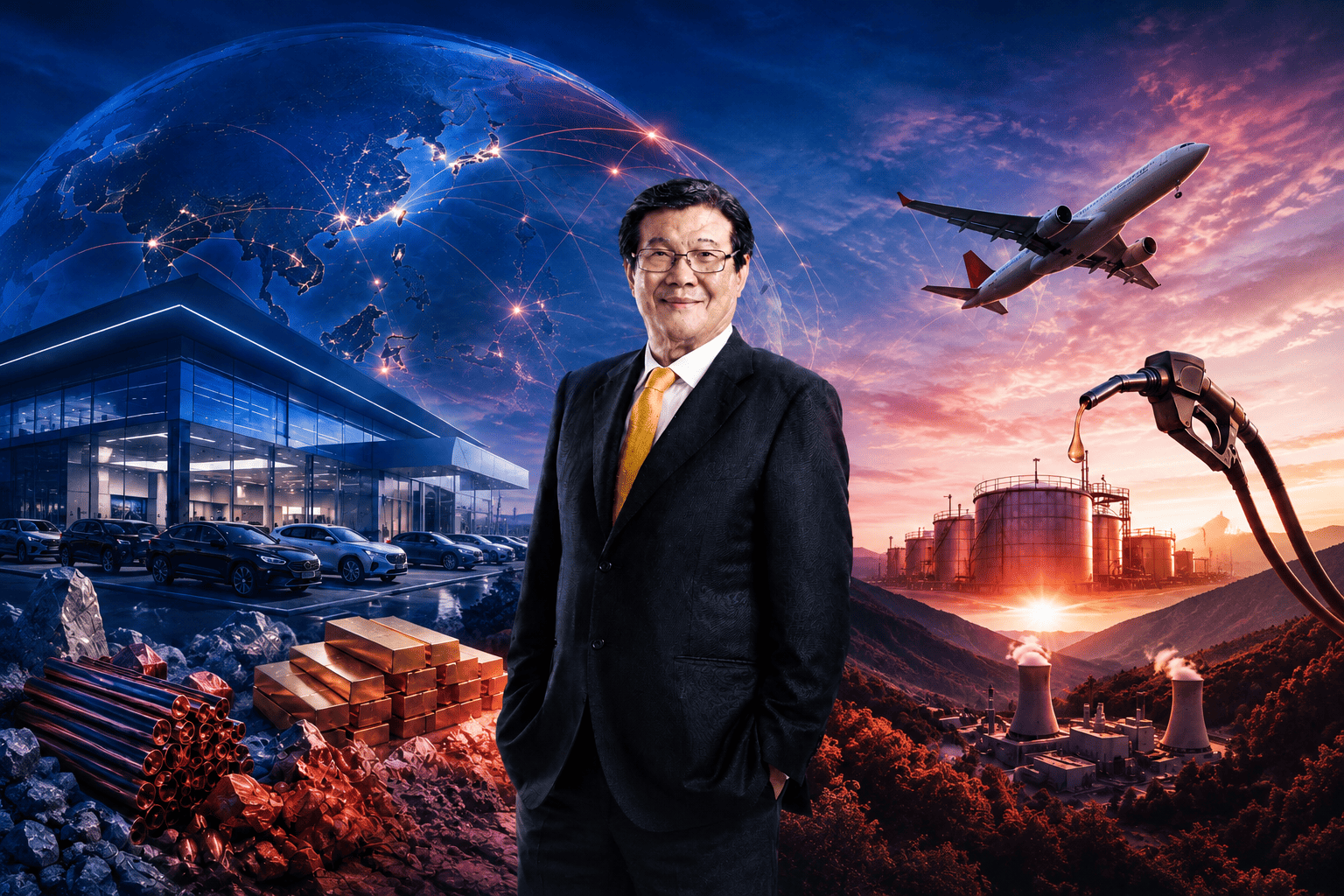
Prajogo Pangestu is expanding his business interests beyond Indonesia, with his companies moving into automotive dealerships, gold and copper, geothermal power, and aviation fuel.
The moves are widening the footprint of the Indonesian billionaire’s business empire across Southeast Asia and the Pacific. They also show how companies linked to Pangestu are building positions in businesses beyond their traditional energy, petrochemical, and coal-related operations.
Prajogo Pangestu Expands Beyond Indonesia
One of the latest moves comes from Chandra Asri Pacific, controlled by Prajogo Pangestu, which has agreed to acquire Jardine Cycle & Carriage’s automotive dealership business in Malaysia and Singapore for S$265 million (US$208 million).
The transaction would mark Chandra Asri’s first entry into the automotive sector. It would also complement the group’s existing energy operations in Singapore and follow its acquisition of the Esso-branded fuel retail network in the city-state.
Chandra Asri President Director and CEO Erwin Ciputra said the proposed acquisition would be another milestone in the group’s transformation into a regional provider covering energy, chemicals, infrastructure, and mobility solutions.
The transaction remains subject to approvals from several Jardine Cycle & Carriage partners and other customary conditions.
Jardine Cycle & Carriage has operated since 1899. In Singapore, it runs six facilities and represents brands including Mercedes-Benz, Kia, and Mitsubishi. It also operates Republic Auto for used vehicles, provides vehicle leasing services, and supplies electric vehicles to logistics companies.
In Malaysia, the company operates as a Mercedes-Benz dealer through a network of 11 sales and after-sales facilities.
Jardine said the transaction would allow it to realize value from the Cycle & Carriage business while concentrating on its core markets of Indonesia and Vietnam. The proceeds are planned to be used to reduce debt.
Chandra Asri Builds a Regional Mobility and Energy Portfolio
The Cycle & Carriage deal is part of a broader expansion by Chandra Asri in Singapore.
In April 2025, a joint venture between Chandra Asri and commodities giant Glencore completed the acquisition of Shell’s refinery and petrochemical assets in Singapore. Five months later, Chandra Asri acquired Esso’s petrol station network in the city-state.
The group is also expanding into aviation fuel infrastructure. Aster, the joint venture between Chandra Asri and Glencore, is set to become a new shareholder in Changi Airport Fuel Hydrant Installation Pte. Ltd. (CAFHI).
CAFHI operates an aviation fuel infrastructure platform designed to support Singapore’s Changi Airport. Through the investment, Aster will join other energy companies supplying aviation fuel to international airlines operating at the airport.
Aster said the investment would strengthen its position in meeting Singapore’s and the region’s growing aviation energy needs.
The transaction still depends on the required approvals and completion conditions.
Aster already has an interest in sustainable aviation fuel. In November 2025, it partnered with Aether Fuels to establish a commercial-scale SAF facility on Singapore’s Bukom Island.
The project will use Aether Fuels’ Aurora technology to process waste materials into 50 barrels of fuel per day, or around 2,000 tonnes annually. Commercial operations are projected to begin in 2028.
Aster is also working with Keppel’s Infrastructure Division to study a commercial-scale ethanol-based sustainable aviation fuel facility on Jurong Island.
Prajogo Pangestu Bets on Gold and Copper
Prajogo’s expansion is not limited to Singapore. Petrosea and its parent company, Petrindo Jaya Kreasi, have made a binding offer for AU$23.75 million (US$15.6 million) in convertible notes issued by Australian-listed Tolu Minerals.
If converted, the notes would give the Indonesian consortium a minimum 4.99% stake in Tolu Minerals, which is focused on the Tolukuma Gold Mine in Papua New Guinea.
The investment gives Petrindo exposure to gold and copper assets in the Pacific Ring of Fire. The move also represents a shift from the group’s established domestic coal and mining-services businesses toward ownership of overseas mineral resources.
Tolu Minerals holds a portfolio that includes the Tolukuma Gold Mine. Its strategy focuses on near-term production from high-grade veins, which fits Petrosea’s stated ambition to generate additional value beyond its traditional service-fee business.
The investment comes against a sharp contrast in Petrosea’s financial and market performance.
Petrosea reported that its 2025 net profit jumped 251% to US$35 million, compared with US$9.95 million a year earlier. Revenue increased 28% to US$886.45 million, supported by overburden removal contracts and infrastructure projects.
Despite those results, Petrosea’s share price had fallen by more than 55% during the year, trading at Rp4,930 at the time reported in the source.
Prajogo responded by buying millions of shares in both Petrosea and Petrindo Jaya Kreasi. On January 29 alone, he spent Rp7.21 trillion (about US$456 million) to acquire four million CUAN shares after the price reached a low.
By the end of January, his ownership in Petrindo Jaya Kreasi had increased to 84.091%.
Geothermal and Aviation Fuel Add New Growth Areas
Another major expansion is taking place in the renewable energy sector.
Forbes reported in July 2026 that Barito Renewables Energy planned to acquire Philippine energy company Energy Development Corporation (EDC) for US$5 billion, equivalent to around Rp89.7 trillion.
The proposal was described by EDC’s largest shareholder, First Gen Corporation, as indicative and non-binding. The potential acquisition remained subject to due diligence and the required approvals, with First Gen stating that no discussions had taken place between the parties and no agreement had been signed at the time.
EDC operates 16 geothermal power plants across the Philippines, with combined capacity of about 1,302.78 megawatts.
The company also owns almost 300 MW of hydroelectric, solar, and wind facilities. EDC was originally a state-owned company before First Gen acquired a majority stake in 2007.
The potential deal would add to Prajogo’s existing geothermal interests. Barito Renewables Energy is the parent company of Star Energy Geothermal Group, described in the source as Indonesia’s largest geothermal producer, with 886 MW of capacity from three geothermal projects in West Java.
Prajogo has also expanded his renewable energy interests through a partnership with Philippine billionaire Jaime Augusto Zobel de Ayala’s ACEN. The companies agreed in 2024 to develop wind power projects in Indonesia.
At the same time, his companies continue to build their presence in Singapore’s energy sector, including the Shell refinery and petrochemical assets and the Esso petrol station network acquired by Chandra Asri.
The expansion into mobility, minerals, geothermal power, and aviation fuel gives Prajogo Pangestu’s business empire a broader regional footprint. The latest moves span Singapore, Malaysia, Papua New Guinea, and the Philippines, while building on businesses already operating in Indonesia.
This article is a summary of two original articles. The full versions can be read at the following links:
This article was created with AI assistance.
We make every effort to ensure the accuracy of our content, some information may be incorrect or outdated. Please let us know of any corrections at [email protected].
Read More