





 Friday, 16-10-26








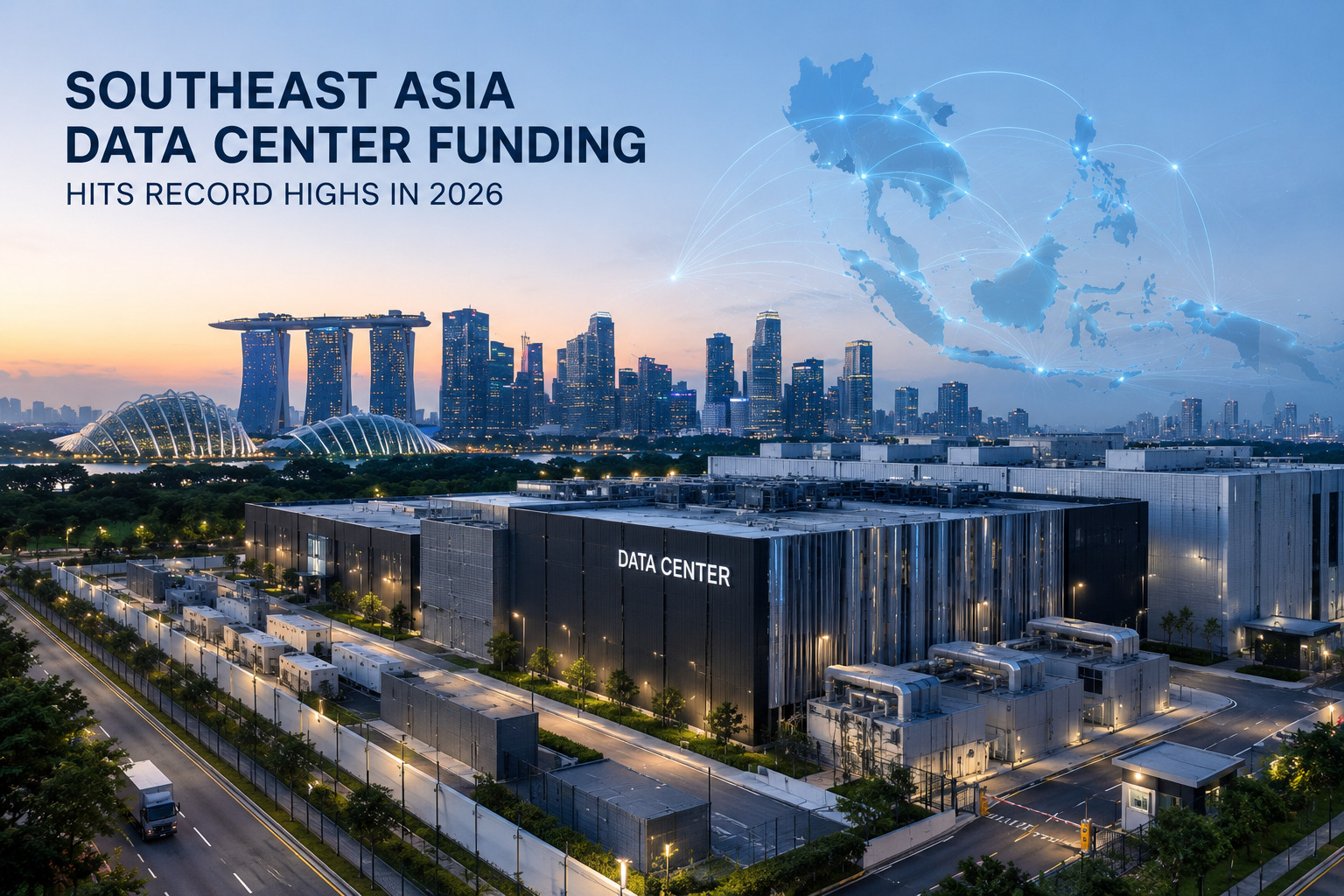
Southeast Asia data center funding has entered a phase that even seasoned infrastructure investors are calling unprecedented. In under three years, the region's data center companies have raised more capital than they did in the previous decade combined, and the pace shows no sign of slowing down. Behind the headline numbers sits a small group of Singapore headquartered operators that have absorbed nearly all of that capital, turning what was once a quiet corner of the real estate market into one of the hottest investment stories in Asia.
According to market intelligence firm Tracxn, Southeast Asia's data center companies have raised about $11.5 billion in disclosed equity funding across 19 rounds since tracking began, and roughly 85 percent of that total has arrived since the start of 2024. That timing is not a coincidence. The explosion of generative AI, the launch of the Johor Singapore Special Economic Zone, and a wave of hyperscaler expansion across Malaysia, Indonesia, and Thailand have all converged at once, pulling in sovereign wealth funds, pension plans, and private equity giants that had previously kept their distance from the sector.
Why Southeast Asia Data Center Funding Is Accelerating
The numbers tell their own story. Between 2020 and 2023, the region's data center firms raised a combined $1.68 billion in disclosed equity. That figure was matched and then dwarfed almost immediately, with $3.2 billion arriving in 2024, $1.9 billion following in 2025, and 2026 already producing $4.7 billion in the first eight months alone. Each of those years, notably, was carried by a single outsized transaction rather than a broad spread of smaller deals, which says something important about how concentrated this Southeast Asia data center funding boom really is.
Land, power, and permitting have become the real bottlenecks, and that scarcity is exactly what is drawing in institutional money. Building a hyperscale campus from scratch now takes years of negotiation over electricity supply, water rights, and connectivity, so investors are increasingly betting on established platforms with existing land banks and operating licenses rather than trying to build new entrants from zero. That shift explains why so much capital is chasing so few companies.
DayOne Leads with a Record Breaking Series C
No company captures this moment better than DayOne, the Singapore headquartered platform that was spun out of China's GDS Holdings in 2022. DayOne closed its Series C equity round at $4.5 billion in June 2026, more than doubling the size of the raise since an initial $2 billion close just five months earlier. The round was led by existing investors Coatue and Hillhouse, now the company's two largest shareholders, with new participation from Indonesia's sovereign wealth fund and Achi Capital Partners.
Since its founding, DayOne has secured roughly $6.4 billion in total equity and booked more than 1.5 gigawatts of capacity commitments across Asia Pacific and Europe. It has committed more than MYR 28 billion, or about $7 billion, to Malaysia alone by the end of 2026, and is reportedly seeking to expand an existing loan facility there to as much as $7 billion. A confidential filing for a US initial public offering surfaced in August 2026, with reports suggesting a raise of around $5 billion at a valuation near $20 billion. If that listing goes ahead, it would give the entire Southeast Asia data center funding market its first real public price benchmark.
Princeton Digital Group Builds Scale with Sovereign Backing
Princeton Digital Group sits in second place with roughly $2.2 billion in disclosed equity funding. Founded in 2017 by Rangu Salgame and Varoon Raghavan alongside anchor investor Warburg Pincus, the company built its base gradually through rounds involving Ontario Teachers' Pension Plan and Abu Dhabi's Mubadala before infrastructure investor Stonepeak stepped in with a $1.3 billion preferred equity investment in July 2025. That single deal, paired with $1.2 billion in debt raised two months earlier, brought the company's total 2025 capital raise to $2.5 billion.
The company now operates more than 1.1 gigawatts of capacity across six markets, including China, Singapore, India, and Indonesia, and in March 2026 it announced plans to raise up to $5 billion more in debt, including a $750 million sustainability linked facility. That heavy reliance on debt alongside equity is becoming the norm across the industry, since operational data centers with long term hyperscaler leases generate the kind of predictable cash flow that lenders find attractive.
ST Telemedia's Full Buyout Becomes the Landmark Deal
The most dramatic development in the entire Southeast Asia data center funding story belongs to ST Telemedia Global Data Centres, known widely as STT GDC. The company first brought in KKR and Singtel as minority investors in June 2024, when the pair paid S$1.75 billion, about $1.3 billion, for an 18.3 percent stake. Twenty months later, in February 2026, the same consortium agreed to buy the remaining 82 percent outright for S$6.6 billion, roughly $5.1 billion, implying a total enterprise value of around S$13.8 billion, or about $10.9 billion.
That transaction, more than any single funding round, illustrates how quickly ownership in this space is consolidating. STT GDC operates close to 100 data centers across a dozen markets with combined capacity of about 2.3 gigawatts, and its full transition from a founder owned business to a KKR and Singtel controlled platform marks the sector's largest transaction to date.
Nxera and Digital Edge Round Out the Top Five
Rounding out the list are two smaller but still significant platforms. Nxera, Singtel's separate regional data center arm, brought in KKR for a 20 percent stake worth roughly $806 million back in September 2023, with an option for KKR to increase its holding to 25 percent by 2027. At the time of that deal, Nxera had 62 megawatts live in Singapore and projects underway in Indonesia and Thailand, and it has since added a joint venture with Malaysian telecom operator TM in Iskandar Puteri.
Digital Edge, backed since inception by Stonepeak, raised $640 million in equity alongside $1 billion in debt through a combined $1.6 billion capital raise announced in January 2025. The company closed its first $575 million holding company loan in May 2026 specifically to fund expansion into Indonesia and the Philippines, adding to a footprint that already covers Japan, Korea, India, and Malaysia.
The Bigger Picture Beyond the Top Five
It would be a mistake to think Southeast Asia data center funding begins and ends with these five companies. Several major operators headquartered outside Singapore are pouring equally large sums into the region. AirTrunk, based in Sydney, was acquired by Blackstone and CPP Investments for roughly A$24 billion in September 2024, the largest data center transaction in history at the time, and its Johor campuses in Malaysia recently secured a $2.3 billion green loan of their own. Bain Capital owned Bridge Data Centres, meanwhile, has been in talks for a loan of up to $6 billion to fund expansion in Thailand, on top of separate plans to invest several billion dollars into Singapore.
These companies fall outside the strict Singapore domiciled ranking used by most market trackers, but their presence underscores just how competitive the regional landscape has become. Malaysia, Indonesia, Thailand, and the Philippines are all racing to attract this capital with tax incentives, streamlined permitting, and dedicated economic zones designed specifically for digital infrastructure.
Where the Money Goes from Here
What makes this wave of Southeast Asia data center funding different from earlier cycles is the character of the money involved. Sovereign wealth funds like Mubadala and Indonesia's Investment Authority, pension capital such as Ontario Teachers, and private equity giants including KKR, Stonepeak, Brookfield, and Warburg Pincus now sit alongside crossover growth investors like Coatue, Hillhouse, and SoftBank Vision Fund on the same cap tables. That mix of patient, long horizon capital and fast moving growth money is unusual, and it suggests investors on both ends of the risk spectrum believe the region's digital infrastructure boom still has years left to run.
The pace of dealmaking backs that up. The gap between major transactions in the sector has shrunk from roughly four and a half years to just nine months, with DayOne's Series C and the STT GDC buyout landing almost in the same window. Whether that momentum holds through a possible DayOne listing, or whether rising power costs and water constraints slow things down first, will likely determine how the next chapter of Southeast Asia data center funding gets written.
Read More