





 Friday, 09-10-26








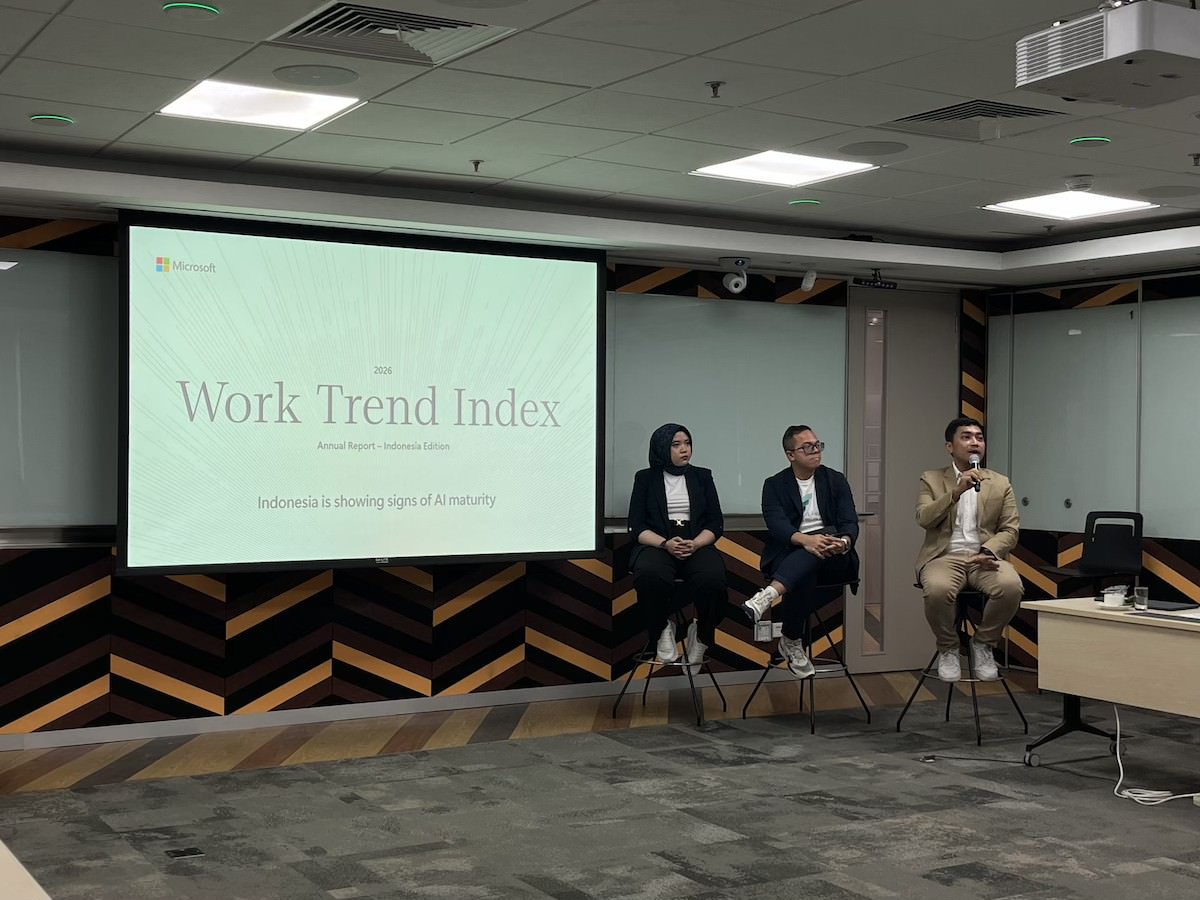
Indonesia is emerging as one of the clearest bright spots in Microsoft’s Work Trend Index 2026. The latest findings show that 33% of Indonesian workers are categorized as Frontier Professionals, the report’s term for advanced AI users, more than double the global average of 16%. That places Indonesia ahead of the global benchmark in advanced AI adoption at work, while also revealing something more important than speed alone: Indonesian workers are increasingly using AI with a strong sense of responsibility and human judgment.
The story is not just about how many people are using AI. It is about how they are using it, what kind of work they are doing with it, and whether organizations are ready to turn individual experimentation into broader transformation. Microsoft’s Indonesia findings suggest the country has a real opportunity to move beyond basic AI use and into a more mature phase of advanced AI adoption, where workers, leaders, and systems all move together.
Indonesia Is Moving Faster Than The Global Average
Microsoft’s Work Trend Index 2026 puts Indonesia in a notably strong position. The report says 33% of Indonesian workers now fall into the Frontier Professionals category, which means they are among the most advanced AI users in the study. That is more than twice the global average of 16%, a gap that is difficult to ignore and even harder to explain away as a temporary fluctuation. It suggests that advanced AI adoption in Indonesia is no longer limited to a small group of tech enthusiasts. It is becoming a broader workplace behavior.
The report’s regional framing is also important. Microsoft says Indonesia has a strong foundation to lead the next phase of AI transformation in the workplace, and that the country stands out not only for adoption speed but also for the maturity of workers using AI. In the same release, Microsoft highlighted that Indonesian workers continue to place human judgment, quality control, and responsibility at the center of how they work. That combination of scale and caution is one of the clearest signals that advanced AI adoption in Indonesia is developing in a more sustainable way than simple hype would suggest.
What makes this even more striking is the contrast with how some other markets are still struggling to move from interest to execution. In Singapore, for example, Microsoft reported that workers are also highly active in AI use, but organizations still need stronger leadership alignment and incentives to capture value at scale. Indonesia’s report shows a similar tension, but with stronger signals that leadership alignment and reinvention rewards are already beginning to appear. In the Indonesian findings, 42% of AI users say their leaders have clear and consistent alignment on AI, while 41% say reinvention efforts are rewarded even when they do not immediately pay off.
What The Work Trend Index Says About Worker Behavior
The most revealing part of the report is not merely the adoption statistic. It is the way Indonesian workers describe their relationship with AI. Microsoft says 93% of AI users in Indonesia treat AI output as a starting point rather than a final answer, and they still see themselves as responsible for the thinking process and the final result. That is a critical distinction. It shows that advanced AI adoption in Indonesia is happening alongside a strong human-in-the-loop mindset, not in place of it.
That matters because AI confidence is only useful when it is paired with discernment. Microsoft’s report says Indonesian respondents identified critical thinking and quality control of AI output as the skills becoming more important in the AI era. In one sense, that sounds obvious. In another, it reveals a deeper cultural shift. Workers are not just asking what AI can do for them. They are asking how to judge AI output, how to verify it, and how to make it useful in real work. That is what separates casual use from advanced AI adoption.
The report also shows that the psychological pressure around AI is real. In Indonesia, 85% of AI users say they worry about falling behind if they do not adapt quickly. That is above the global figure of 65%. The number suggests strong momentum, but it also suggests anxiety. Many workers understand that AI is no longer optional in a competitive workplace. They also understand that the learning curve is steep. Advanced AI adoption is therefore being driven by both opportunity and urgency.
Microsoft’s global Work Trend Index framework helps explain why this matters. The company describes four collaboration patterns between humans and AI: author, editor, director, and orchestrator. In that model, work becomes more strategic as AI takes on more execution. Humans increasingly define direction, standards, and outcomes, while AI helps with drafting, task execution, and workflow coordination. This is a useful lens for Indonesia because it shows that advanced AI adoption is not just about using a chatbot. It is about redesigning the way work gets done.
Why Advanced AI Adoption Matters For Businesses
For companies, the Indonesia findings should be read as a warning and an opportunity at the same time. The warning is simple: employees may already be using AI faster than their organizations are ready to support. Microsoft calls this the transformation paradox, where workers move quickly while systems, incentives, and leadership structures lag behind. In the global report, organizational factors such as culture, leadership alignment, and talent practices account for more than twice the impact of individual effort alone. That means companies cannot rely on enthusiastic employees to carry transformation by themselves.
This is where advanced AI adoption becomes a business issue rather than a technology trend. If employees are already using AI to draft content, summarize information, solve problems, or speed up analysis, then leaders need policies, training, and governance that turn those habits into repeatable value. Without that structure, organizations risk inconsistent quality, unmanaged risk, and duplicated effort. With it, they can build faster decision making, better knowledge sharing, and more scalable productivity gains.
The Indonesian report suggests that some organizations are beginning to get this right. Microsoft says 41% of AI users in Indonesia believe reinvention efforts are rewarded even when they do not immediately succeed. That is a healthy sign because innovation often fails before it works. A workplace culture that tolerates experimentation is usually a better setting for advanced AI adoption than one that only rewards short term certainty.
The banking sector example included in Microsoft’s Indonesia coverage is especially telling. Bank Syariah Indonesia is described as using AI not just for efficiency, but as a strategic enabler that supports data driven decision making and improves responsiveness to customer needs, while still keeping security, governance, and compliance at the center. That is the kind of practical use case businesses should study. It shows that advanced AI adoption is most valuable when it strengthens existing workflows instead of trying to replace them wholesale.
What Comes Next For Indonesia's AI Economy
Indonesia’s strong showing in the Work Trend Index 2026 also fits a broader national pattern. The country has been pushing harder into AI policy and digital transformation, with Reuters reporting that Indonesia is preparing to integrate AI into key government programs and develop a wider AI roadmap. That larger policy environment matters because workplace adoption does not happen in a vacuum. It is influenced by infrastructure, regulation, education, and the speed at which institutions normalize new tools.
That means the next phase of advanced AI adoption in Indonesia will depend less on whether people are willing to use AI and more on whether organizations are willing to redesign work around it. Microsoft’s report suggests the willingness is already there. Workers are using AI, checking its outputs, and staying personally accountable for the results. The remaining challenge is to ensure that companies scale that behavior responsibly, with clear standards and better management systems.
There is also a competitive angle that should not be overlooked. Countries that normalize advanced AI adoption earlier are likely to build stronger productivity habits, faster knowledge cycles, and better organizational learning over time. Microsoft’s research argues that the real advantage comes when companies structure work deliberately around human and AI collaboration patterns. That is a valuable insight for Indonesian firms competing in industries where speed, accuracy, and customer responsiveness all matter.
For Indonesian workers, the takeaway is encouraging. The country is not lagging behind. In fact, on this specific measure, it is moving ahead of the global average. But the deeper lesson is that advanced AI adoption is not a finish line. It is an operating habit. The organizations that benefit most will be the ones that treat AI literacy, quality control, critical thinking, and reinvention as core capabilities, not side projects.
Indonesia’s position in the Work Trend Index 2026 is therefore more than a positive headline. It is evidence that the country’s workforce is learning how to use AI with maturity, restraint, and ambition. If businesses can match that energy with stronger leadership and better systems, advanced AI adoption may become one of the most important productivity stories in Indonesia’s next economic chapter.
Read More