





 Wednesday, 03-06-26








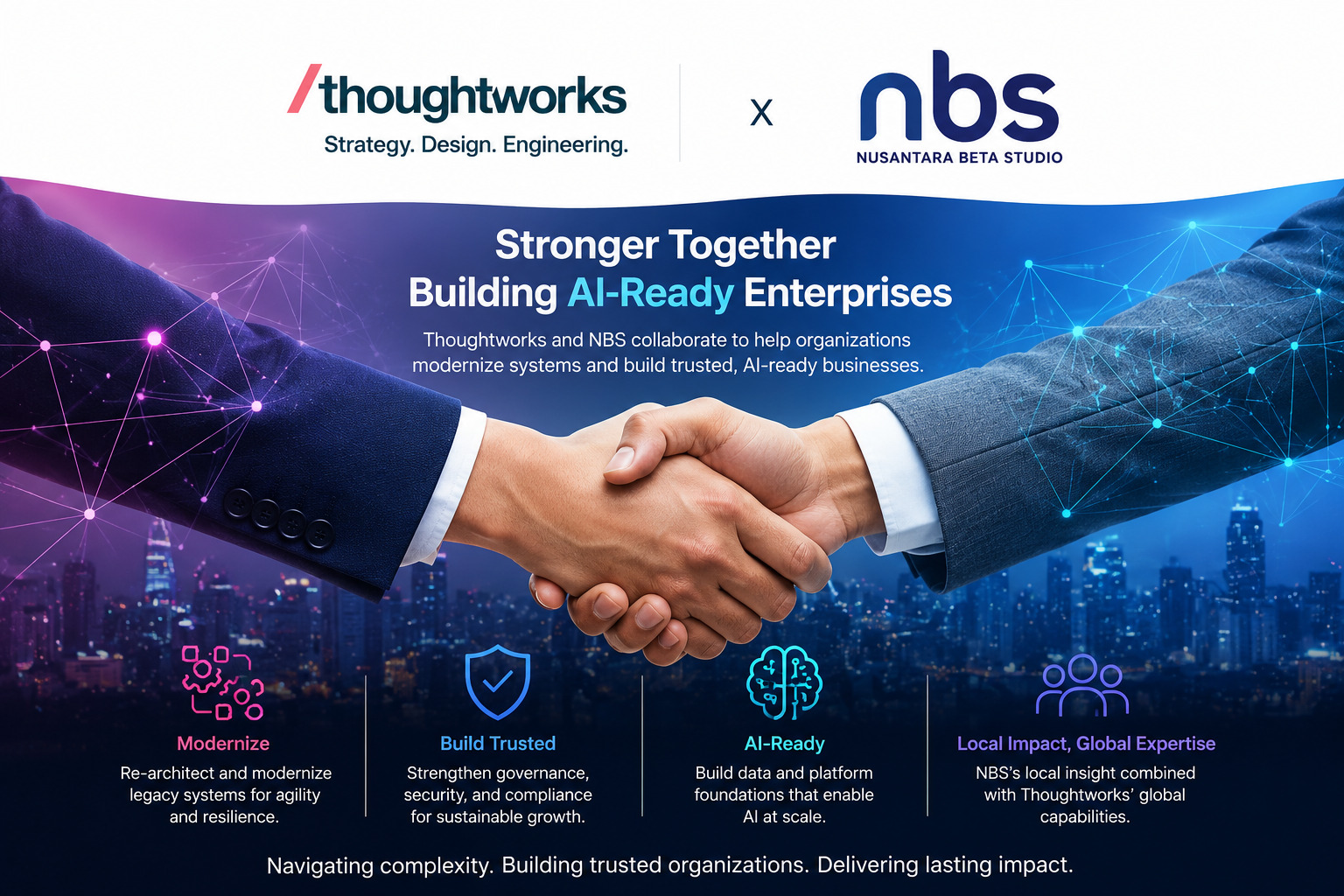
The rush to adopt artificial intelligence is forcing many companies to confront an uncomfortable truth. AI is only as strong as the systems beneath it. That is the core message behind the new collaboration between Thoughtworks and Nusantara Beta Studio, or NBS, which is focused on helping Indonesian businesses build AI-ready architecture before they scale AI across the enterprise. The partnership was introduced alongside a closed-door forum in Jakarta on June 3, 2026, where technology leaders discussed trust, governance, and modernization as practical foundations for long-term digital growth.
The timing matters. Across industries, companies are moving fast on AI, but many still rely on fragmented systems, legacy platforms, and weak integration layers. IBM’s recent guidance on AI readiness says modernizing integration architecture is becoming the foundation of AI readiness because it reduces friction in data, workflows, and intelligence delivery. Thoughtworks, meanwhile, has said it helps organizations rebuild legacy cores and modernize data and enterprise systems to support AI at scale. That makes the Thoughtworks and NBS collaboration especially relevant for firms that want innovation without creating technical debt that becomes even more expensive later.
Why AI-Ready Architecture Is Becoming A Business Priority
For many executives, AI still feels like a product decision. In reality, it is an architecture decision. If data is scattered, APIs are inconsistent, and core systems are brittle, then AI projects tend to stall, underperform, or create more operational risk than value. That is why the phrase AI-ready architecture is more than a buzzword. It describes a business environment where systems are structured to support AI safely, continuously, and at scale. IBM’s guidance on AI readiness and Thoughtworks’ modernization services both point to the same conclusion: without stronger foundations, enterprise AI will remain stuck in pilot mode.
In the Indonesian context, that point lands even harder. Many firms are modernizing under pressure from competition, customer expectations, and internal demands for speed. But speed alone can be misleading. Thoughtworks Managing Director Jakob Webster said in the reported event that leaders often want to adopt the latest technologies while overlooking the strategic planning required to modernize properly. He argued that governance and legacy infrastructure should not be treated as obstacles, but as strategic engines that need to be transformed so AI can be integrated sustainably and at scale.
That framing is useful because it shifts the conversation away from hype and toward operational readiness. A company does not become AI-capable simply by buying software tools or signing a cloud contract. It becomes AI-capable when its architecture can move clean data, support reliable workflows, and enforce governance without slowing the business down. That is the practical meaning of AI-ready architecture, and it is exactly the kind of foundation that allows companies to expand from isolated experiments into production use cases.
What Thoughtworks And NBS Are Trying To Solve
The partnership between Thoughtworks and NBS is built around a simple but difficult problem. Many companies in Indonesia want the benefits of AI, but they also need local guidance on how to modernize systems in a way that fits regulatory, organizational, and market realities. According to the report, Thoughtworks brings global consulting experience across strategy, design, engineering, and AI, while NBS brings local understanding of technology landscapes and corporate needs in Indonesia. That combination matters because modernization programs often fail when they ignore local constraints or underestimate the complexity of legacy environments.
The forum that introduced the collaboration, titled “Navigating Complexity and Building Trusted Organisations,” gathered around 40 technology leaders from different sectors, including CIOs, CTOs, and VP Engineering figures. The panel included representatives from Indosat Group, BFI Finance Indonesia, Thoughtworks APAC, and NBS, with a broader discussion on legacy modernization, trusted AI, and secure governance. That lineup suggests the partnership is not aimed at abstract thought leadership. It is meant to produce actionable blueprints for decision-makers who need to modernize without shutting down critical operations.
One of the strongest messages from the event is that modernization does not have to mean a total teardown. That is important because many firms assume they must replace core systems all at once before AI can be deployed properly. In practice, that approach can be expensive, slow, and risky. The reported discussion instead emphasized measured transformation, where legacy systems are gradually improved, governance is strengthened, and AI capabilities are introduced on top of more stable infrastructure. That is a much more realistic path for enterprises that cannot afford disruption.
For businesses, this is where AI-ready architecture starts to become a competitive advantage rather than a technical requirement. When architecture is modern enough to support AI, companies can move faster on automation, analytics, and decision support. They can also reduce the friction that usually comes from disconnected platforms and manual processes. IBM says stronger integration reduces exceptions and manual work, while Thoughtworks says modernized data and platform foundations help organizations move from experimentation to lasting AI impact. Those are not cosmetic benefits. They are the mechanics of better execution.
Why Legacy Modernization Cannot Be Treated As An Afterthought
The temptation in many companies is to treat legacy modernization as a back-office issue that can be solved later. That is risky. Legacy architecture often determines whether AI projects can access usable data, whether workflows can be automated, and whether governance can be enforced without creating bottlenecks. If the foundation is weak, even the best AI strategy will struggle to create consistent business value. That is why the current push toward AI-ready architecture should be read as a strategic shift, not a technical trend.
Thoughtworks has repeatedly described modernization as a way to reduce technical debt, improve future readiness, and unlock new growth opportunities. IBM’s current AI guidance makes a similar argument, saying modern architecture helps data, workflows, and intelligence move at the speed the business requires. Together, these positions reinforce a clear message for enterprise leaders. AI success does not begin with the model. It begins with the system.
That message is especially relevant in sectors where trust, compliance, and operational continuity matter. Financial services, telecommunications, and large consumer businesses cannot afford repeated experimentation that breaks core services. They need a modernization path that strengthens resilience while creating room for AI-driven innovation. The Thoughtworks and NBS collaboration is interesting because it is framed around that exact tension, innovation on one side, governance and reliability on the other.
What This Means For Indonesian Enterprises
The practical takeaway from this partnership is clear. Indonesian companies that want to scale AI should not treat architecture as a downstream concern. They should treat it as the first strategic layer. That means reviewing data quality, integration flows, governance models, and legacy dependencies before expanding AI pilots into production. It also means building a shared language between technology leaders and business leaders so modernization is tied to measurable outcomes, not just technology refresh cycles.
The bigger story here is that AI-ready architecture is becoming part of the new corporate operating model. The companies that move early on structured modernization will likely have an easier time scaling AI responsibly, while those that keep layering new tools onto old systems may face growing friction. In that sense, the Thoughtworks and NBS initiative is not just about one event in Jakarta. It is a sign that the market is maturing and that businesses are being pushed to think more seriously about the foundation beneath their AI ambitions.
Conclusion
Thoughtworks and NBS are making a timely argument. If companies want durable AI outcomes, they need more than ambition. They need architecture that can support scale, governance that can support trust, and modernization plans that do not collapse under their own complexity. That is why AI-ready architecture is becoming one of the most important ideas in enterprise transformation today.
Read More