





 Monday, 21-09-26








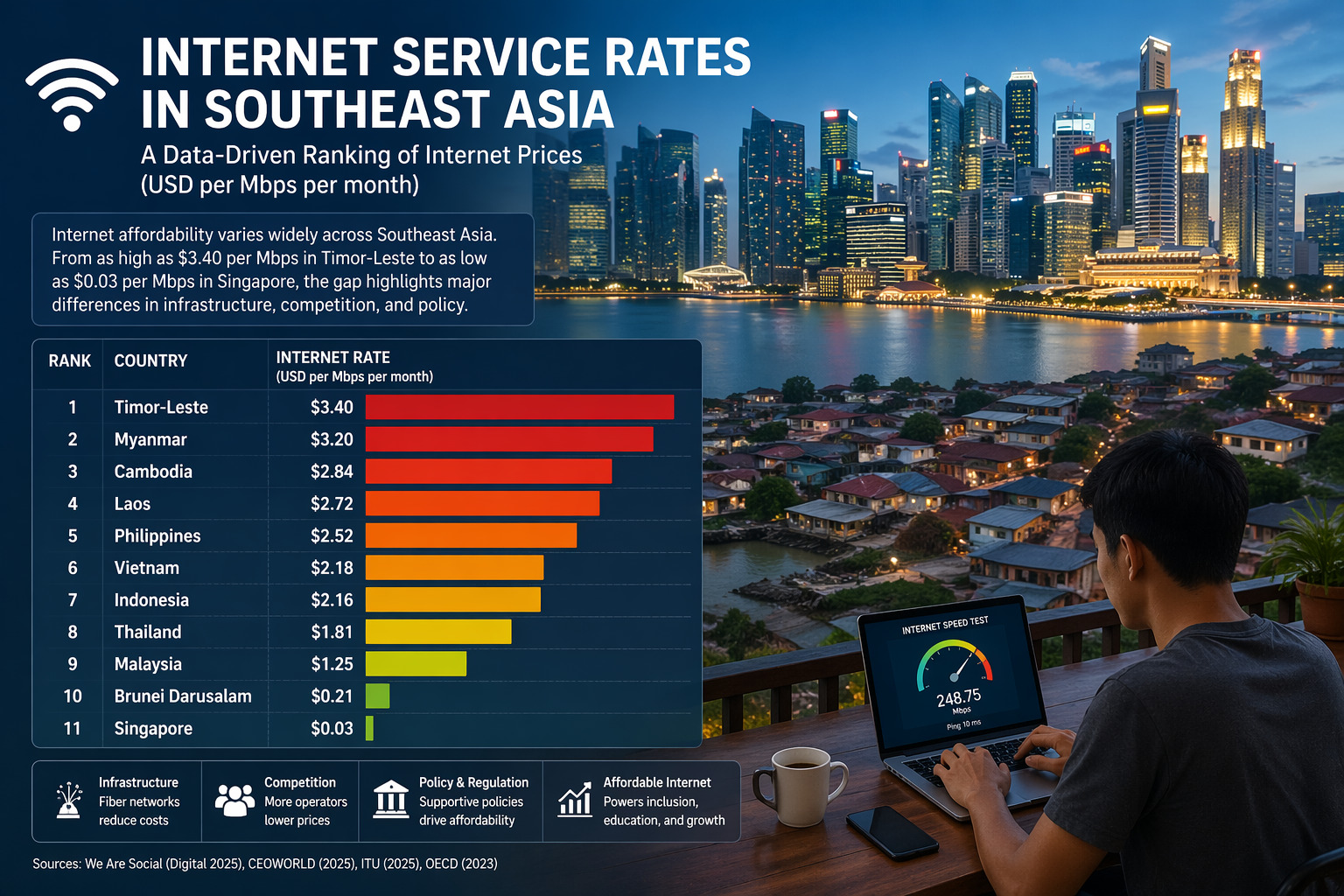
Internet service rates in Southeast Asia are far from uniform. Using the standardized price per Mbps per month metric, the region shows a very wide gap, from Singapore at US$0.03 per Mbps to Timor-Leste at US$3.40 per Mbps in the latest global ranking. That spread matters because it changes how much households pay for access, how much SMEs spend to stay online, and how competitive digital markets can become.
This article uses the same comparison method throughout, because raw monthly plan prices can be misleading when speeds differ. The International Telecommunication Union says affordability remains a major barrier to internet access, and it also notes that the fixed broadband affordability target for developing countries is 2 percent of GNI per capita. That is why a per-Mbps ranking is a cleaner way to compare internet service rates in Southeast Asia.
How The Ranking Was Built
The ranking below is based on the 2025 global internet pricing data published by CEOWORLD, which presents price in USD per Mbps and is grounded in We Are Social’s Digital 2025 dataset. In other words, this is not a list of the cheapest monthly subscriptions by sticker price. It is a normalized affordability comparison that makes it easier to see which Southeast Asian markets offer the best value and which still carry a heavy connectivity premium.
That distinction matters. A country can have a lower advertised monthly bill but still be more expensive per unit of speed, while another market may look pricey on the surface but become affordable once speed is included. The ITU’s affordability framework exists for exactly this reason, because internet access is now treated as a core public utility for economic participation rather than a luxury product.
Most Expensive To Cheapest
Here is the Southeast Asia ranking, from the most expensive internet service rates to the cheapest, based on the 2025 price per Mbps metric.
- Timor-Leste at US$3.40 per Mbps.
- Myanmar at US$3.20 per Mbps.
- Cambodia at US$2.84 per Mbps.
- Laos at US$2.72 per Mbps.
- Philippines at US$2.52 per Mbps.
- Vietnam at US$2.18 per Mbps.
- Indonesia at US$2.16 per Mbps.
- Thailand at US$1.81 per Mbps.
- Malaysia at US$1.25 per Mbps.
- Brunei Darussalam at US$0.21 per Mbps.
- Singapore at US$0.03 per Mbps.
The pattern is striking. In this dataset, Singapore is not just cheaper than its neighbors. It is dramatically cheaper per unit of speed, which reflects a mature broadband market, dense infrastructure, and intense competition. At the other end, Timor-Leste, Myanmar, Cambodia, and Laos sit in the expensive cluster, where structural bottlenecks still push pricing upward.
Why The Price Gap Persists
The price spread across Southeast Asia is not random. The OECD says broadband is a critical enabler of digital transformation and economic growth, but it also notes that fixed broadband subscriptions are highest in Singapore and Vietnam, while Cambodia, Lao PDR, and Myanmar are far lower. That gap in network maturity helps explain why internet service rates in Southeast Asia remain so uneven.
The same OECD report points to market structure, competition intensity, regulatory independence, and infrastructure sharing as major policy variables. It also notes that mergers and state involvement can reshape telecom markets, while the quality and cost of broadband depend heavily on whether governments make it easier to build networks and share passive infrastructure. In plain terms, where competition is strong and fiber is widespread, prices tend to fall. Where markets are concentrated or network rollout is harder, prices stay high.
CEOWORLD reaches a similar conclusion in its 2025 internet pricing analysis. It argues that affordable internet is concentrated in countries with strong fiber networks, supportive public policy, and active telecom competition, while expensive markets often face weak infrastructure and limited competition. That pattern fits Southeast Asia well, especially when you compare Singapore and Brunei with markets like Timor-Leste and Myanmar.
There is also a scale effect. Small markets with lower population density or more difficult geography often struggle to spread fixed network costs over enough subscribers. By contrast, highly urbanized markets can push more users onto fiber, recover investment faster, and keep prices per Mbps lower. That is one reason internet service rates in Southeast Asia can diverge so sharply even among neighboring countries. This is an inference from the pricing pattern and the OECD’s discussion of infrastructure, competition, and urban-rural divides.
What The Numbers Mean For Business Growth
The takeaway is not only that some countries are cheaper than others. The deeper story is that affordable connectivity is now part of economic infrastructure. The ITU says affordability remains a major barrier to internet access, and the OECD describes broadband as a foundation for digital transformation. Put together, those findings suggest that internet service rates in Southeast Asia influence far more than entertainment or consumer convenience. They shape remote work, online education, cloud adoption, e-commerce, and even where digital businesses choose to expand.
For households, high internet service rates mean less room in the monthly budget for other essentials. For small businesses, they raise operating costs and make digital tools harder to use at scale. For governments, they slow inclusion because expensive broadband limits who can participate fully in the online economy. That is why the price per Mbps metric is useful. It does not just tell us who pays the highest bill. It tells us who gets the best value from each unit of connectivity. This is an inference grounded in the ITU affordability benchmarks and the OECD’s broadband development framework.
The region also shows that cheap internet is not always a sign of low quality. Singapore’s US$0.03 per Mbps is a strong example of how investment, density, and competition can combine to produce world-class affordability. Meanwhile, Brunei’s relatively low US$0.21 per Mbps shows that smaller Southeast Asian markets can still deliver competitive pricing when conditions are favorable. Those are important counterexamples for anyone who assumes expensive connectivity is inevitable in Asia.
In practical terms, businesses expanding across Southeast Asia should not treat internet service rates as a background issue. They are a location factor, a cost factor, and a productivity factor. The countries with the most expensive rates are likely to feel stronger pressure on digital adoption, while the cheapest markets are better positioned to scale cloud usage, software-heavy operations, and internet-first services. That is the real significance of this ranking. It is not only about prices. It is about where digital growth can move fastest.
Read More