





 Friday, 16-10-26








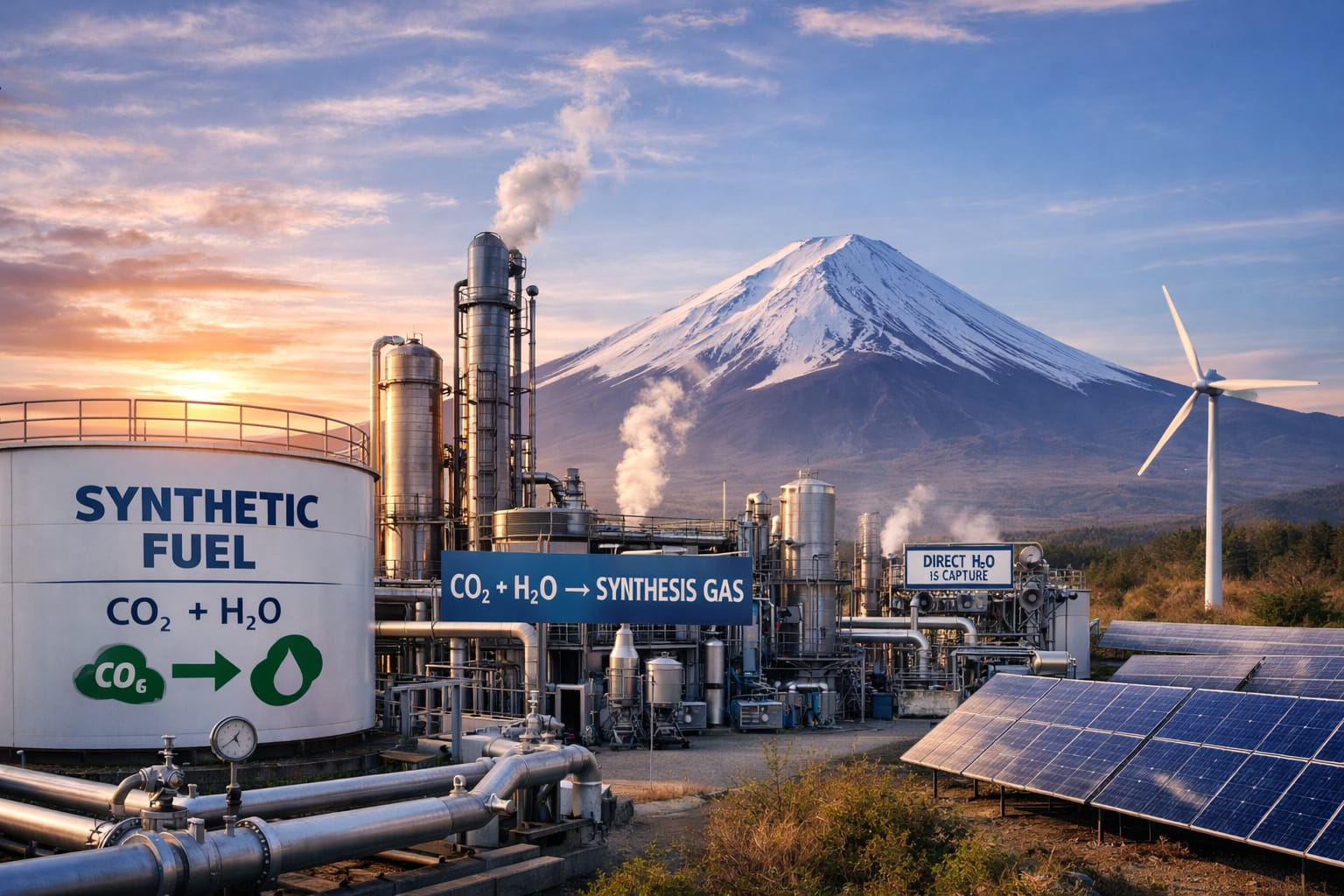
Japan is not trying to find oil in water. It is trying to manufacture a liquid fuel that behaves like oil, without depending on crude. That distinction matters. The country’s synthetic fuel push is part industrial policy, part climate strategy, and part strategic hedge by incumbents that know the hydrocarbon era is not ending cleanly. Japan’s Ministry of Economy, Trade and Industry has framed carbon recycling as a pathway to turn captured carbon dioxide into fuels, among other products, while ENEOS says its demonstration plant in Japan integrates CO2 supply, water electrolysis for carbon-free hydrogen, reverse water gas shift, Fischer-Tropsch synthesis, and upgrading.
For business leaders, the deeper question is not whether synthetic fuel is real. It is. The question is whether it can become economically meaningful before electrification, efficiency gains, and policy pressure make its value proposition too narrow. Japan’s own energy giants are signaling caution. Reuters reported in May 2025 that ENEOS plans to raise investment in LNG and sustainable aviation fuel while slowing work on hydrogen, and that the company removed its earlier target of supplying up to 4 million metric tons of hydrogen by fiscal 2040. That is a telling move: the company is still backing transition fuels, but it is clearly prioritizing assets with nearer-term cash flow and lower execution risk.
Why Japan Is Betting On Synthetic Fuel
The appeal of synthetic fuel is easy to understand if you think like a refinery owner, an airline, or a government worried about industrial continuity. Synthetic fuels can preserve much of the existing liquid-fuel stack, including tanks, pipelines, engines, fueling infrastructure, and trading relationships. That makes them attractive in sectors where battery electrification is technically difficult or commercially painful, especially aviation and maritime transport. The International Energy Agency has said e-fuels could scale by 2030 if backed by cheaper renewable electricity and lower electrolyzer costs, and it specifically identifies aviation and shipping as major use cases. In the same IEA analysis, an ambitious target would be 10% e-fuels in aviation and shipping by 2030.
Japan is also building policy architecture around this idea rather than treating it as a lab curiosity. The Carbon Recycling Roadmap from METI describes carbon dioxide as a source of carbon that can be recycled into fuels, and lists synthetic fuels, SAF, and water electrolysis as part of the technology pathway. That is important because it shows the state is not simply funding a science project. It is trying to create a new industrial category, one that sits between the fossil economy and the fully electrified economy. In practical terms, Japan is asking whether carbon can be moved from waste stream to feedstock, and whether liquid fuel can be decoupled from oil wells without being decoupled from the rest of the system.
ENEOS’s demonstration plant shows how serious the effort has become. The company says the plant is the first of its kind in Japan and is capable of integrated production from raw materials. It uses green energy to make CO2-free hydrogen via water electrolysis, then converts CO2 and hydrogen into synthetic gas and synthetic fuel. The plant also plans to use direct air capture CO2 from Climeworks as a feedstock. ENEOS says the first phase began from a much smaller facility that produced about 30 mL per day before scaling up to the current demonstration site. That is not commercial volume, but it is not symbolic either. It is a real engineering program with a process chain, materials, catalysts, and operational learning curves.
The Economics Are The Real Battleground
This is where the story becomes less romantic and more consequential. Synthetic fuel is not free oil. It is a manufactured product with a severe energy penalty. A 2026 review in Energy Conversion and Management found that liquid e-fuel process efficiencies range from 59% to 89%, while current production costs for synthetic kerosene and methanol vary between 1,200 and 4,200 euros per ton, depending on the pathway and technology maturity. Those numbers are useful because they cut through the marketing. Synthetic fuel can work, but it is expensive, capital-intensive, and highly dependent on cheap low-carbon electricity.
That cost structure explains why the strategic debate is so intense. In sectors with good alternatives, synthetic fuel is hard to defend economically. Direct electrification is usually more efficient, and the IEA continues to frame energy efficiency as one of the fastest and most cost-effective decarbonization measures. Even where liquid fuels remain necessary, the market is still tiny relative to the fossil system it wants to replace. The IEA projects global oil demand at 104.4 million barrels per day in 2026, which shows just how enormous the incumbent market remains. Against that scale, synthetic fuel is still a demonstration-stage option, not a mass-market substitute.
That scale gap is why many executives see synthetic fuel less as a substitute for oil and more as a strategic option for constrained segments. The IEA’s renewables analysis says aviation and shipping account for more than 75% of new biofuel demand by 2030, and transport fuel demand growth is increasingly shaped by electric vehicles and efficiency improvements. In other words, the fastest-growing opportunities for liquid low-carbon fuels are not the daily commuter markets that built the oil age. They are the sectors that cannot easily swap molecules for electrons. That is a much narrower but far more credible business case.
The Real Market Is Hard-To-Abate Sectors
If synthetic fuel has a future, it is likely to begin in aviation, shipping, and certain industrial applications. The IEA’s transport analysis says e-fuels are a viable pathway for aviation and shipping because they can add decarbonization options where direct electrification is not feasible. Reuters reported in February 2025 that ENEOS and Mitsubishi are moving ahead with a sustainable aviation fuel project in Wakayama expected to produce about 300,000 metric tons annually from fiscal 2028, with feedstock mainly from waste products and by-products such as used cooking oil and tallow. That is not the same as CO2-to-liquid fuel, but it shows where capital is actually moving first: into sectors with immediate policy support and clearer demand visibility.
That separation matters for investors. The phrase synthetic fuel often sounds like a universal solution, but the economics say otherwise. A fuel can be technically elegant and commercially niche at the same time. Aviation may pay a premium for lower lifecycle emissions because it has fewer alternatives. Maritime operators may do the same if regulation tightens and fuel suppliers scale reliably. But passenger cars, light commercial transport, and much of road freight are moving toward better efficiency, electrification, and grid-linked charging. The market for synthetic fuel is therefore not the whole transport economy. It is the part that cannot wait for a perfect battery or a perfect grid.
For Japan, this is both an opportunity and a warning. The opportunity is to become an early platform builder in carbon recycling and synthetic fuel know-how. The warning is that early leadership in a technology category does not guarantee profitable scale. Reuters has already shown that ENEOS is repositioning capital toward LNG and SAF while slowing some of its cleaner hydrogen ambitions. That suggests management teams are making a distinction between what sounds strategic and what can actually deliver returns in the current macro environment. In the energy transition, that distinction is often the difference between visionary capex and stranded capex.
What Business Leaders Should Watch Next
The strategic lesson is not that synthetic fuel will fail. It is that synthetic fuel will probably not win everywhere, and that is exactly why it is interesting. Leaders should watch three variables closely: renewable power prices, electrolyzer costs, and regulatory support for hard-to-abate sectors. The IEA’s view is that e-fuels can scale if the cost of clean electricity falls and electrolyzer economics improve. The current science also suggests that the pathway can work technically, but high capital expenditure and regulatory complexity remain barriers to commercial scale.
That means the smartest corporate question is not, “Will synthetic fuel replace oil?” The better question is, “Where does synthetic fuel create enough strategic value to justify its cost?” In aviation, shipping, and select industrial uses, it may become an essential bridge. In mass-market mobility, it may become an expensive detour. Japan’s synthetic fuel push is therefore less a simple energy story than a capital allocation case study. It asks whether companies and governments can fund a transition fuel without confusing it for the final destination. The answer will shape refinery strategy, airline procurement, and the next decade of climate industrial policy.
Read More