





 Tuesday, 15-09-26








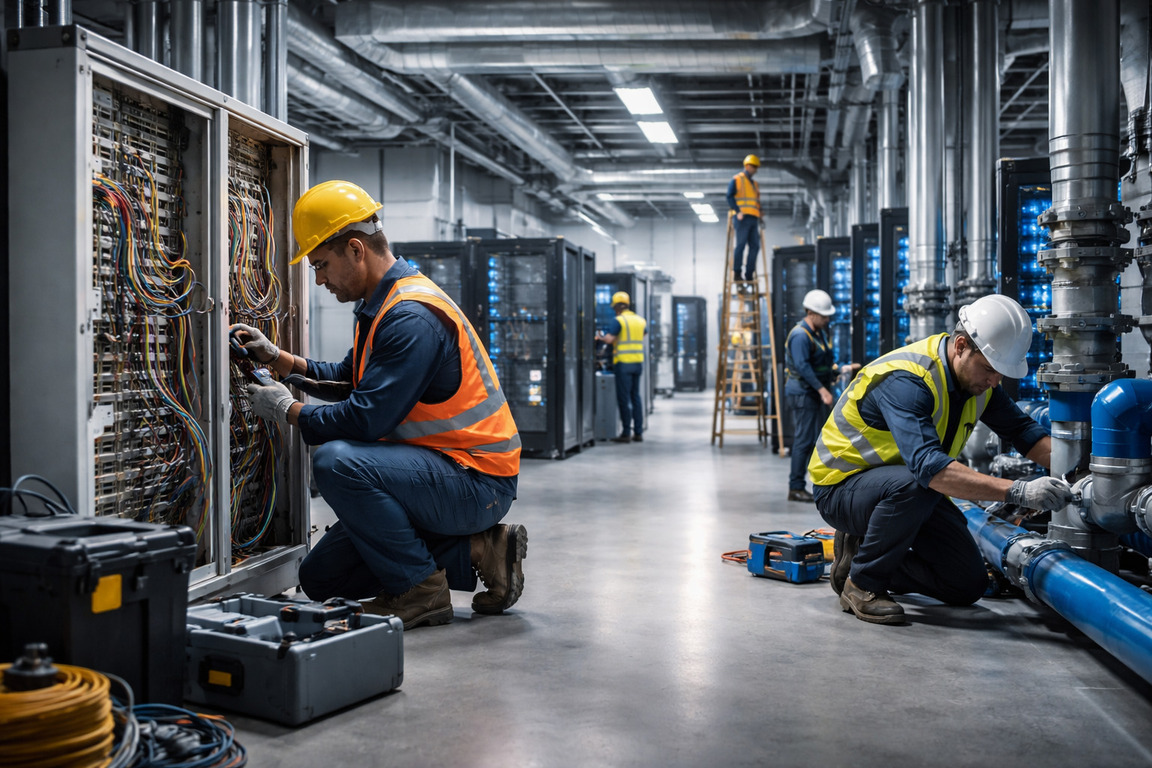
The global artificial intelligence boom is often framed as a triumph of software, algorithms, and silicon. Headlines focus on large language models, trillion-parameter systems, and soaring valuations of chipmakers and cloud providers. Yet beneath this digital narrative lies a far more physical reality. The AI revolution is also one of the largest infrastructure buildouts the modern economy has ever seen, and it is creating a surge in AI infrastructure jobs that depend not on code, but on human hands.
From electricians wiring megawatt-scale power systems to plumbers managing complex cooling networks, skilled trades workers are becoming indispensable to the AI economy. As data center construction accelerates across the United States, Europe, and Asia, these workers are emerging as some of the biggest and most overlooked winners in the race to scale artificial intelligence.
This shift challenges the dominant assumption that AI primarily destroys jobs. In reality, the rapid expansion of AI data centers is generating new forms of labor demand that cannot be automated, outsourced, or replaced by software.
The Physical Reality Behind AI Data Centers
Every AI breakthrough ultimately depends on physical infrastructure. Generative AI systems require enormous computational power, which in turn demands massive data centers filled with servers, networking equipment, cooling systems, and electrical infrastructure. These facilities are not abstract digital spaces. They are industrial-scale buildings that resemble power plants more than offices.
Industry leaders have increasingly acknowledged this reality. Nvidia CEO Jensen Huang has described the current AI boom as a global infrastructure transformation, comparable in scale to the construction of highways, railroads, or electrical grids in earlier eras. Unlike consumer software revolutions, AI requires energy-intensive, water-cooled, and highly specialized facilities to operate.
This is where AI infrastructure jobs come into focus. Before a single AI model can be trained, electricians must design and install high-voltage systems capable of supporting continuous power loads. HVAC specialists must build advanced cooling architectures to prevent overheating. Plumbers must manage water circulation systems essential for liquid cooling technologies. Construction workers must assemble facilities that meet strict regulatory and operational standards.
Without these skilled trades workers, AI data centers simply do not function. The digital economy rests on a foundation of concrete, steel, copper, and human labor.
A Data Center Construction Boom With No Historical Precedent
The scale and pace of data center construction are accelerating rapidly. Hyperscale operators such as Amazon Web Services, Microsoft, Google, and emerging AI-focused companies are investing tens of billions of dollars annually to expand capacity. In many regions, local governments are racing to attract these facilities due to their long-term economic impact.
This boom is translating directly into demand for skilled trades workers. Data center construction projects often require hundreds or thousands of electricians, plumbers, welders, and HVAC technicians over multi-year timelines. Unlike residential or commercial construction, these projects demand specialized expertise, strict safety protocols, and continuous maintenance after completion.
As a result, companies are struggling to fill positions fast enough. Skilled trades workers with experience in industrial electrical systems or large-scale cooling infrastructure are being recruited aggressively. In some cases, contractors report delays not because of capital shortages, but because there are not enough qualified workers to build fast enough.
AI infrastructure jobs are no longer peripheral roles. They are becoming critical bottlenecks in the global AI supply chain.
Six-Figure Salaries Without A Four-Year Degree
One of the most striking outcomes of this trend is wage growth. Traditionally, skilled trades were viewed as stable but modestly paid careers. The AI data center boom is changing that perception.
Electricians and plumbers working on advanced data center projects are increasingly earning six-figure incomes, particularly in high-demand regions. Overtime pay, specialized certifications, and long-term contracts have pushed total compensation well above national averages. Importantly, these earnings often come without the burden of student debt associated with a four-year college degree.
This shift is reshaping how younger workers view career choices. As white-collar roles face increasing automation and wage pressure from AI tools, skilled trades workers are benefiting from scarcity and indispensability. Their work cannot be automated, and the demand curve is rising sharply.
AI infrastructure jobs are thus redefining economic mobility. They offer a pathway to middle and upper-middle-class incomes rooted in practical expertise rather than academic credentials.
Inside Job Sites Where Trades Meet Artificial Intelligence
On the ground, the convergence of skilled trades workers and AI technology is visible at construction sites around the world. Electricians coordinate with data engineers to ensure power redundancy meets uptime requirements. HVAC teams collaborate with thermal engineers to optimize cooling efficiency for dense server racks. Plumbers integrate water systems designed to minimize environmental impact while supporting continuous operation.
These job sites reflect a new kind of industrial collaboration. Digital and physical expertise intersect daily. While AI models may be developed in research labs, their success depends on flawless execution by trades workers operating in challenging environments.
This reality underscores why AI infrastructure jobs are resilient. They are embedded in complex, site-specific systems that require judgment, adaptability, and experience. No algorithm can replace the electrician troubleshooting a live power system or the plumber adjusting cooling flow in real time.
Workforce Development And The Skills Pipeline Challenge
Despite strong demand, the supply of skilled trades workers is under strain. Many experienced workers are approaching retirement, while fewer young people have entered apprenticeships over the past two decades. This demographic imbalance poses a serious challenge to the AI infrastructure boom.
In response, workforce development programs are expanding rapidly. Unions, technical schools, and private companies are investing in apprenticeship models tailored to data center construction. These programs combine classroom instruction with paid on-the-job training, offering a faster and more affordable alternative to traditional higher education.
Some AI and cloud companies are also partnering directly with training institutions to ensure a steady pipeline of qualified workers. These partnerships reflect a growing recognition that talent shortages in skilled trades workers could slow the pace of AI deployment.
AI infrastructure jobs are therefore not just an economic opportunity, but a strategic priority for governments and corporations alike.
Why This Reframes The AI Jobs Debate
Public discourse around artificial intelligence often focuses on job displacement. While certain roles will undoubtedly change or disappear, the rise of AI infrastructure jobs highlights a countervailing force. AI is not eliminating work across the board. It is redistributing demand toward roles that bridge the physical and digital worlds.
Electricians, plumbers, and construction workers are not relics of a pre-digital economy. They are builders of the AI age. Their labor enables every chatbot response, every AI-generated image, and every cloud-based service.
Recognizing this reality matters. It shifts policy discussions toward investment in vocational education, infrastructure planning, and labor mobility. It challenges cultural biases that undervalue manual expertise. And it provides a more balanced understanding of how technological revolutions actually unfold.
The AI revolution is not only written in code. It is wired, cooled, and constructed by human hands.
Read More