





 Sunday, 26-07-26








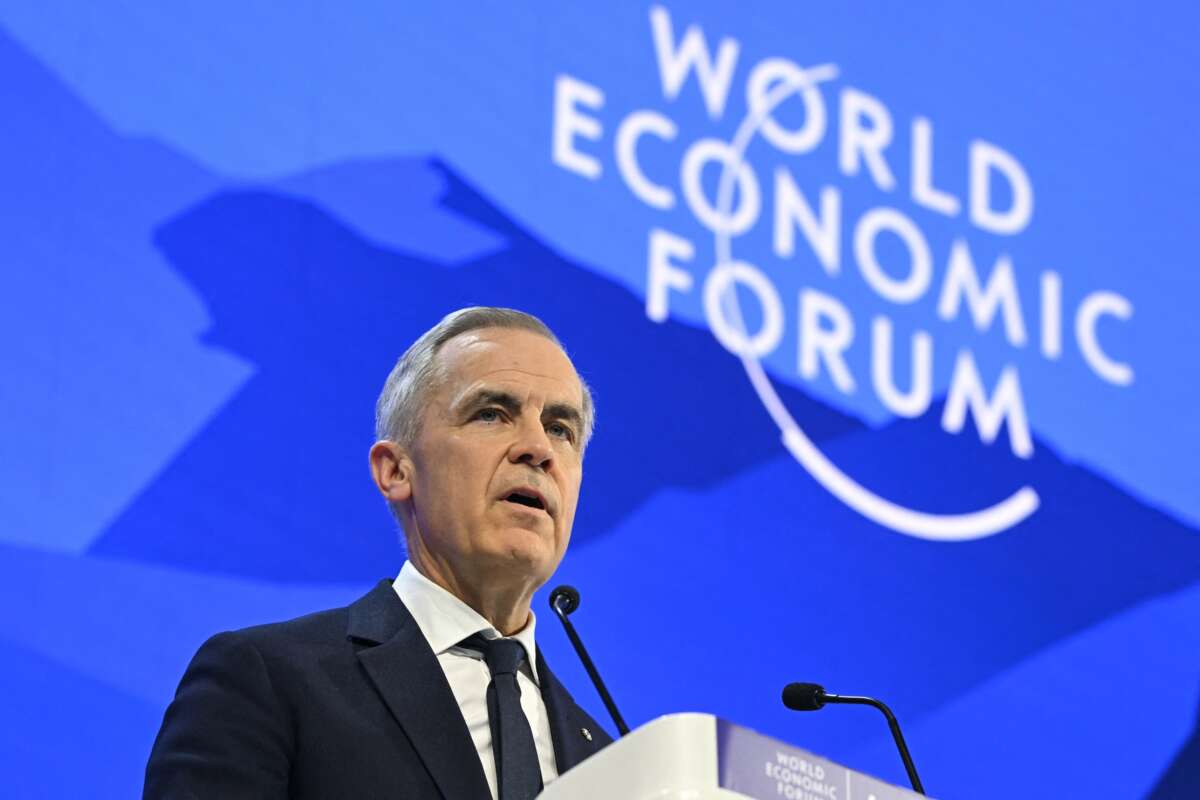
In January 2026, at the World Economic Forum Annual Meeting in Davos, Canadian Prime Minister Mark Carney delivered a defining address titled “Principled and Pragmatic: Canada’s Path.” In his speech, Carney outlined a strategic vision rooted in what he termed a principled and pragmatic global strategy, emphasizing that the long-standing rules-based international order has weakened, and that countries—especially middle powers like Canada—must adapt to the new geopolitical landscape with honesty, resilience, and cooperation. His remarks reflected a broader global reassessment of capitalism, multilateralism, and strategic autonomy amid the rising tide of geopolitics and great power rivalry.
The central thrust of Carney’s address was that the world has entered a period of structural change where nostalgia for the old international system is no longer viable. Instead of lamenting the past, countries must pursue a principled and pragmatic global strategy that integrates core values—such as respect for sovereignty, human rights, and territorial integrity—with realistic engagement in international affairs. This message resonated across the Davos forum, where economic, political, and civil society leaders gathered to navigate a world that is increasingly multipolar and unpredictable.
The End of the Old Global Order and the Call for Pragmatic Engagement
Carney’s speech began with a stark assessment: the familiar rules-based international order that defined global relations for decades is fading, not merely transitioning. According to him, great power competition now operates with fewer constraints, and multinational institutions no longer provide the reliable predictability they once did. This shift demands what Canada calls a principled and pragmatic global strategy: a strategy that combines upholding values with hard-headed realism about the world as it is.
For decades, nations—including Canada—benefited from the predictability of institutions built after World War II. These frameworks were grounded in cooperation, shared norms, and mutual benefit. However, Carney argued that integration has increasingly been weaponized. Economic interdependence, once seen as a mutual gain, has become a potential mechanism of coercion, with tariffs, supply chain leverage, and financial tools used strategically by powerful states to extract concessions from others. This has exposed vulnerabilities in many nations that previously relied on these structures for security and prosperity.
In this new environment, Carney contended, Canada must stop clinging to outdated assumptions of automatic security stemming from alliances or geography. Instead, it must forge a principled and pragmatic global strategy that reinvests in domestic strength while pursuing broad, strategic international partnerships. His call was clear: nations must accept the emerging global reality and act accordingly rather than waiting for an old world to return.
Defining Canada’s Principled and Pragmatic Global Strategy
A cornerstone of Carney’s address was the concept of value-based realism. He cited the term as articulated by Alexander Stubb, President of Finland, to describe a balanced approach where principles and realism coexist. Being principled means Canada remains committed to core norms such as human rights, respect for international law, and the peaceful resolution of disputes. Pragmatism, on the other hand, involves recognizing that progress is incremental, interests diverge among nations, and not all partners share the same values.
Carney stressed that engaging with the world as it is—not as an idealized version—requires a calibrated approach to diplomatic relations. Canada must align the depth of its relationships with its values while prioritizing broad engagement to maximize influence. This involves putting aside the notion that adherence to old norms alone will guarantee security or prosperity. Instead, Canada must build strength at home—through economic diversification, investment, and social cohesion—and cultivate partnerships that reflect shared interests and mutual respect.
The notion of principled pragmatism also informed Canada’s stance on sovereignty and resilience. Carney emphasized that sovereignty today means having the capacity to produce essential goods, defend one’s territory, and cultivate technological and economic autonomy where possible. He made the case that countries should pursue strategic autonomy in critical areas such as energy, food systems, critical minerals, finance, and supply chains. Without such autonomy, nations risk vulnerability in a world where economic and geopolitical pressure can be applied through diverse means.
Building Resilience at Home: Economic Diversification and Strategic Partnerships
Carney’s vision of a principled and pragmatic global strategy is grounded in strengthening Canada’s domestic base as a foundation for international engagement. In the months leading up to Davos, Canada pursued diversified trade partnerships and resilient economic policies that reduce dependence on any single power or market. This included negotiating strategic alliances around the world and broadening access to new markets across Asia, Europe, and the Middle East. Such diversification is not just economic but strategic, enhancing Canada’s ability to withstand global shocks and trade coercion.
Canada also emphasized attracting global investment and building resilient trade networks. For example, new trade agreements and economic cooperation frameworks, including strategic partnerships with nations like China and Qatar, reflect Canada’s desire to diversify its economic ties. These agreements often target sectors such as energy, clean technology, agriculture, and critical minerals—areas that strengthen internal capacity and international market presence.
At Davos, Carney highlighted that Canada is positioning itself as a reliable and stable partner. Part of this strategy is fostering strong internal economic growth through tax reforms, infrastructure investments, and major projects designed to build domestic capacity and resilience. This blend of internal fortification and external engagement exemplifies the principled and pragmatic global strategy that Canada seeks to champion in an era of shifting geopolitical currents.
Pragmatic Cooperation Among Middle Powers
An important aspect of the principled and pragmatic global strategy is cooperation among middle powers. Carney argued that while great powers may exert overwhelming influence, middle powers have significant capacity to build cooperative frameworks that address global challenges without being dominated by larger actors. He underscored that if middle powers fail to act collectively, they risk being marginalized in a world shaped by unilateralism and coercive economic strategies.
Rather than waiting for universal consensus via traditional institutions, middle powers can form flexible coalitions around specific issues based on shared values and interests. Such coalitions can respond more nimbly to contemporary challenges like climate change, technological governance, and economic resilience. Carney’s remarks suggested that middle powers should embrace their agency by working together to shape global norms and mechanisms suited to the current geopolitical reality.
The pragmatism component of this strategy acknowledges that not all nations will align perfectly on every issue. However, selective cooperation on specific priorities can build trust, enhance shared capabilities, and create frameworks that contribute to global public goods. These efforts help middle powers carve out a meaningful role in global affairs that is based on mutual benefit rather than dependency on great power agendas.
Navigating Great Power Rivalry
Carney’s address also confronted the challenge of great power rivalry, a central feature of the current global order. He warned that economic integration has become a tool for geopolitical leverage, where powerful nations use tariffs, financial systems, and supply chain control to assert influence and extract concessions. In this context, he argued, reliance on integration without strategic autonomy can leave nations vulnerable.
To navigate this environment, Canada’s principled and pragmatic global strategy embraces both cooperation and autonomy. This means building partnerships with like-minded states and pursuing diversified trade networks while shoring up domestic capacity to withstand external economic pressures. Such an approach seeks to balance engagement with caution, fostering alliances that are resilient rather than subordinate.
Carney described this moment not as a transition but as a rupture from the past, cautioning against a retreat into protectionism or isolationism. Instead, he urged nations to act collectively where possible, building coalitions and alliances that reflect shared values and common interests, even if they do not align perfectly across all fronts. This approach encourages pragmatic cooperation without sacrificing core principles.
The Role of Principled and Pragmatic Global Strategy
Prime Minister Mark Carney’s address at Davos 2026 articulated a compelling vision for how nations—especially middle powers—can navigate the complexities of today’s geopolitical environment. His call for a principled and pragmatic global strategy acknowledges that the traditional rules-based order is no longer reliable, and that realistic engagement with the world’s evolving dynamics is essential.
By grounding foreign policy in fundamental values while embracing a pragmatic understanding of present global realities, Canada aims to strengthen its sovereignty, resilience, and influence on the world stage. This dual-approach strategy encourages nations to build robust domestic foundations, diversify economic ties, and pursue flexible, values-aligned cooperative frameworks.
As global power balances continue to shift, the principled and pragmatic global strategy provides a framework that blends moral conviction with strategic realism—an approach designed to secure both national interests and global stability. Carney’s speech underscores that the future of international cooperation may well depend on how effectively countries internalize and implement such a balanced strategy.
Read More