





 Wednesday, 27-05-26








The largest oil reserves countries list offers a crucial lens into global energy wealth, geopolitical leverage, and long term market dynamics. While oil demand faces increasing pressure from renewable energy and climate policies, the countries that control the most proven crude oil reserves still play an outsized role in shaping economic strategy and energy security.
In early 2026, the rankings of proven oil reserves demonstrate dramatic contrasts between resource endowments and production realities. At the top of the list is Venezuela, whose heavy crude deposits give it the world’s largest reserves. However, extensive reserves have not translated into production power due to infrastructure decay and political turbulence. This article outlines the largest oil reserves countries, places that own these vast underground assets, and explains why reserve figures matter beyond simple barrel counts.
What Defines the Largest Oil Reserves Countries?
The largest oil reserves countries are identified by the volume of proven crude oil reserves. Proven reserves refer to quantities of oil that geological and engineering data demonstrate with reasonable certainty to be recoverable under existing economic and operating conditions. This metric does not include all unconventional fuels in some datasets, depending on reporting standards.
Proven reserves are expressed in billions of barrels. They serve as indicators of long term energy potential, though they do not directly equate to current production capacity or economic output. Many factors influence how a country taps its reserves, including technology, investment, export capacity, and political environment.
With that clarification, the largest oil reserves countries list provides a snapshot of global resource distribution.
The Top 10 Largest Oil Reserves Countries by Proven Barrels
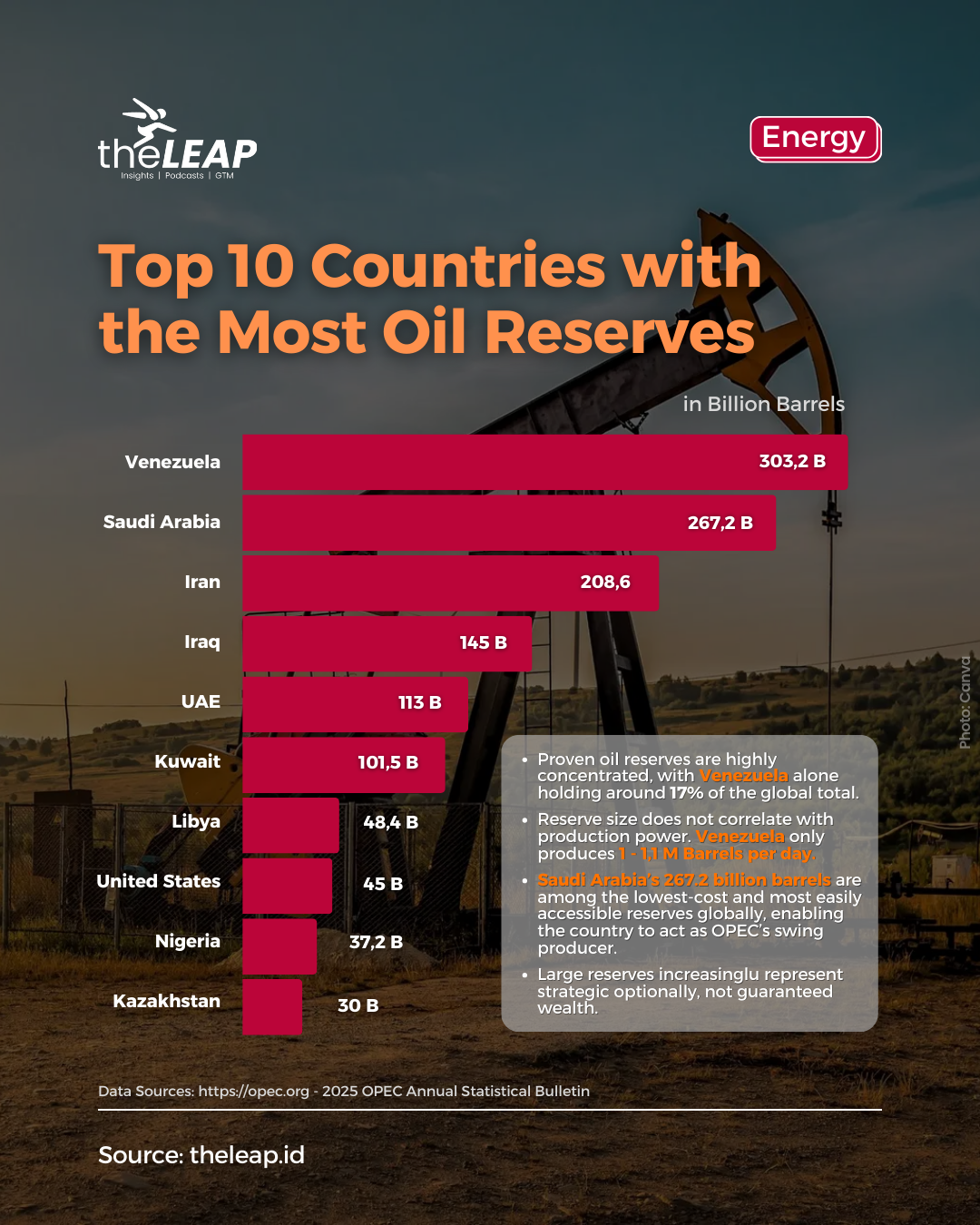
Based on the most recent aggregated reserve figures, the largest oil reserves countries and their approximate proven crude oil totals are as follows:
- Venezuela holds approximately 303.2 billion barrels of proven oil reserves.
- Saudi Arabia follows with about 267.2 billion barrels.
- Iran ranks third with roughly 208.6 billion barrels.
- Canada holds around 163.0 billion barrels.
- Iraq follows with about 145.0 billion barrels.
- The United Arab Emirates has roughly 113.0 billion barrels.
- Kuwait holds approximately 101.5 billion barrels.
- Russia’s reserves stand near 80.0 billion barrels.
- Libya holds about 48.4 billion barrels.
- The United States rounds out the top ten with around 45.0 billion barrels.
Collectively, these ten countries account for a majority share of global proven oil reserves. Venezuela alone represents roughly 17 percent of total proven reserves worldwide, underscoring how concentrated oil wealth remains.
Venezuela: Largest Reserves but Severely Limited Output
Venezuela’s position at the top of the largest oil reserves countries ranking is striking. With over 303 billion barrels of proven crude oil, it holds more reserves than any other nation. Yet this geological advantage has not translated into production leadership.
In the late 1990s, Venezuela produced approximately 3.5 million barrels of oil per day. By 2025 and early 2026, production levels hovered around 1.0 to 1.1 million barrels per day, representing less than 1 percent of global daily oil output.
This collapse reflects years of underinvestment, deteriorating infrastructure, loss of skilled labor, and international sanctions. As a result, Venezuela exemplifies the central paradox within the largest oil reserves countries ranking: vast reserves do not guarantee market influence.
Saudi Arabia and Iran: Turning Reserves Into Strategic Power
Saudi Arabia and Iran occupy second and third place among the largest oil reserves countries, and both demonstrate stronger alignment between reserves and production capacity.
Saudi Arabia’s 267.2 billion barrels of reserves are among the most accessible and cost efficient globally. This allows the kingdom to sustain high output levels and function as a swing producer within OPEC. Its ability to increase or reduce supply quickly gives Saudi Arabia disproportionate influence over global oil prices.
Iran, with 208.6 billion barrels, also holds immense long term potential. However, sanctions and geopolitical constraints have limited its ability to fully monetize its reserves. Even so, Iran remains a critical player in global oil diplomacy due to the sheer scale of its resource base.
These two countries illustrate how institutional capacity, infrastructure, and policy stability shape the real value of reserves within the largest oil reserves countries list.
Canada and Iraq: Large Reserves With Structural Constraints
Canada ranks fourth among the largest oil reserves countries with 163.0 billion barrels, largely driven by oil sands. These reserves are technically recoverable but require high capital investment and energy intensive processing. Environmental regulations and pipeline constraints further complicate large scale expansion.
Iraq, with 145.0 billion barrels, possesses one of the richest hydrocarbon endowments in the Middle East. Its reserves underpin its importance within OPEC. However, political instability, security risks, and infrastructure limitations have slowed production growth.
Both countries highlight how reserve size alone does not determine speed or scale of output.
The Remaining Top Ten Oil Reserve Holders
Several other countries complete the top ten largest oil reserves countries ranking:
The United Arab Emirates holds approximately 113.0 billion barrels and combines reserve strength with economic diversification.
Kuwait, with 101.5 billion barrels, has one of the highest reserve per capita ratios globally.
Russia’s 80.0 billion barrels support its role as a leading global oil exporter, even though its reserves are smaller than Middle Eastern peers.
Libya holds 48.4 billion barrels, but ongoing political instability disrupts consistent production.
The United States holds around 45.0 billion barrels, yet remains one of the world’s largest oil producers due to shale extraction technology.
These examples reinforce the point that production leadership depends on far more than ranking position alone.
Why Production Does Not Follow Reserve Rankings
One of the most important insights from the largest oil reserves countries data is that reserves and production are not directly correlated.
The United States produces over 13 million barrels per day, despite ranking lower in total reserves. This is driven by private sector investment, advanced drilling technologies, and flexible capital markets.
In contrast, Venezuela’s production remains a fraction of its potential due to structural and political barriers. This divergence demonstrates that technology, governance, and investment climate are decisive factors in oil market power.
Energy Transition and the Strategic Value of Oil Reserves
As global energy systems evolve, the relevance of the largest oil reserves countries ranking is changing. Long term demand growth is expected to slow as electric vehicles, renewable energy, and efficiency gains expand.
Countries with vast reserves face pressure to monetize resources before demand peaks. Those unable to adapt risk leaving significant volumes undeveloped. As a result, reserve size increasingly reflects strategic optionality rather than guaranteed wealth.
Geopolitical and Economic Implications
Oil reserves continue to shape geopolitics. Countries high in the largest oil reserves countries ranking wield influence through supply decisions, alliances, and export policies. However, reliance on oil revenues also creates vulnerability to price swings and external shocks.
This dual reality has pushed many reserve rich nations to pursue economic diversification while still leveraging oil income in the short term.
Reading Beyond the Largest Oil Reserves Countries Ranking
The largest oil reserves countries ranking provides valuable insight into where the world’s oil wealth is concentrated, but it does not tell the full story. Venezuela’s vast reserves, Saudi Arabia’s production leadership, and the technological edge of the United States illustrate very different pathways from geology to global influence.
Ultimately, reserves are potential. Their real value depends on governance, investment, infrastructure, and timing in a world moving toward energy transition. The ranking is not a measure of current power alone, but a reflection of strategic choices that will shape energy markets for decades.
Read More